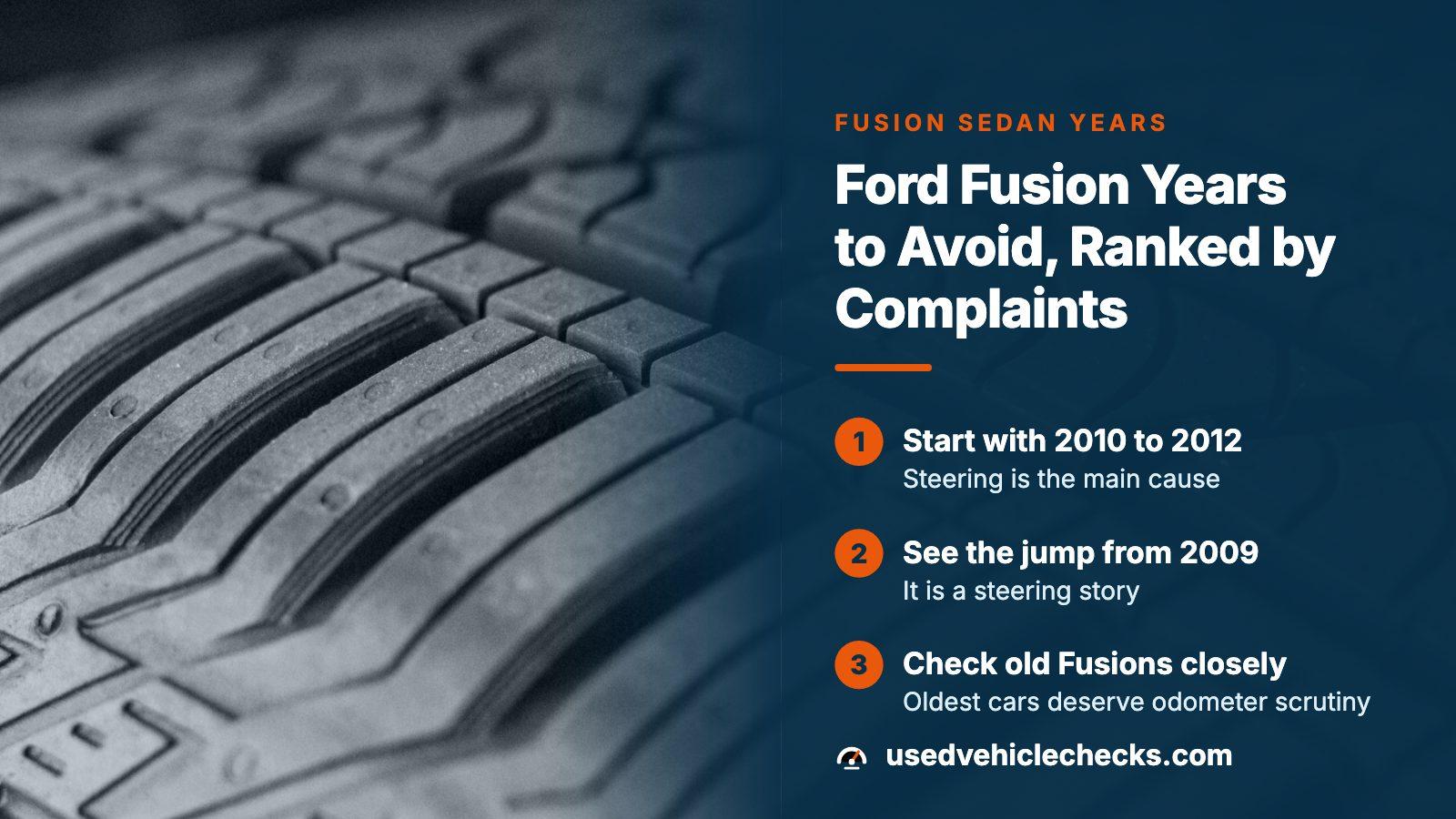
THE SHORT ANSWER
Be most careful with the 2010, 2011 and 2012 Ford Fusion, each at about two to four times the model's median of 1,353 NHTSA complaints a year, with steering the main cause. The 2013 sits above the line too. The 2018 to 2020 years look cleanest, though they are also the youngest. Treat a flagged year as grounds for a tougher inspection and a lower offer, never as a ruling on one car. Check the VIN's odometer readings, open recalls and title record before you pay.
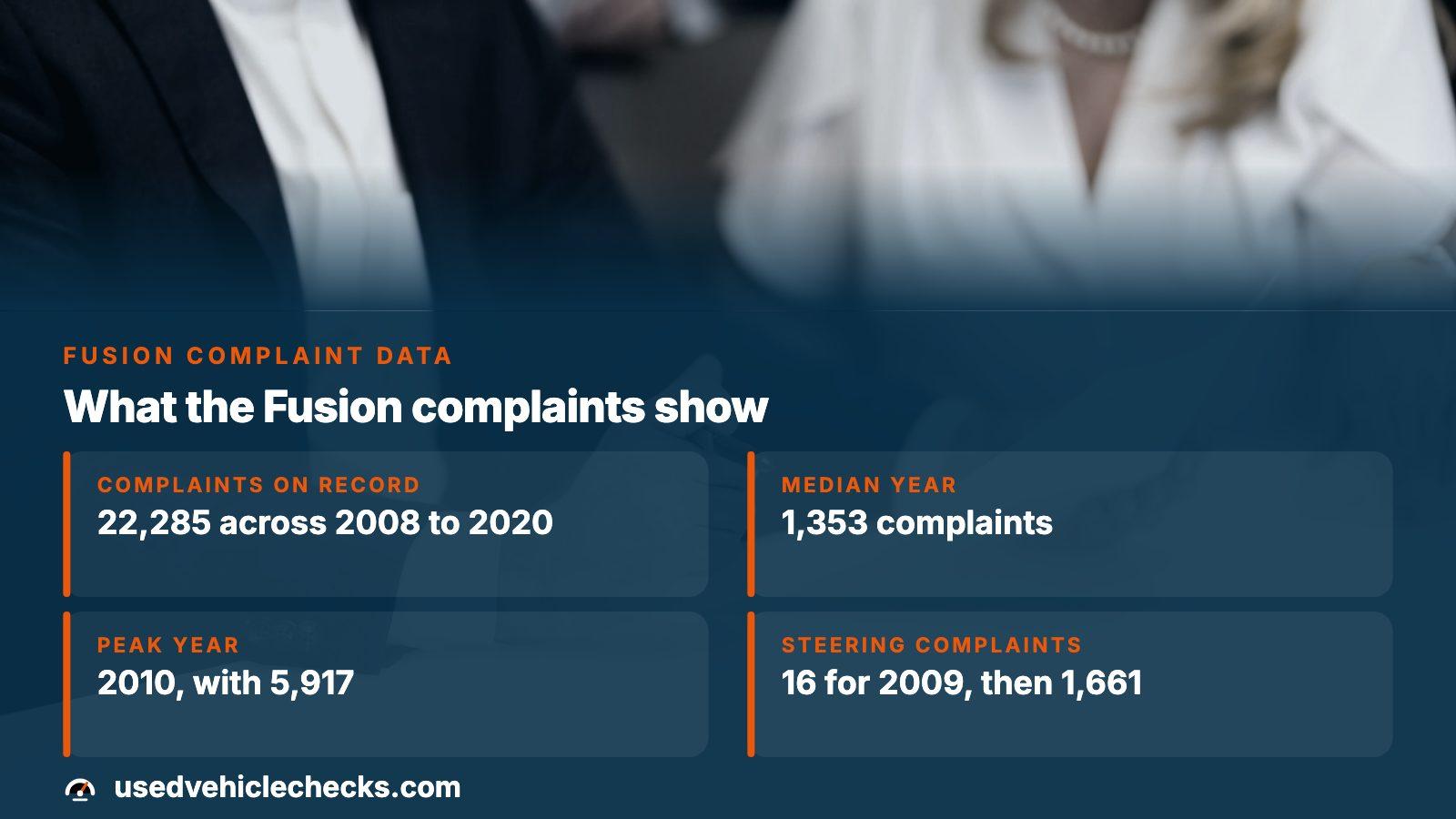
- Complaints on record
- 22,285 across 2008 to 2020
- Median year
- 1,353 complaints
- Peak year
- 2010, with 5,917
- Steering complaints
- 16 for 2009, then 1,661 for 2010
Every Fusion year against the model's own median
Owners filed 22,285 complaints with NHTSA about 2008 to 2020 Fusions, and the filings bunch up. The middle year sits at 1,353, so each row below is judged against that mark, not against other sedans.
| Model year | Complaints | Times the median | Recalls on file |
|---|---|---|---|
| 2008 | 1,353 | 1× | 6 |
| 2009 | 1,021 | 0.75× | 7 |
| 2010 | 5,917 | 4.37× | 13 |
| 2011 | 2,915 | 2.15× | 9 |
| 2012 | 2,610 | 1.93× | 6 |
| 2013 | 1,949 | 1.44× | 19 |
| 2014 | 1,420 | 1.05× | 19 |
| 2015 | 1,053 | 0.78× | 13 |
| 2016 | 1,672 | 1.24× | 13 |
| 2017 | 1,184 | 0.88× | 4 |
| 2018 | 500 | 0.37× | 2 |
| 2019 | 463 | 0.34× | 3 |
| 2020 | 228 | 0.17× | 3 |
Four years sit well above the line, led by 2010 at 4.37 times the median, then 2011, 2012 and 2013. After that the counts settle near or under the median, apart from 2016 at 1.24. A high count tells you to look harder and negotiate; it proves nothing about the Fusion in front of you.
The jump from 2009 to 2010 is a steering story
Total filings leap from 1,021 for 2009 to 5,917 for 2010, and the component data shows where. In the plain Fusion listing, steering draws 16 complaints for 2009, then 1,661 for 2010, 1,436 for 2011 and 1,512 for 2012. By 2013 it is back down to 418.
NHTSA recall 15V340000 deals with power steering assist shutting off, yet it names only 2011 and 2012 cars without the 3.5L engine. The list of 13 campaigns for 2010 holds no steering entry at all.
From an NHTSA owner complaint
The first owner of a 2010 Fusion, bought new from Ford and since driven 101,079 miles, lost steering assist on the drive home. On Monday the wheel would not budge. A repair estimate of $2,500 covered parts plus a front alignment, so the car now sits, and the owner complained of getting no warning letter when the 2011 and 2012 models were recalled.
Read a 2010 to 2012 Fusion as a steering inspection first. Ask whether the steering gear or its module was ever replaced, and have a mechanic test assist at parking-lot speed.
What owners report shifts with the model year
| Model years | Leading area | Reports in that area |
|---|---|---|
| 2008 to 2009 | Service brakes | 1,073 |
| 2010 to 2012 | Steering | 4,609 |
| 2013 to 2014 | Steering | 764 |
| 2015 to 2020 | Engine | 1,564 |
These tallies use the plain Fusion listing, so they will not tie exactly to the table above. Air bags rank second in the first two rows and power train second in the last. Three recall campaigns are worth looking up by VIN on an early car:
- 15V793000: the fuel vapor purge valve on 2010 and 2011 cars, where pressure swings can crack the tank and leak fuel.
- 19V904000: the ABS valves on 2006 to 2010 cars, which can fail to close after contact with certain brake fluids and lengthen pedal travel.
- 21V158000: the driver air bag inflator on 2006 to 2012 cars, which can rupture after years of heat and humidity.
A campaign applies to a build window inside a model year, so the year alone overstates some and misses others. Only the VIN tells you which ones fit and whether a dealer did the work.
When a Fusion's mileage disagrees with its paperwork
At least four NHTSA filings on 2008 to 2020 Fusions describe a mileage mismatch found after the sale: a 2010, a 2013, a 2015 and a 2017, all filed between June 2025 and June 2026. Four among tens of thousands is a sliver, and each is one owner's side, yet the odometer is the figure a buyer leans on hardest.
From an NHTSA owner complaint
A dealer sold a 2010 Fusion showing 86,785 miles. At a trade-in appointment, the owner learned the odometer had been rolled back, as a history report now showed, and the true figure was 125,121. The report seen at purchase had carried no warning. The owner contacted North Carolina's transportation department.
A clean report on the day of sale is a snapshot, not a guarantee.
From an NHTSA owner complaint
A 2013 Fusion changed hands in a private sale at 174,000 miles. At registration, the recorded mileage came back as 202,000.
Here the mismatch appeared only once the paperwork reached the registry. Pull the readings yourself, line them up in date order and expect a believable climb. A step down or a long silent stretch needs explaining first.
Why the oldest Fusions deserve the closest odometer read
Federal odometer disclosure has an age exemption. The rule at 49 CFR 580.17 lets a seller skip the mileage statement on any 2010 or older model once a decade has passed, counted from January 1 of the model year. That covers every 2008, 2009 and 2010 Fusion changing hands today. Newer cars wait for 20 years, and the rule's example for 2031 puts model year 2011 and older outside the requirement.
So a 2010 Fusion, the year with the heaviest steering history, can be sold with no signed mileage figure behind the dash. State paperwork may ask for more, so check your own state. NMVTIS, the federal title database, shows the latest reported odometer readings beside title brands, but the Department of Justice cautions that holes in reporting can hide a problem, so a clean search is not proof. One number from one source is a checkpoint, not a trail.
How to read these counts without fooling yourself
The quietest files are 2020 with 228, 2019 with 463 and 2018 with 500. They are also the newest cars in the table, so part of that calm is fewer years on the road.
- Volume: best sellers rack up more filings than low-volume cars built just as well, which is why each year is held to the Fusion's own median.
- Time on the road: 2008 has had many more years to collect filings than 2019 has, and the youngest years look spotless because owners have barely begun to file.
- Reliability of the source: a complaint is one owner's unverified account. Thousands of them point to a pattern; a single one proves little.
- Recalls tell a different story. One means Ford itself agreed there is a defect and covers the fix, so a long list may show problems were caught.
Before you pay for one specific Fusion
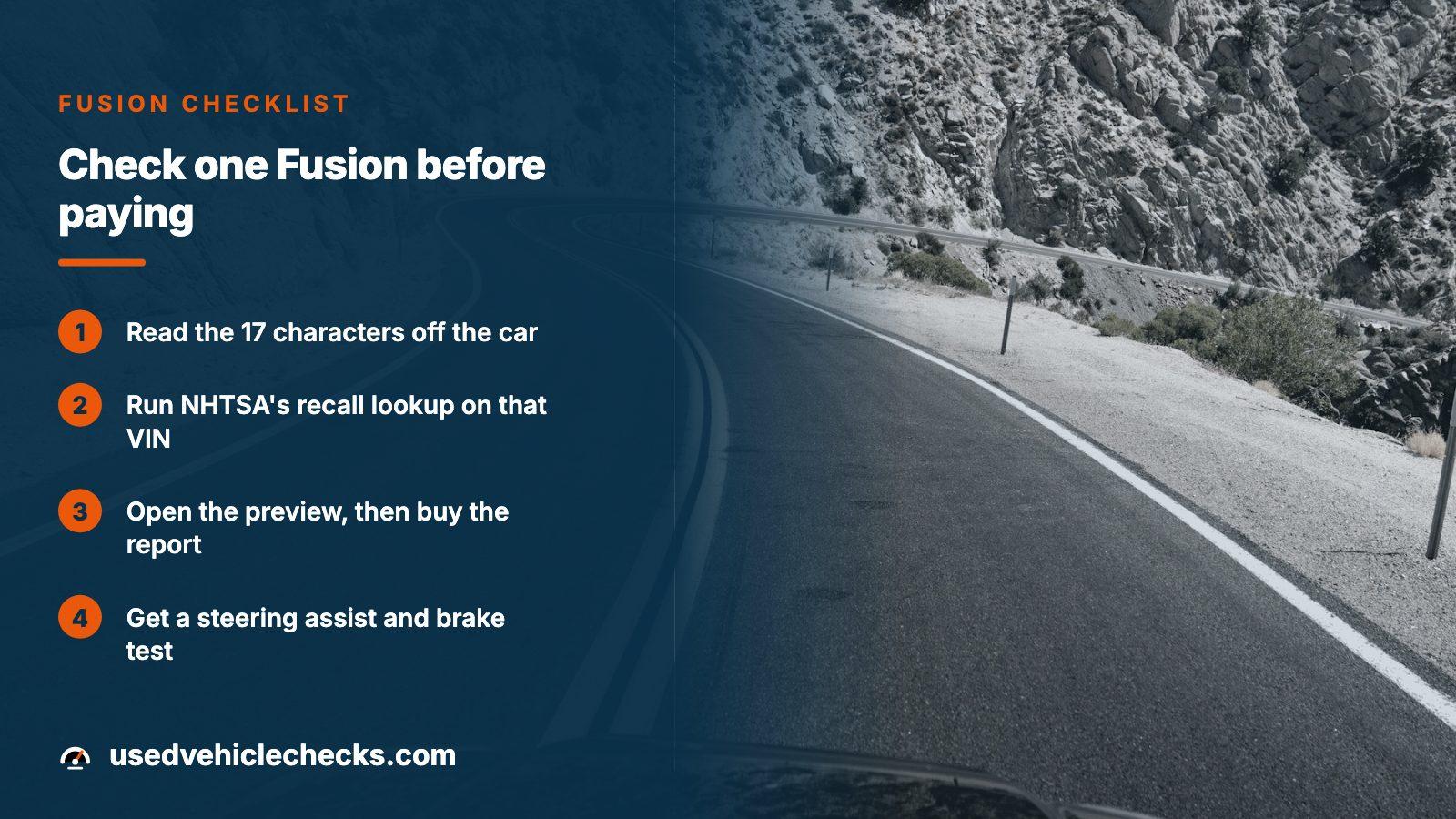
- Read the 17 characters off the car, not the ad, and make sure they match the listing.
- Run NHTSA's recall lookup on that VIN and note any open campaign, such as the steering, brake valve, fuel tank or air bag ones above.
- Open the preview here, which costs nothing.
- If the Fusion stays in the running, buy the report and start with the odometer readings in date order, then title brands, accident and salvage entries, liens and use type.
- Take it to a mechanic for a steering assist test and a brake pedal check before you sign.
Payment is one charge with no renewal. The pricing page lays out the single report and the packs.
Where this information comes from
- NHTSA: vehicle safety and owner complaints — The federal home of the owner complaint filings behind each model year's count.
- NHTSA: recalls by vehicle — A lookup for open campaigns on one VIN, including the steering, fuel tank, brake valve and air bag recalls named here.
- NMVTIS: information for consumers — What the Justice Department's title database holds, including the latest reported odometer readings, and why gaps can hide a problem.
- eCFR: 49 CFR 580.17, odometer disclosure exemptions — The age exemption from the federal mileage statement, for 2010 and older and for 2011 and newer cars.
- NHTSA owner complaint 11170067 — owner experience, paraphrased
- NHTSA owner complaint 11733204 — owner experience, paraphrased
- NHTSA owner complaint 11666315 — owner experience, paraphrased
Sources and photos: Facts checked against the sources above in November 2026. Photos by Yvette S, Will Truettner and Carrie Allen www.carrieallen.com on Unsplash; diagrams by UsedVehicleChecks.
Keep reading
- Mileage Check by VIN: What the Recorded Odometer Readings ShowRead a VIN's dated odometer readings before a Fusion makes your shortlist.
- Odometer Rollback Check by VIN: Run the Mileage Test Before You PayHow to spot a reading that steps backward, as in the two filings above.
- How Many Miles Is Too Many on a Used Car? Age, Pace and ProofDecide what a high number on the dash means for a sedan of this age.
- Hyundai Sonata Years to Avoid, and the Mileage That MattersThe same complaint-by-year read for another midsize sedan.
Frequently asked questions
Are some Ford Fusion model years worth skipping?
Start your caution with 2010, 2011 and 2012, then 2013. The 2010 year leads with 5,917 NHTSA complaints against a median of 1,353, mostly steering. Good Fusions turn up in every year, so a flagged one calls for a firmer inspection and a lower offer.
Which Fusion years look cleanest on the record?
By complaint count, 2020, 2019 and 2018 carry the lightest files, at 228, 463 and 500. They are also the youngest, with less time for owners to file, so the numbers flatter them a little. Judge any one of them by its own recall status, odometer readings and service record.
Where do Fusion owners report the most trouble?
Steering leads, at 5,919 reports across 2008 to 2020, packed into 2010 through 2012. Engine follows with 3,246 reports and power train with 3,102. A mechanic should test steering assist at low speed on any early car and read the VIN's recall list.
Should I walk away from a high-mileage Fusion?
Not on the number alone. What counts is whether readings agree: entries that climb at a believable pace and wear that fits the dash. A high figure with a documented trail beats a low one nobody can back up, especially on a 2010 or older car, where no federal mileage statement is required.
What should I run on a Fusion before handing over money?
Start with the VIN: NHTSA's recall lookup first, then the preview here, and the paid report only once the car survives that pass. In the report, read the odometer readings, title brands and damage entries. The model year tells you about a crowd; the VIN tells you about the car you would own.
Now check the car itself
The guide explains what to look for. The report shows what this VIN has on record.