THE SHORT ANSWER
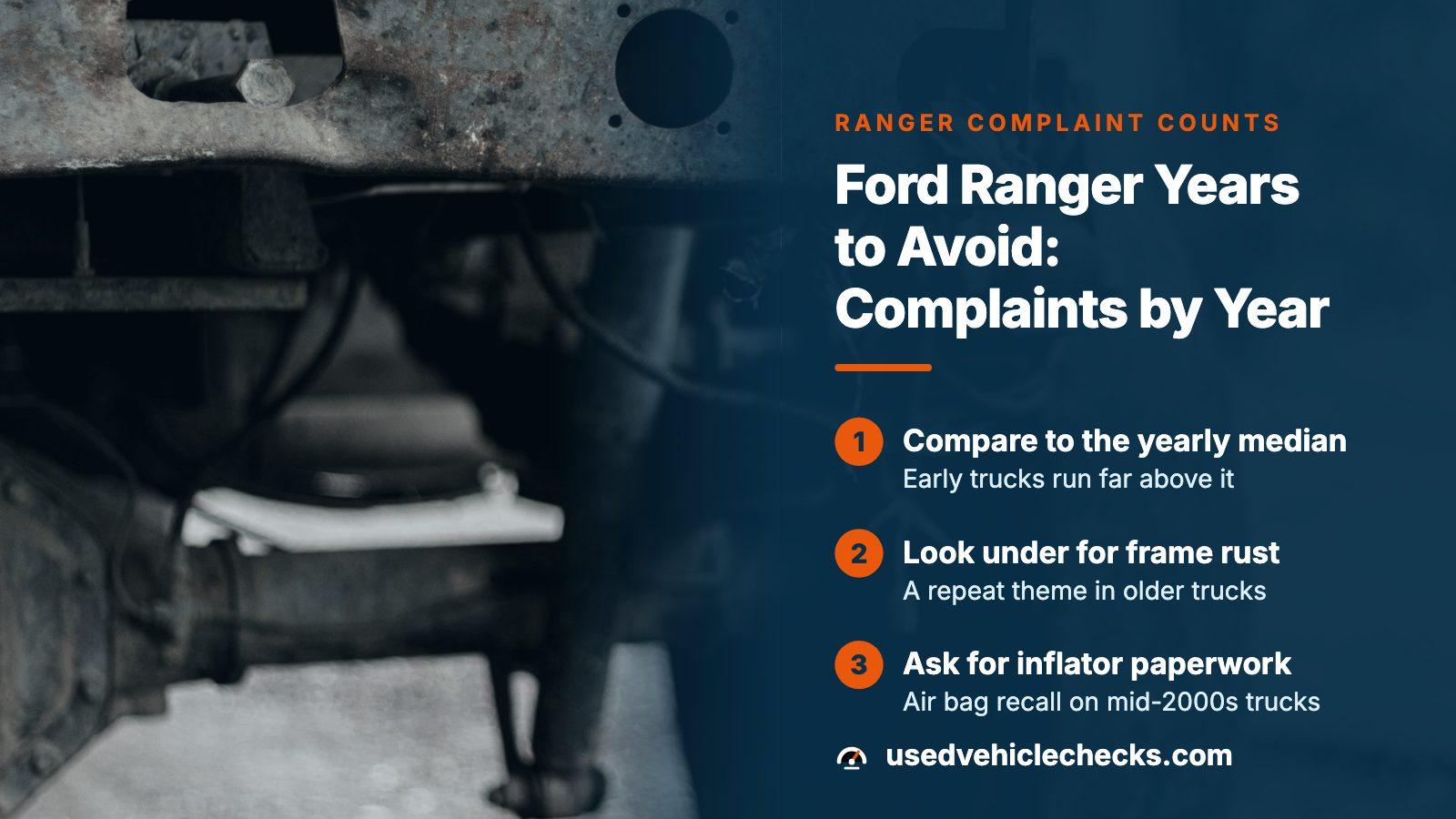
Be most careful with the 1998 to 2001 Rangers, where owner complaints run at more than double the 289-per-year median and rusting frames show up again and again. Treat any 2004 to 2006 truck as a recall-proof job: ask for the air bag inflator paperwork. The 2019 Ranger draws transmission complaints. The lightest records belong to 2009, 2011 and 2020, but a light record is not a clean one, so read the VIN's odometer and recall history before paying.
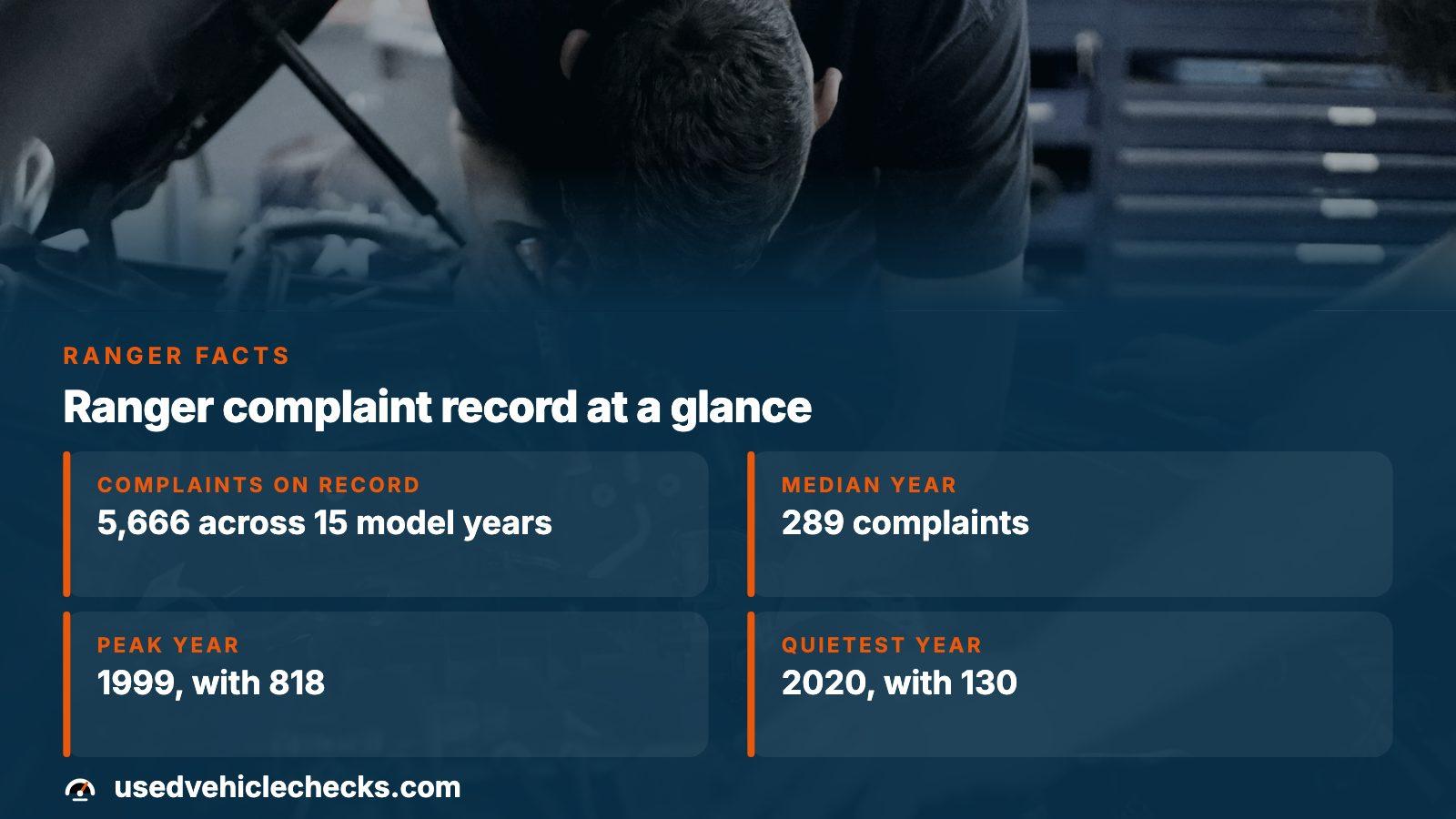
- Complaints on record
- 5,666 across 15 model years
- Median year
- 289 complaints
- Peak year
- 1999, with 818
- Quietest year
- 2020, with 130
Where owners have filed the most complaints
I pulled NHTSA's public complaint and recall data for each Ranger year that returned records: 15 years, 5,666 complaints, and a middle year of 289, the yardstick for the rows below.
| Model year | Complaints | Most reported areas | Ford recalls listed (rough load) |
|---|---|---|---|
| 1999 | 818 | Tires, structure, brakes | 4 |
| 2000 | 694 | Tires, structure, brakes | 3 |
| 1998 | 656 | Tires, speed control | 5 |
| 2001 | 540 | Structure, suspension, air bags | 4 |
| 2004 | 405 | Air bags | 10 |
| 2002 | 347 | Mixed, no clear leader | 3 |
| 2019 | 272 | Power train, electrical | 11 |
The four years from 1998 to 2001 all run well above the median. The 1998 to 2003 trucks alone account for 3,298 of the 5,666.
The 1998 to 2001 trucks and their frames
Tires lead the complaint list for 1998, 1999 and 2000, but the pattern that matters for a used buyer today is structure. Owners filed 46 structure complaints on the 1998 trucks, 90 on 1999, 106 on 2000 and 114 on 2001. Owners also used the word rust in 92 of the 1999 filings, 91 of 2000 and 106 of 2001.
From an NHTSA owner complaint
One 2001 Ranger owner described a highway failure: rust ate the rear frame, the back bumper dropped away and the steel cracked. Everything forward of that, engine included, worked perfectly. In their view the rot is a familiar problem on Rangers from the late nineties and early two-thousands.
The takeaway is practical. A truck can drive well and still be rotten where the driver never looks, so put these years on a lift with a flashlight before any price talk. Rust also hides how hard a truck has lived, which is where the odometer record comes in.
2004 to 2006: the air bag inflator trucks
The 2004 Ranger drew 405 complaints, and 189 of them were filed under air bags. The 2004 to 2006 trucks sit inside a chain of inflator campaigns, which is why 2006 lists 12 Ford vehicle recalls, the heaviest load of any year here before 2024.
- 15V322000 and 16V036000 covered passenger and driver inflators on trucks built from March 24, 2003 to May 4, 2006.
- 17V787000 and 17V788000 replaced those with a final repair, and owners were advised not to drive until it was done.
- 18V022000 and 18V023000 told 2006 owners not to drive their trucks until repaired.
- 23V125000 and 23V306000 asked for a second inspection because replacement passenger inflators may have been installed incorrectly.
From an NHTSA owner complaint
The owner of a 2004 Ranger described a single-vehicle crash at about 45 mph into a concrete culvert, and the air bags did not deploy. The truck had been bought from friends who believed the inflator recall was finished. It appeared to be a total loss.
What to take from it: never accept a seller's belief that the recall is done. Ask for the dealer's repair record, then confirm the VIN against NHTSA's recall lookup yourself.
The 2019 Ranger and its 10-speed automatic
The Ranger returned for 2019 with 272 complaints on file, 92 of them under power train. In 74 owner narratives the word transmission appears, with owners describing harsh shifts, hesitation off the line and surging. The 2020 truck repeats the theme in a smaller file of 130, with 44 naming the transmission.
From an NHTSA owner complaint
A 2019 Ranger owner wrote that the transmission stuttered and lunged at only 43,000 miles. They said Ford would not cover the repair at no cost once the warranty ran out, and asked NHTSA to look at it as a possible recall.
This is the one year on the list where a low odometer reading is good news and bad news. Low miles mean plenty of life left, but a transmission complaint at 43,000 miles means you should drive the truck through every gear, cold, before you sign. Campaigns that year also touched the shift selector, the shifter cable bracket and the HVAC blower motor, so ask which were completed.
The years with the lightest records
Owners filed 169 complaints on the 2009 Ranger, 235 on 2011 and 130 on 2020, the three lowest in the set. The 2005 to 2008 trucks cluster between 270 and 326, near the median.
- 2009 still had a recall for 11,134 4x2 trucks with front spindles that may fracture, so a quiet year can hide one serious campaign.
- 2007 to 2011 trucks sit inside inflator campaigns for the driver side and the passenger side.
- 2020 is quiet partly because it is young; its transmission complaints are the same family as 2019.
A thin file can also mean fewer trucks sold or fewer owners reporting. It is a hint, nothing more.
What the counts cannot tell you
The records returned nothing for 2010 and nothing for 2021 to 2025, and the recall data shows no Ranger for 2012 to 2018, when this nameplate was off the US lineup. Missing complaints for 2021 and newer reflect a lack of records in the data I pulled, not a verdict on those trucks. The 2024 and 2025 trucks each list 13 recalls, among them front ball joint fasteners, a fuel pump bolt and side curtain air bags.
Complaint counts also rise with age and with how many trucks were sold. A year with hundreds of filings is a pointer to where problems cluster, not proof that your specific truck has one.
Why the odometer record matters on an old Ranger
A Ranger from the late 1990s or early 2000s has likely passed through several owners and inspections, maybe a swapped instrument cluster. Rust, thin paperwork and a reading that looks too good make the classic rolled-back truck.
A VIN-based history report from UsedVehicleChecks lays out the dated odometer readings recorded for the truck, so you can see whether each reading is higher than the last and whether the dash agrees with the latest one. It also lists open recalls and title brands, useful on the 2004 to 2006 trucks. Start with the free preview, then decide on the one-time report; the pricing page lists the options.
Red flags in the readings
A reading that drops between entries, a long gap with no readings, or a dash that shows far fewer miles than the latest record. Any of these on a rusty truck means walk away or cut the price.
A checklist before you pay for a used Ranger
- Match the VIN stamped on the dash against the door-jamb label and the title paperwork.
- Search that VIN on NHTSA's recall lookup and note every open campaign.
- Get the odometer history and set it beside the dash and any service stickers.
- For a 1998 to 2001 truck, lift it and examine the rear frame, spring mounts and spare tire carrier.
- For a 2004 to 2006 truck, ask to see the inflator repair paperwork.
- For a 2019 or 2020 truck, drive it cold and listen for harsh shifts.
- Hand over money only once the title record shows no brand.
A flagged year means inspect harder and negotiate, not refuse on sight.

Where this information comes from
- NHTSA recalls API: Ford Ranger — Campaign numbers, dates and remedies for each model year, including the inflator chain.
- NHTSA complaints API: Ford Ranger — Source of the yearly complaint counts and component tallies.
- NHTSA: recalls lookup — Free check of one VIN for open recall campaigns.
- VehicleHistory.gov: NMVTIS — The federal title record system and why buyers use it.
- NHTSA owner complaint 11463502 — owner experience, paraphrased
- NHTSA owner complaint 11553215 — owner experience, paraphrased
- NHTSA owner complaint 11747616 — owner experience, paraphrased
Sources and photos: Facts checked against the sources above in November 2026. Photos by Zoshua Colah, Dimitri Karastelev and Mustafa Sheikhmouss on Unsplash; diagrams by UsedVehicleChecks.
Keep reading
- Mileage Check by VIN: What the Recorded Odometer Readings ShowSee a VIN's dated odometer readings before a Ranger makes your shortlist.
- Odometer Rollback Check by VIN: Run the Mileage Test Before You PayHow a reading that steps backward gives a rolled-back truck away.
- How Many Miles Is Too Many on a Used Car? Age, Pace and ProofDecide what a high number on an older pickup actually means.
- Toyota Tacoma Years to Avoid: Judge the Odometer Before the Model YearThe same year-by-year complaint read for the Ranger's main rival.
Frequently asked questions
Which Ford Ranger years are the worst?
On NHTSA complaint counts, 1999 is worst with 818, then 2000, 1998 and 2001. Each runs at more than twice the 289-per-year median. Frame rust and tire trouble drive those filings. The 2004 to 2006 years follow because of their air bag inflator recalls.
Is the 2019 Ford Ranger reliable?
The 2019 file holds 272 complaints, and 92 are about the power train. Owners describe harsh or late shifts in the 10-speed automatic. It also logged 11 recalls. Plenty run fine, so test drive it cold and confirm each recall repair.
Which Ranger years have the fewest complaints?
The lightest files are 2020 with 130, 2009 with 169 and 2011 with 235. A short list can mean fewer sales or fewer reports, and 2009 still has a spindle recall covering 11,134 trucks, so quiet does not mean clean.
Can I check a Ranger's recalls by VIN for free?
Yes. NHTSA's recall lookup takes a VIN and shows open campaigns at no charge. Do that before you pay, because repairs on the air bag inflator campaigns for 2004 to 2006 trucks should be confirmed on the exact VIN, not taken on a seller's word.
Does a high-mileage Ranger mean a bad truck?
Not by itself. What matters is whether the dated readings climb steadily and match the dash. A well-documented truck with high miles can beat a low-mileage one with gaps or a reading that drops, particularly among rust-prone 1998 to 2001 trucks.
Now check the car itself
The guide explains what to look for. The report shows what this VIN has on record.