THE SHORT ANSWER
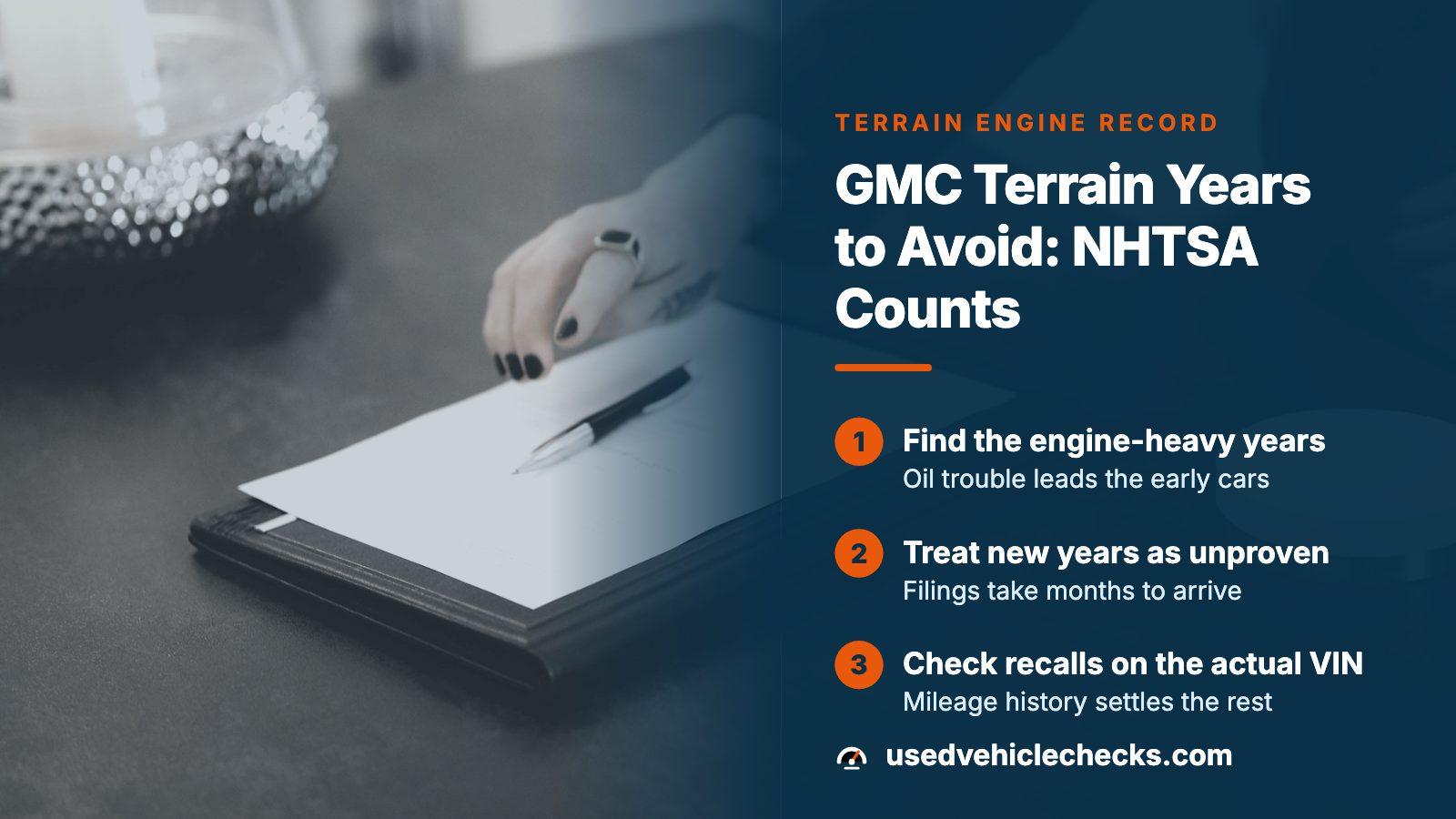
Approach the 2010 to 2013 Terrain with the most care: those four years hold 1,432 NHTSA complaints, and engine is the top category in each. The 2014 and 2015 years are middling, 2016 and 2017 are lighter, and 2018 to 2020 shift toward brake complaints. Newer years look quiet, though they have simply had fewer months to collect filings. Whatever the year, check the VIN's mileage history, recalls and title before paying.
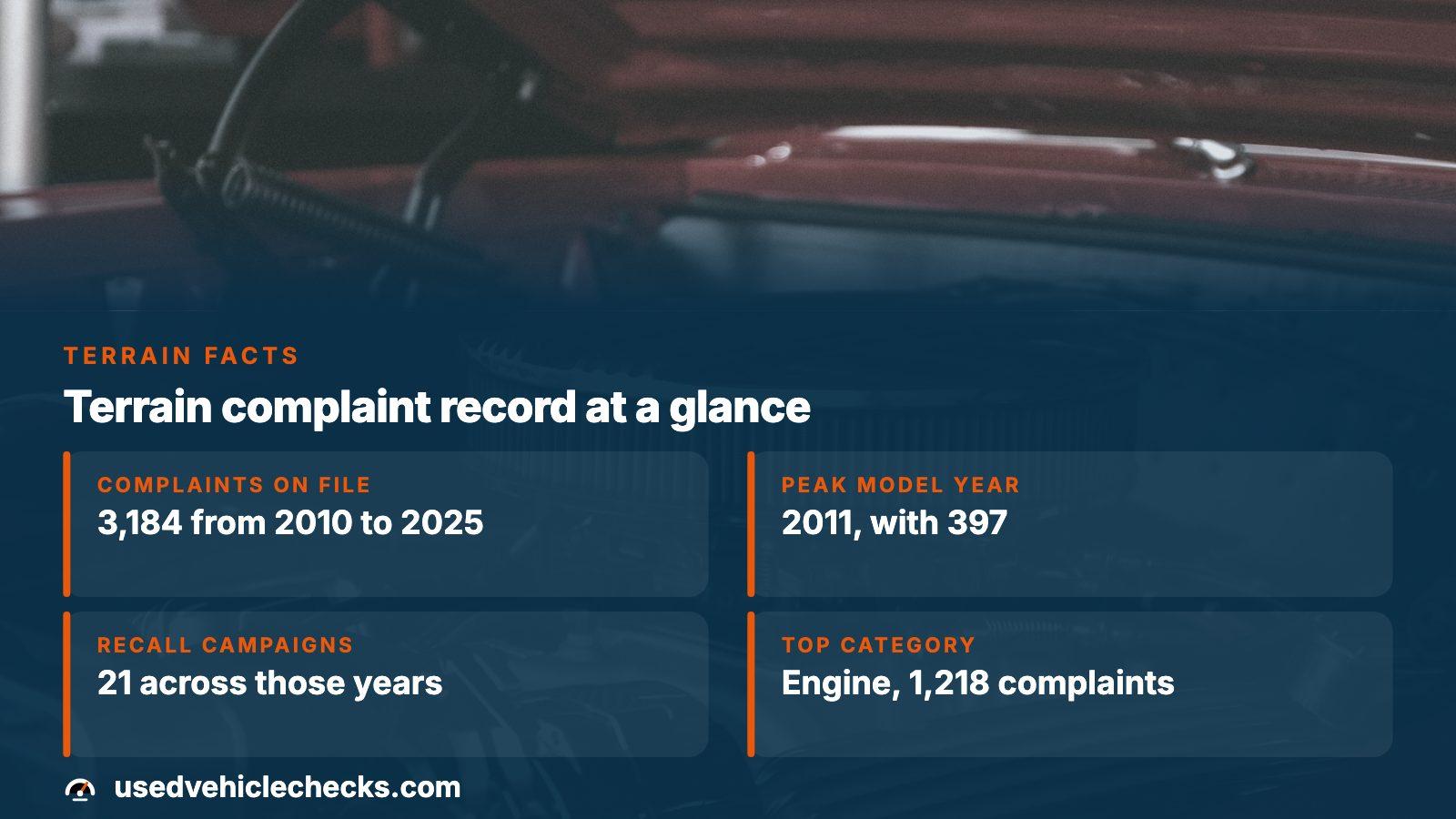
- Complaints, 2010 to 2025
- 3,184 on file
- Peak model year
- 2011, with 397
- Recall campaigns
- 21 across those years
- Top category
- Engine, 1,218 complaints
The years that collect the most complaints
We pulled the NHTSA complaint record for every GMC Terrain model year from 2010 through 2025. The pile is lopsided. The first four years carry 1,432 complaints between them, and after 2013 no year comes close to the 2011 peak.
| Model year | Complaints | Top category | Recall campaigns |
|---|---|---|---|
| 2010 | 295 | Engine (107) | 3 |
| 2011 | 397 | Engine (178) | 4 |
| 2012 | 370 | Engine (170) | 4 |
| 2013 | 370 | Engine (198) | 3 |
| 2014 | 302 | Engine (124) | 2 |
| 2015 | 317 | Visibility/wiper (102) | 3 |
Use the table to decide where to inspect harder. It is no blacklist. A complaint is one owner's report, and a well-kept 2012 with documented repairs can beat an unexplained 2016.
The engine and oil pattern behind 2010 to 2017
Engine is the most reported category across the whole record, with 1,218 complaints. We also ran a plain word match on owner summaries, which is our own count and not an NHTSA category. Summaries that mention oil number 663 for 2010 through 2017 and only 51 for 2018 through 2025. Summaries mentioning a timing chain run between 24 and 34 a year from 2010 to 2015.
From an NHTSA owner complaint
An owner of a 2011 Terrain told NHTSA the engine drank oil at a startling rate, six quarts added in one month, and that the car will stall in traffic if nobody keeps topping it up. The owner linked it to the timing chain, which relies on oil pressure.
The takeaway for a buyer: on an early Terrain, ask for the oil-change records and pop the dipstick cold. A car that has been topped up between changes is telling you something the listing will not.
Why mileage settles it more than the year
Two 2013 Terrains can sit in the same complaint bucket and be very different cars. One had its oil checked by an owner who cared, the other ran low for months. The model year cannot see that. Dated odometer readings can, because they show how fast the miles were added and when.
From an NHTSA owner complaint
A 2013 owner reported a check engine light at 109000 miles. An independent shop measured the level more than 3 quarts low without finding a leak. After a fresh fill the codes pointed at the timing chain, and the estimate was 1500 to 2000 dollars.
That owner's story begins with a mileage number and a service gap. Before you buy, line up the readings from inspections, titles and service stops. A step backward, or a long flat stretch followed by a jump, should send you off to find paperwork or to find another car.
2014 to 2017: lighter, but not clean
Complaints ease from 302 in 2014 and 317 in 2015 to 153 in 2016 and 135 in 2017. Engine still tops the list for 2014, 2016 and 2017, and 2017 still has 59 owner summaries that mention oil. So the drop in volume does not mean the pattern vanished.
One recall spans all of this stretch and the years before it. Campaign 22V137000 covers 2010 through 2017: a reflection from the headlight housings can send excessive light above the car, and dealers fit headlamp appliques at no charge. A second one, 22V165000, reaches 2014 and 2015: the wiper module's ball joints can corrode and leave a wiper dead.
- 2014 to 2015: ask whether the wiper module was inspected under its campaign.
- 2016: two campaigns, the headlight one and a tire-label correction, with a thin complaint file.
- 2017: one recall on record, the headlight one, yet more oil mentions than 2016.
2018 to 2025: fewer complaints, different ones
Service brakes becomes the leading category for 2018 with 83 complaints, then 72 for 2019 and 73 for 2020. Engine mentions of oil fall sharply. The 2018 year also has the busiest recall file of any year, with 5 campaigns that touch air bag software, the fuel pump, a front driveshaft, brake bleeding and a transmission accumulator.
From 2021 on, counts fall to 36, 89, 41, 55 and 13, but be careful reading that as quality. Young model years have had little time to collect filings, and 2025 has barely started. A 2022 car has 89 on record, mostly around fuel and propulsion, which is worth a test drive and a recall lookup.
Safety campaigns worth confirming on a late Terrain
Campaign 23V339000 covers 2020 to 2023 rear child-seat anchors, and until the fix is done the advice is to secure child seats with the regular belts. Campaign 23V869000 covers 2024 door strikers that may fracture.
Check the recalls on the actual VIN
Across 2010 to 2025 we found 21 distinct recall campaigns touching the Terrain, and every remedy in those records is done by dealers free of charge. A campaign printed for a model year may or may not apply to a particular car, so the VIN decides.
- Read the 17-character VIN from the Terrain's dash plate, or from the label on the driver's door frame.
- Enter it into NHTSA's recall lookup, which costs nothing.
- Note any open campaign and ask the seller for proof that the repair was done.
- Compare the repair date with the mileage on the invoice.
A closed recall also leaves a mileage reading on the paperwork, which is useful when you are testing whether the odometer story holds together.

When a VIN check is the natural next step
A model-year table narrows a shortlist. It cannot tell you a car's past. Once one Terrain is the candidate, use the VIN to see its recorded odometer readings, any title brand, and salvage or damage history, which is where an engine that failed and was patched often leaves a trace.
Previewing the Terrain is free; the whole report is bought once, and its price is on the pricing page. Add a mechanic's look, a cold start and the oil-record question from earlier. A low price on a 2011 to 2013 Terrain with no maintenance papers is the combination to be most wary of.
- Dated odometer readings that climb steadily and plausibly.
- A clean title record that matches what the seller told you.
- Open recalls listed and, ideally, already closed.
- Oil-change receipts that go back before the last year of ownership.
Where this information comes from
- NHTSA owner complaints: GMC Terrain 2011 — Source of the per-year complaint counts, categories and crash flags we tallied.
- NHTSA recalls: GMC Terrain 2018 — Source of the campaign numbers, components and remedies cited.
- NHTSA: recalls by VIN — The no-cost lookup for open recalls on one vehicle.
- VehicleHistory.gov: NMVTIS — The federal title-information system behind brand and fraud checks.
- NHTSA owner complaint 11443821 — owner experience, paraphrased
- NHTSA owner complaint 11585224 — owner experience, paraphrased
Sources and photos: Facts checked against the sources above in November 2026. Photos by Annika Wischnewsky, Michal Biernat and Victor Hughes on Unsplash; diagrams by UsedVehicleChecks.
Keep reading
- GMC Acadia Years to Avoid, and What the Odometer AddsThe same year-by-year read for GMC's bigger crossover.
- Mileage Check by VIN: What the Recorded Odometer Readings ShowHow to pull the dated odometer readings for one Terrain.
- Odometer Rollback Check by VIN: Run the Mileage Test Before You PaySpot a step backward in a car's mileage history.
- How Many Miles Is Too Many on a Used Car? Age, Pace and ProofDecide what a high number on the dash means for your budget.
Frequently asked questions
What is the worst year for the GMC Terrain?
On NHTSA complaint counts it is 2011, with 397, followed by 2012 and 2013 at 370 each. Engine is the leading category in all three. That points to where to inspect hardest, not a car to refuse. A documented, well-maintained example from a bad year can still beat a mystery car from a quiet one.
Which GMC Terrain years are the best bets?
The lightest settled records are 2016 and 2017, at 153 and 135 complaints. Newer years show even fewer, but owners have had less time to file, so those low numbers prove less. Whichever year you like, look up the VIN's recalls and mileage history before you agree on a price.
Do Terrain engine problems show up in recalls?
Not in the recall records we read. The engine pattern lives in owner complaints, where engine is the top category with 1,218 filings. The recalls we found cover items such as headlights, wipers, seats and air bags. Request the service paperwork for oil changes and pay a mechanic to test the engine rather than relying on a clean recall list.
Does a low-mileage Terrain avoid the problems?
Not automatically. One owner reported oil trouble at 109000 miles, but another described heavy oil use within a single month of driving. Low mileage helps only if the number is real, so confirm it against dated readings from inspections, titles and service visits instead of trusting the dash alone.
How do I check one Terrain before I buy it?
Begin with its VIN. NHTSA's recall lookup is free. After that, run the preview on this site, and if the Terrain still tempts you, the paid report lists recorded odometer readings, title brands and damage records. Finish with a cold-start drive and a mechanic's inspection.
Now check the car itself
The guide explains what to look for. The report shows what this VIN has on record.