THE SHORT ANSWER
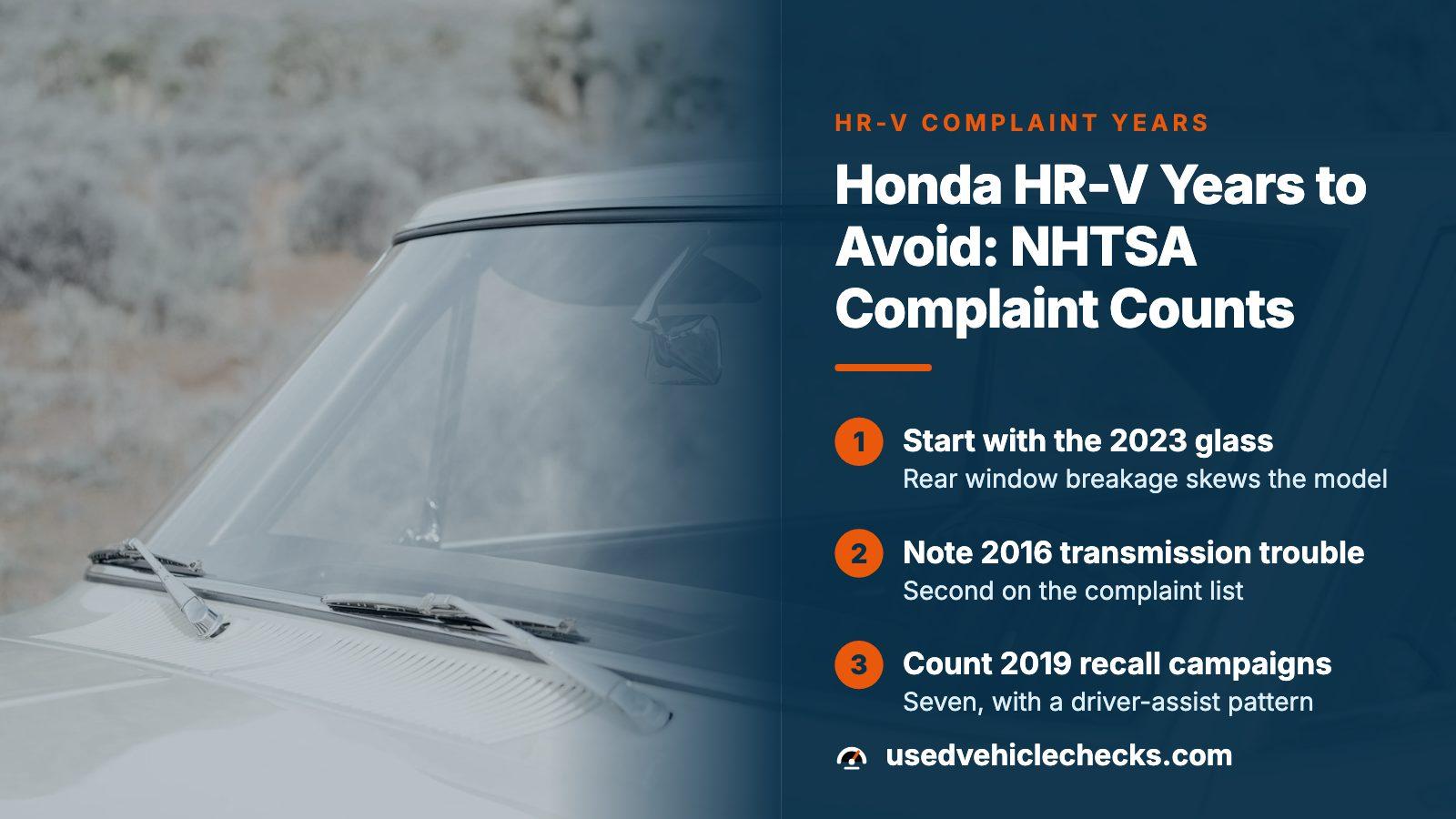
The worst Honda HR-V model years on NHTSA's record are 2023 (688 complaints, mostly rear window breakage), 2016 (243, with transmission trouble leading) and 2019 (242 complaints and 7 recall campaigns). The typical year logs 117. The calmest years are 2021, 2020 and 2022. Whatever year you shop, read the specific car's mileage history and recall status before paying.
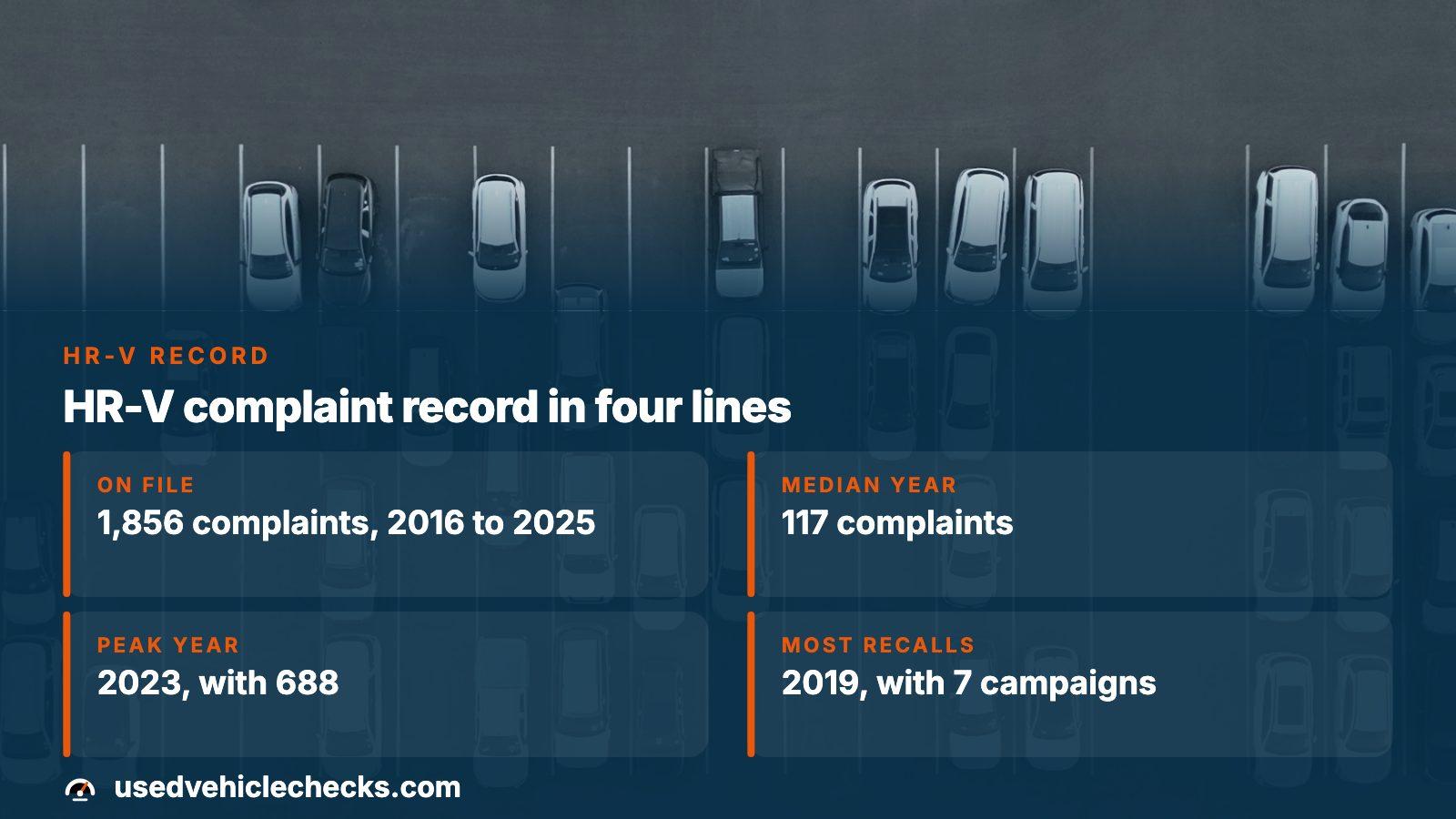
- Complaints, 2016 to 2025
- 1,856 on file
- Median year
- 117 complaints
- Peak year
- 2023, with 688
- Most recalls
- 2019, with 7 campaigns
What NHTSA has on file for each HR-V year
The HR-V reached US dealers as a 2016 model, so the record covers ten model years. I pulled the owner complaints and the recall campaigns for each one straight from NHTSA's public data feeds in November. Complaints are unverified owner reports, and recalls are manufacturer-filed safety repairs, so the two measure different things. Put together, they show where a year stands.
| Model year | Complaints | Recalls | Crash reports | Top complaint area |
|---|---|---|---|---|
| 2016 | 243 | 2 | 13 | Power train |
| 2017 | 124 | 0 | 13 | Power train |
| 2018 | 160 | 3 | 11 | Electrical |
| 2019 | 242 | 7 | 19 | Electrical |
| 2020 | 86 | 5 | 8 | Electrical |
| 2021 | 65 | 4 | 5 | Air bags |
| 2022 | 89 | 3 | 10 | Electrical |
| 2023 | 688 | 3 | 7 | Rear window glass |
| 2024 | 110 | 4 | 8 | Steering |
| 2025 | 49 | 1 | 4 | Steering |
No complaint in any of the ten years reports a death.
2023: a glass problem that skews the whole model
With 688 filings, 2023 runs about 5.9 times the median year and accounts for roughly 37 percent of every HR-V complaint on record. What makes it unusual is how narrow the complaint is: 319 filings fall under visibility, and 298 of those talk about the rear window or glass. Owners describe it breaking with no impact, sometimes while parked.
From an NHTSA owner complaint
A 2023 owner reported pulling out of a garage, hearing a bang, and finding the back window shattered, then cracking further as they inspected it. The car went to the dealer and the owner was still waiting on Honda corporate, adding that they were "tired of issues with this car."
The takeaway: the glass count is a pattern, not a rumor, but none of these filings turned into a crash story. Steering is the second-biggest 2023 area, with 78 filings, and it links to a real recall covered below.
2016: the transmission year
The first model year logged 243 complaints, and 84 of them mention the transmission or CVT by name. Power train is the top category with 76 filings, ahead of electrical at 57. Owners describe losing power while pulling away from a stop, limp mode and a replacement unit. It also carried the most injuries of any year, at 11.
From an NHTSA owner complaint
A 2016 owner described the car dropping into limp mode far from home with warning lights across the dash. A scan returned code P271E, and a transmission shop confirmed the assembly needed replacing. The owner says Honda has service bulletins covering it, but their car fell outside the warranty extension, so Honda declined to help.
One owner's story proves nothing about your car. A 2016 with no transmission service paperwork still earns a long cold-start drive.
2019: seven recall campaigns and a driver-assist pattern
The 2019 year pairs 242 complaints with the most recall campaigns of any HR-V year, seven, and the most crash-flagged filings at 19. Electrical leads with 67, fuel system follows with 35, and 33 filings concern forward collision avoidance, where several driver-assist warning lights come on together.
From an NHTSA owner complaint
A 2019 owner said the camera and radar unit failed, a fault Honda's service center confirmed. Every start-up now brings warnings that automatic emergency braking, forward collision warning and other features are out. The owner says those safety systems were a main reason they bought the car.
Seven campaigns does not mean seven open defects, since dealers fix them free once an owner shows up. The risk is a car whose owners never did, and a recall lookup by VIN settles that.
The recalls that cross model years
A few campaigns recur across years, so one skipped notice can follow a car through several owners. These are the ones that matter most, all repaired by a dealer at no charge.
- Fuel pump (three campaigns, filed 2020, 2021 and 2023): the tank-mounted pump can quit and stall the engine at speed. It explains why 2018 to 2020 cars carry several entries.
- Rear brake calipers (filed 2018): thin piston coating can let gas pockets form and cut braking. It reaches 2016, 2018 and 2019 cars.
- Rearview camera (filed 2023, then repeated in 2024): the picture may not appear after a key start. A software update covers 2019 to 2022 cars.
- Seat weight sensor (filed 2024 and again in 2026): a cracked sensor can short out, and the later notice warns of air bags firing unintentionally in a crash.
- Steering gearbox (filed 2024): extra internal friction can make the wheel hard to turn on 2023 to 2025 cars.
Honda's customer line for these repairs is 1-888-234-2138.
The years that look calmest on paper
The lowest counts belong to 2025 with 49, 2021 with 65 and 2020 with 86, followed by 2022 at 89. The newest year barely had time to attract reports, so 2025 proves little. The 2020 to 2022 trio has real mileage behind it and still sits under the median of 117.
Even so, those years are not recall-free. The camera and seat sensor campaigns both reach them, and 2020 carries five campaigns in total. A quiet count says owners filed little, not that this particular car was looked after.
2017 logged 124 complaints and no recall campaigns, with the same power train theme as 2016 at lower volume.
Why the odometer history beats the model year
A model year only tells you which batch of parts went in. The car you are buying has a life of its own, and the dated odometer readings tell you most of it. Steady yearly readings plus a transmission service record make one 2016 an easy yes, while a gap, a drop or a fresh out-of-state title makes another a hard maybe.
Mileage also decides which problems you are likely to meet. Transmission and fuel pump faults tend to show up with use, so a high reading on a flagged year argues for a hard look at repair paperwork, while a suspiciously low one raises the rollback question. A history report lines up readings from inspections, titles and sales so a bad number stands out.
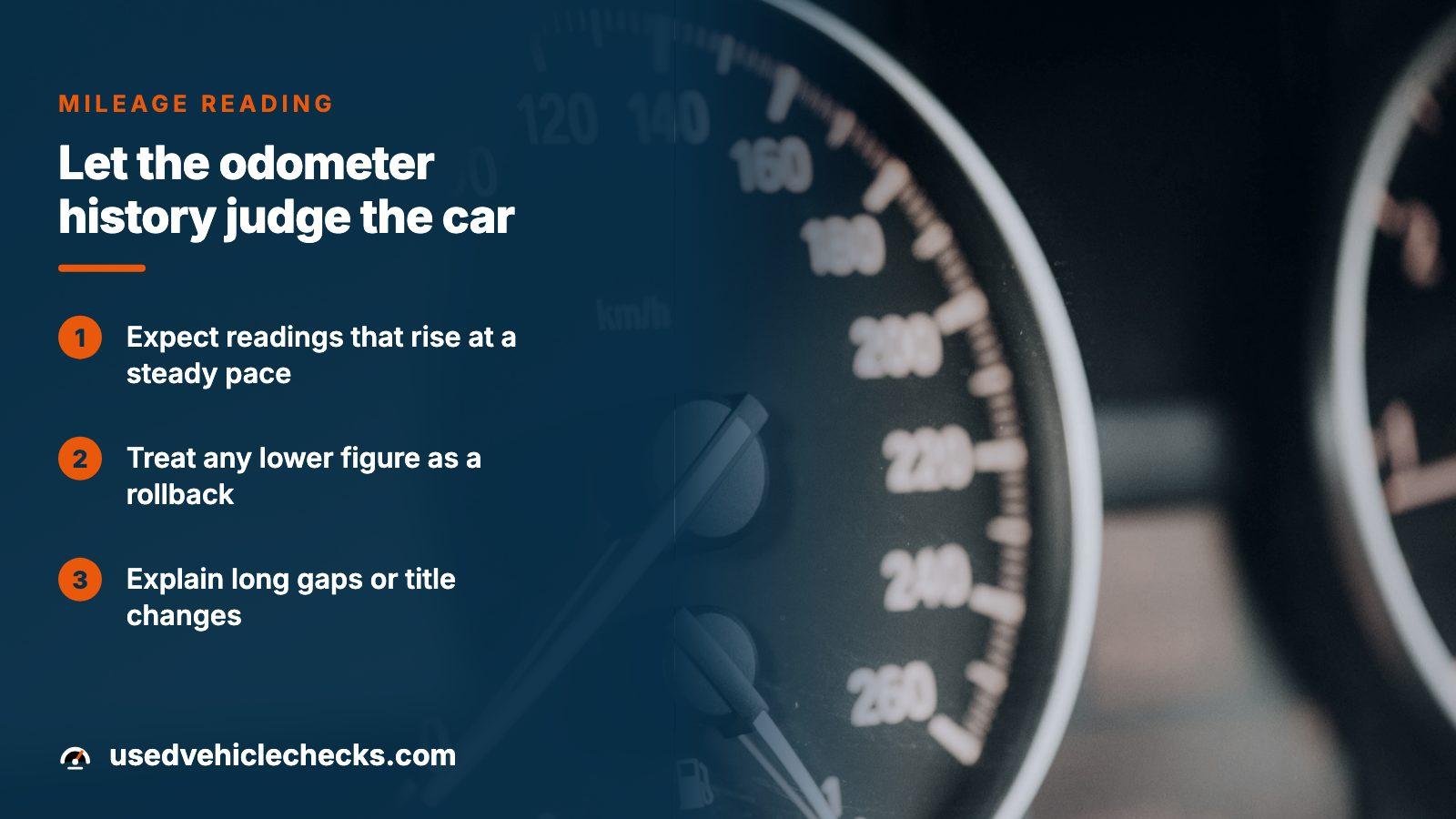
- Readings that rise at a steady pace year after year are normal.
- Any figure under a previous one points to a rollback.
- A long silence between readings, or a title change just before one, needs an explanation from the seller.
Check this exact car first
Two checks answer most of what this page raised. First, enter the VIN on the maker's recall lookup or NHTSA's own tool to see open campaigns for that exact car. Second, pull the history for the same VIN, which brings together mileage readings, title brands, accident and damage records and open recalls in one place.
UsedVehicleChecks shows a free preview once you enter a VIN. Going further means a single purchase, never a monthly plan, and the pricing page lays out the options. The Justice Department says its national title database exists to guard buyers against fraud and unsafe cars, which is the reason to look before handing over money.
A fair rule of thumb
A flagged year calls for service records, not a veto. A mileage gap, a rollback hint or an unrepaired recall calls for a lower price or a walk.
Where this information comes from
- NHTSA complaints API: Honda HR-V by model year — source of every complaint count, component total and crash figure by year
- NHTSA recalls API: Honda HR-V by model year — campaign numbers, defect summaries and remedies for each year
- VehicleHistory.gov: National Motor Vehicle Title Information System — Justice Department page describing what the national title system is for
- NHTSA owner complaint 11739182 — owner experience, paraphrased
- NHTSA owner complaint 11761176 — owner experience, paraphrased
- NHTSA owner complaint 11713776 — owner experience, paraphrased
Sources and photos: Facts checked against the sources above in November 2026. Photos by Wesley Tingey, CHUTTERSNAP and Iain on Unsplash; diagrams by UsedVehicleChecks.
Keep reading
- Mileage Check by VIN: What the Recorded Odometer Readings ShowHow to read the odometer readings tied to one VIN.
- Odometer Rollback Check by VIN: Run the Mileage Test Before You PaySpotting a reading that went backward before you buy.
- How Many Miles Is Too Many on a Used Car? Age, Pace and ProofPutting a mileage figure in context for a used SUV.
- Honda Civic Years to Avoid: Complaints, Recalls and MileageThe same complaint-count method applied to another Honda.
Frequently asked questions
What is the worst year for the Honda HR-V?
By complaint volume the worst is 2023, with 688 filings against a typical 117. Most describe the rear window breaking. For mechanical trouble, 2016 is the usual pick because of transmission complaints, and 2019 has the most recall campaigns. None of that makes every car in those years bad.
Is the Honda HR-V a reliable used SUV?
The record is mixed by year. The 2020 to 2022 cars sit below the median complaint count, while a few years carry spikes tied to a single fault. Reliability for the car you are buying depends on its recall repairs, service papers and honest mileage far more than on the badge.
Which HR-V years have the fewest complaints?
2025 has the fewest with 49, though it is the newest and still gathering reports. Among older cars, 2021 logged 65 and 2020 logged 86. Those totals are owner reports to NHTSA, so they show reported problems, not guaranteed trouble-free ownership.
How do I find out if an HR-V has unrepaired recalls?
Enter its VIN on NHTSA's recall lookup or Honda's owner site. The result lists open campaigns for that exact car. If any are open, the dealer repairs them at no cost. A full history report adds mileage readings and title brands that a recall lookup does not show.
Does mileage matter more than model year on an HR-V?
For most buyers, yes. Transmission and fuel pump problems tend to appear with use, so the reading and the repair records shape your risk. A reading that falls under an earlier one, or a long gap, should be raised with the seller before you commit.
Now check the car itself
The guide explains what to look for. The report shows what this VIN has on record.