THE SHORT ANSWER
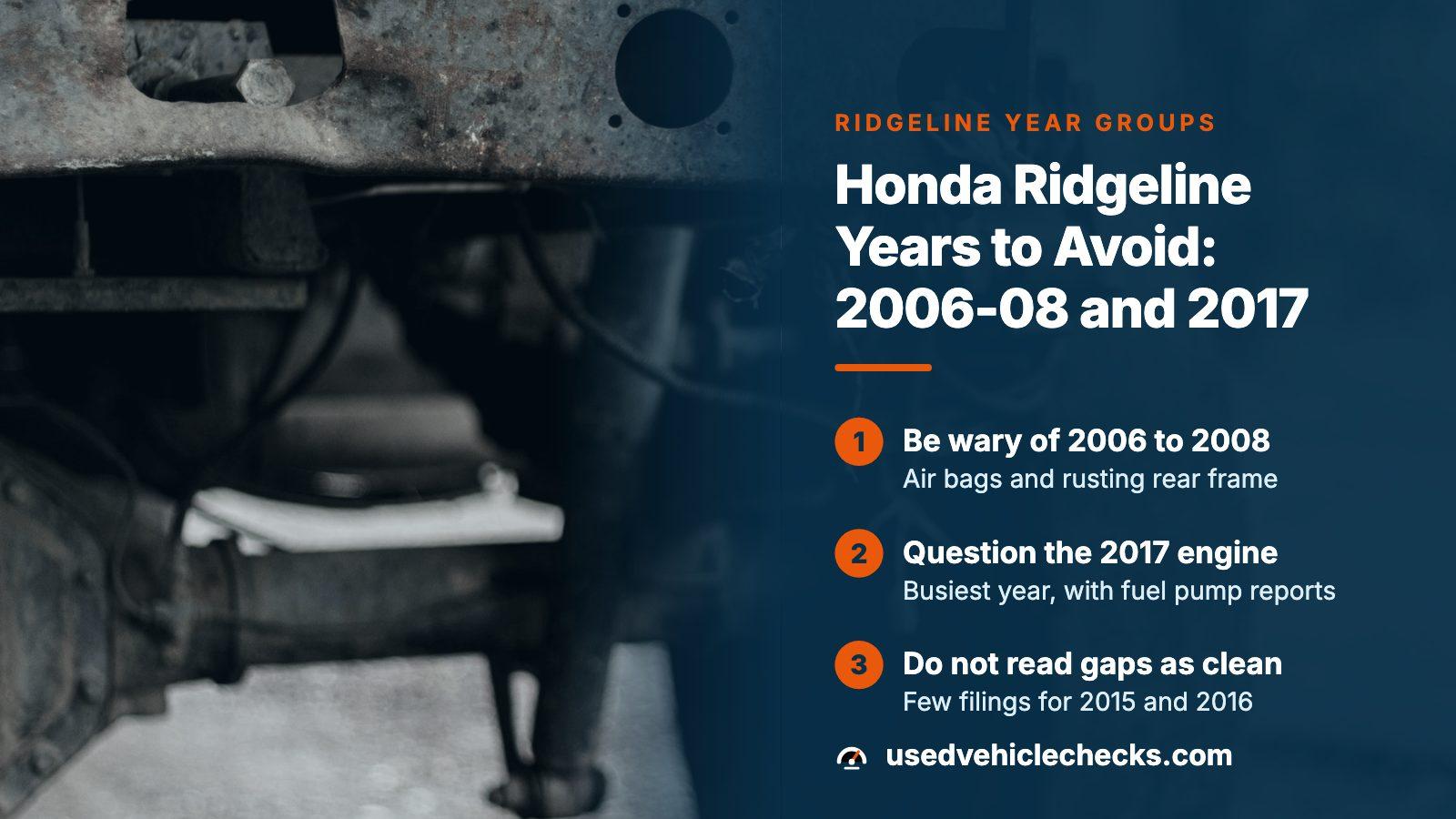
Be most careful with the 2006 (243 NHTSA complaints), 2007 (160) and 2008 (143) Ridgelines, then the 2017 (346) and 2019 (237). The first group carries air bag and rear frame corrosion problems, the second engine, electrical and fuel pump complaints. The 2009 to 2014 trucks and the 2020 to 2023 trucks file far fewer. Whatever the year, check the truck's own recall status and mileage history.
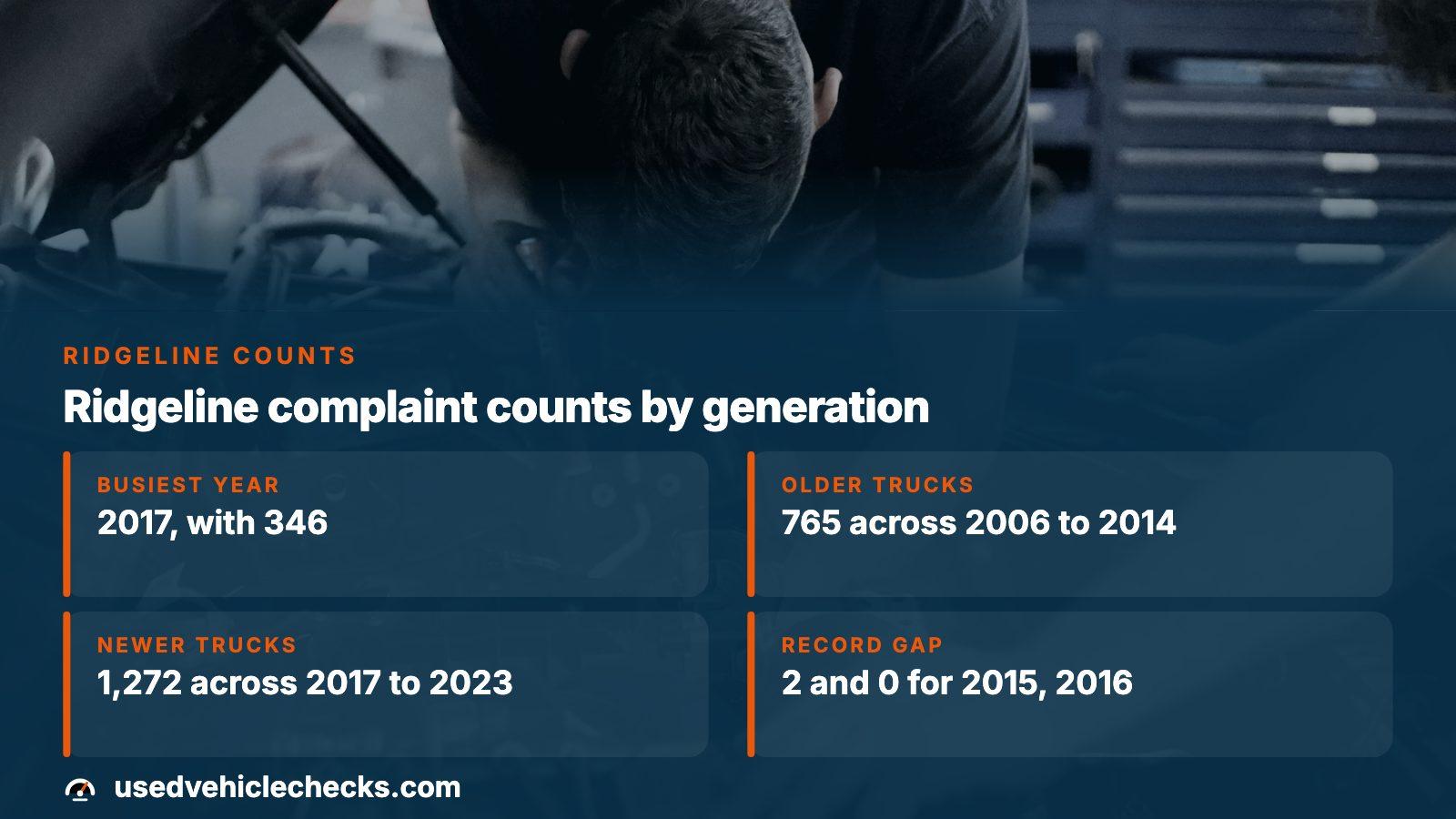
- Busiest year
- 2017, with 346 complaints
- Oldest generation
- 765 complaints across 2006 to 2014
- Newer generation
- 1,272 across 2017 to 2023
- Record gap
- 2015 and 2016 show 2 and 0 complaints
What the NHTSA counts say, year by year
These figures come from owner complaints and recall records that NHTSA holds for the Ridgeline. A complaint is one owner's report, not a confirmed defect, and older trucks have had more time to collect them. The shape still tells a story: two clusters of trouble, with a long calm stretch between.
| Model year | Complaints | Recall records | Largest area |
|---|---|---|---|
| 2006 | 243 | 14 | Air bags |
| 2007 | 160 | 10 | Air bags |
| 2008 | 143 | 10 | Air bags |
| 2009 to 2014 | 24 to 45 a year | 7 to 12 | Air bags |
| 2017 | 346 | 9 | Electrical |
| 2018 | 163 | 8 | Electrical |
| 2019 | 237 | 12 | Fuel system |
| 2020 to 2023 | 103 to 171 | 3 to 9 | Electrical, engine, lighting |
Counts for 2024 and 2025 stand at 75 and 107, but those trucks are young, so judge them later.
2006 to 2008: air bags and a rusting rear frame
Air bags lead the complaint list for all three early years: 63 filings on the 2006, 74 on the 2007 and 60 on the 2008. Honda's replacement-inflator campaigns, numbered 19V182000 for the driver side and 19V501000 for the passenger side, cover 2006 to 2014 trucks. Both involve inflators that could explode, and the fix is a free swap.
The bigger concern for these trucks is corrosion. Campaign 22V430000 reaches 2006 to 2014 Ridgelines that were sold in, or at any point titled in, a list of cold-weather states where roads get salted. Salt can eat the frame surface that holds the fuel tank bands, letting the tank drop and leak. Dealers repair the frame, and Honda may buy the truck back when damage is severe.
From an NHTSA owner complaint
The owner of a 2006 Ridgeline reported that the rear subframe was badly corroded, with no warning lights at all. A dealer had already repaired it under the frame recall and was waiting on Honda for guidance, which never came. The filing lists roughly 200,000 miles.
Take from it that a clean dashboard says nothing about rust underneath, so put the truck on a lift.
2009 to 2014: quieter, but the frame recall still applies
Complaint totals drop sharply here, to 35 for 2009 and 24 for 2012, the lowest of any year. Most are still air bag reports. Structure complaints across the whole 2006 to 2014 run come to 105 of 765, so rust is not unique to the first three years.
A low count does not excuse these trucks from the frame campaign. A 2013 that spent winters in Ohio or New York carries the same salt exposure as a 2007. What the quiet counts do suggest is fewer unresolved mechanical faults, which makes this stretch the better bet for a buyer who can confirm a clean frame.
- Ask whether the frame recall inspection was done, and get the paperwork.
- Look at the frame section above the fuel tank straps for flaking or holes.
- Confirm both air bag inflator campaigns show as completed.
Why nothing shows for 2015 and 2016
NHTSA lists 2 complaints and no recalls for 2015, and nothing at all for 2016. The Ridgeline record jumps straight from the 2014 trucks to the 2017s. If a listing advertises a 2015 or 2016 Ridgeline, treat the year with caution: decode the VIN and compare it with the seller's claim, because a mislabeled model year is a classic way to inflate a price.
A VIN check settles it in seconds, and the odometer entries in the report show whether the truck's mileage story holds together from one record to the next.
2017: the busiest year, and the engine that worries owners
The 2017 Ridgeline leads every year at 346 complaints, spread over electrical (93), engine (87), fuel and propulsion (43) and power train (42). Campaign 23V751000 covers certain 2017 and 2019 trucks whose connecting rod bearing may wear and seize, wrecking the engine. The remedy is an inspection, then a repair or a replacement engine, with no bill to the owner.
From an NHTSA owner complaint
An owner who bought a 2017 Ridgeline new described the engine seizing on the highway at about 84,000 miles, traced to a failed rod bearing. The truck had been driven only by that owner since the day it was delivered.
From an NHTSA owner complaint
Another 2017 owner heard the engine knocking, and the dealer tied the failure to the engine recall. Honda's records did not list that VIN in the campaign, so nothing was repaired. The filing shows about 90,000 miles.
The lesson is that the recall covers only certain VINs. A truck outside it can still fail the same way, so a service record with regular oil changes and a listening drive carry weight.
2018 to 2023: fewer complaints, new recalls to check
The 2018 truck drops to 163 complaints, and the 2019 climbs to 237 with fuel system and engine reports leading. The 2020 sits at 171, the 2021 at 103, the 2022 at 119 and the 2023 at 133. From 2020 on, forward collision avoidance and exterior lighting start showing up beside the usual electrical and engine entries.
Recalls to look up by VIN:
- 19V053000: the fuel pump feed port on 2017 to 2019 trucks can crack after contact with acids such as car wash soap.
- 21V932000: on 2017 to 2020 trucks, the hood latch striker can separate and let the hood open.
- 26V365000: the rear subframe on 2017 to 2023 salt-state trucks can corrode at the suspension mounts. Interim letters went out in July 2026 and the final repair was expected in the fall.
That last campaign matters for shopping: a newer truck from the salt belt may be waiting on parts.
Run the VIN before the test drive
A model-year verdict only narrows the field. Whether one truck is a good buy depends on its own history, and mileage comes first because a pickup used for towing or hauling often runs high on the dash. A history report for the VIN lays out the odometer entries, any title brand, accident and salvage records, and open recalls, so you can see if the truck's story holds together.
You can start with a no-charge preview of the VIN. Going on to the whole report means one payment, no subscription, and the pricing page has the details. Pair it with NHTSA's own recall lookup, which is free, and an inspection from a mechanic who will look under the truck.
- Get the VIN from the seller before you visit.
- Run the preview and then the report if the truck is still interesting.
- Search the VIN on NHTSA's recall page for open campaigns.
- Have a shop inspect the frame, subframe and engine.

Turning the numbers into a buying decision
If you want the older body style, prefer a 2009 to 2014 truck from a dry state, with proof that the frame inspection and both air bag swaps were completed. If you want the newer one, look at the 2018, 2020 or 2021 trucks and ask for service records, since the 2017 and 2019 engine campaign is the biggest unknown.
Price a flagged year lower, and walk away if the seller cannot show the recall paperwork. Complaint counts are an owner-reported signal, so use them to decide where to look hard, not to condemn or approve a truck by year alone.
Where this information comes from
- NHTSA complaints data: Honda Ridgeline — complaint counts and components by model year
- NHTSA recalls data: Honda Ridgeline — campaign numbers, covered years and remedies
- NHTSA owner complaint 11734655 — owner experience, paraphrased
- NHTSA owner complaint 11720461 — owner experience, paraphrased
- NHTSA owner complaint 11681896 — owner experience, paraphrased
- NHTSA: recalls lookup by VIN — free check for open recalls on one truck
- VehicleHistory.gov: NMVTIS for consumers — federal title database purpose
Sources and photos: Facts checked against the sources above in November 2026. Photos by Zoshua Colah, Alejandro Escamilla and Mustafa Sheikhmouss on Unsplash; diagrams by UsedVehicleChecks.
Keep reading
- Mileage Check by VIN: What the Recorded Odometer Readings ShowSee what a VIN-based mileage check shows on a truck you are considering.
- How Many Miles Is Too Many on a Used Car? Age, Pace and ProofDecide how much mileage is acceptable for a used pickup.
- Toyota Tacoma Years to Avoid: Judge the Odometer Before the Model YearCompare the Ridgeline with its closest midsize rival.
- Honda HR-V Years to Avoid: 2016, 2019 and 2023 by the NumbersAnother Honda model, read year by year.
Frequently asked questions
Is the Honda Ridgeline a reliable truck?
Most model years file modest complaint counts, with 24 to 45 a year for 2009 to 2014. Two groups stand out: 2006 to 2008 for air bags and frame rust, and 2017 and 2019 for engine and fuel concerns. Reliability for one truck depends on its recalls, maintenance and mileage history.
Which Ridgeline year has the fewest complaints?
Among trucks old enough to judge, 2012 has the fewest at 24, followed by 2014 at 34 and 2009 at 35. The 2015 and 2016 entries are nearly empty, but that reflects a gap in the record, not a clean truck.
Does the Ridgeline frame recall cover every state?
No. Campaign 22V430000 applies to 2006 to 2014 trucks tied to a state list that leans north, plus Washington D.C. A truck that moved there later is still covered, so an out-of-state history matters.
Can I find out if a Ridgeline has an open recall?
Yes. Enter the VIN on NHTSA's recalls page, which is free. Recalls apply by VIN, not by model year, so a truck in an affected year can still be clear, and a repaired record is worth keeping.
Should I skip a 2017 Ridgeline entirely?
Not necessarily. The year draws the most complaints, yet many trucks never had trouble. Ask for service records, listen for engine knock on a cold start, confirm the VIN against the engine campaign, and run a history report to check the mileage.
Now check the car itself
The guide explains what to look for. The report shows what this VIN has on record.