THE SHORT ANSWER
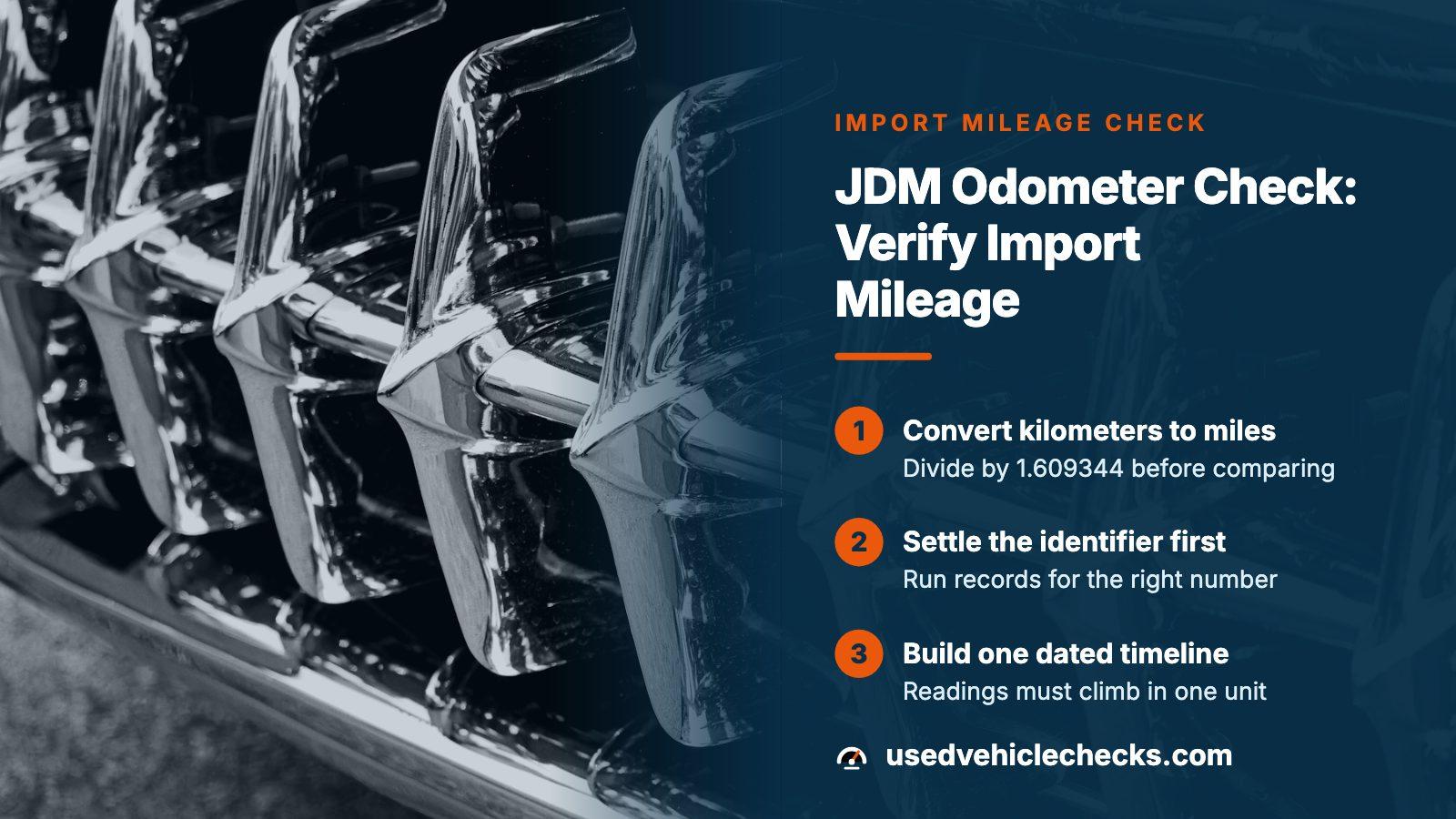
To check the odometer on a JDM car, collect every dated reading you can: US title records by VIN, plus any paperwork from before the export. Convert kilometers to miles by dividing by 1.609344, sort the figures by date, and confirm each is higher than the last and fits the dash. A figure above the display, or a long stretch with no record, is your cue to question the seller or walk away.
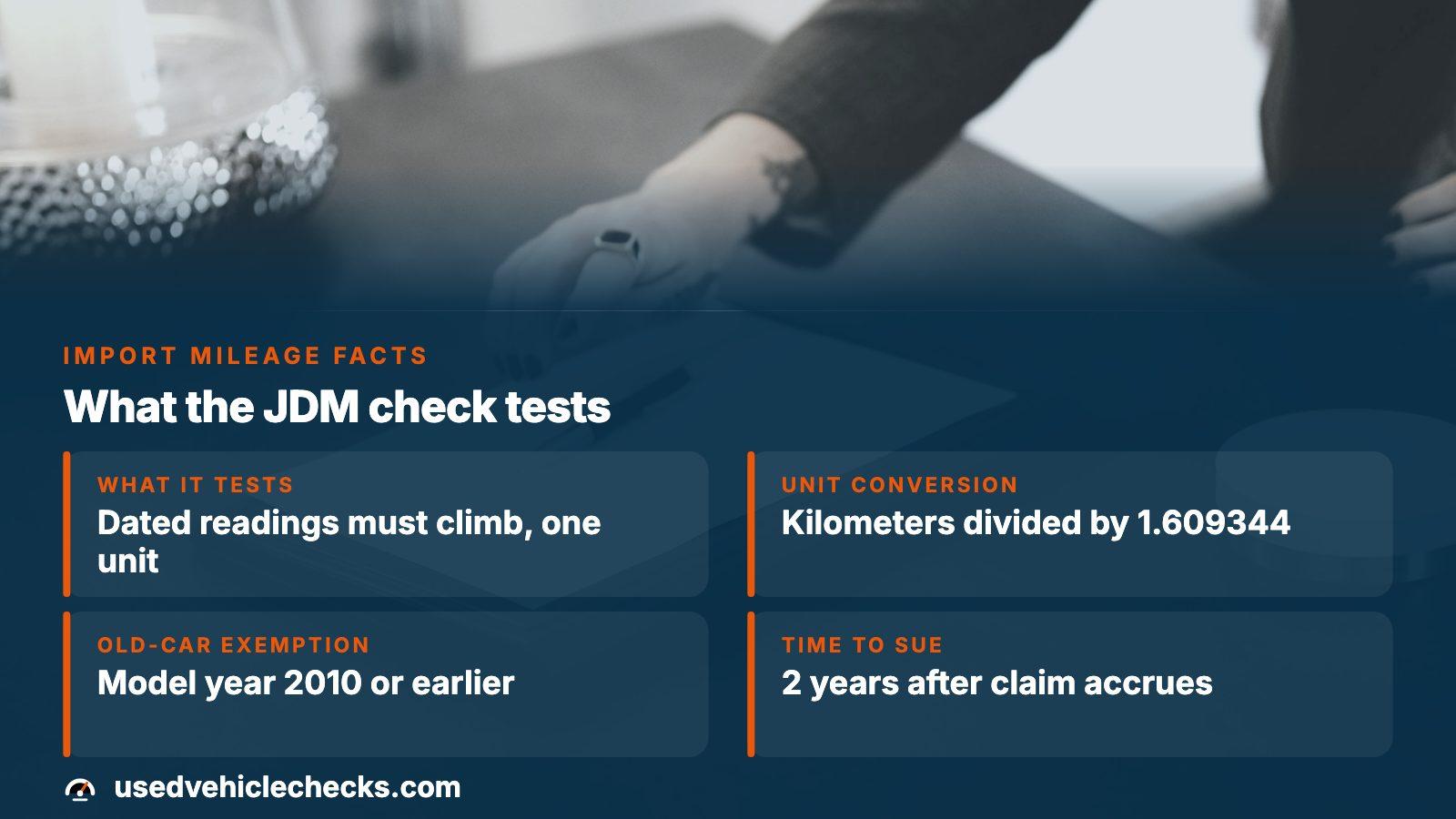
- What it tests
- Dated readings must climb, in one unit
- Unit conversion
- Kilometers divided by 1.609344 gives miles
- Old-car exemption
- Model year 2010 or earlier: exempt after 10 years
- Time to sue
- 2 years after the claim accrues
What the check sees on a Japanese import, and what it misses
JDM stands for Japanese domestic market: a car built to be sold in Japan. UsedVehicleChecks begins with mileage on every used car, and an import makes the test harder because the record splits in two. The VIN report reads the American half. The federal title system behind part of it is fed by state titling agencies, junk and salvage yards, recyclers and insurers, so the years abroad are not where to look.
- Shows: readings recorded on US titles since the car was first titled here, in date order.
- Shows: any odometer brand on a US title, such as a reading marked not actual.
- Shows: accident, salvage and auction entries, each one another dated point on your timeline.
- Does not show: the mileage in Japan, or whether the display was already wrong at the border.
Settle the identifier before you run anything
A report is filed under a VIN, so learn which number the US title carries. In a test run, a short hyphenated chassis-style number put into NHTSA's public decoder returned three errors: an incomplete VIN, a maker with no NHTSA registration for road use here, and an invalid character (the hyphen). Only 5 of 141 fields filled in.
- Read the number on the US title, then find the same number stamped on the car. If the two differ, stop there.
- If the title shows a 17-character VIN, run it through the preview form.
- If the title shows only a short chassis number, a VIN report has nothing to key on. Ask how the state recorded the car and lean on the paperwork route below.
- Buy the report only for a car still in the running, and open the odometer readings first.
Kilometers first: convert before you compare
Check which unit the cluster is marked in. Federal disclosure rules speak only of miles, so every figure from the Japan side must be converted before it sits beside a US reading. NIST publishes the exact factor: one mile is 1.609344 kilometers.
| Figure on the paperwork or cluster | In miles |
|---|---|
| 100,000 km | about 62,137 |
| 150,000 km | about 93,206 |
| A number with no unit written beside it | Ask which unit before doing any arithmetic |
Be wary of a listing that quotes the kilometer figure and lets you read it as miles.
Why title mileage proves little on an old import
Federal law makes a seller state the mileage at transfer, but not on old cars. The cutoffs run on age: model year 2010 or earlier drops out of the rule after 10 years, later models after 20, counted from the first day of the year matching the model year. A car that came in on NHTSA's age route sits far beyond that line, so under federal law its seller owes no mileage statement. Texas, for one, prints an Exempt brand for cars that may change hands without one.
Exempt is not the same as true
An exempt label means nobody had to certify the number. It says nothing about accuracy, and the ban on altering an odometer applies to every car, old or new.
Build one timeline from every dated reading
Ask the seller for anything from before the export that states a mileage with a date and a unit, and photograph it. Then assemble the list.
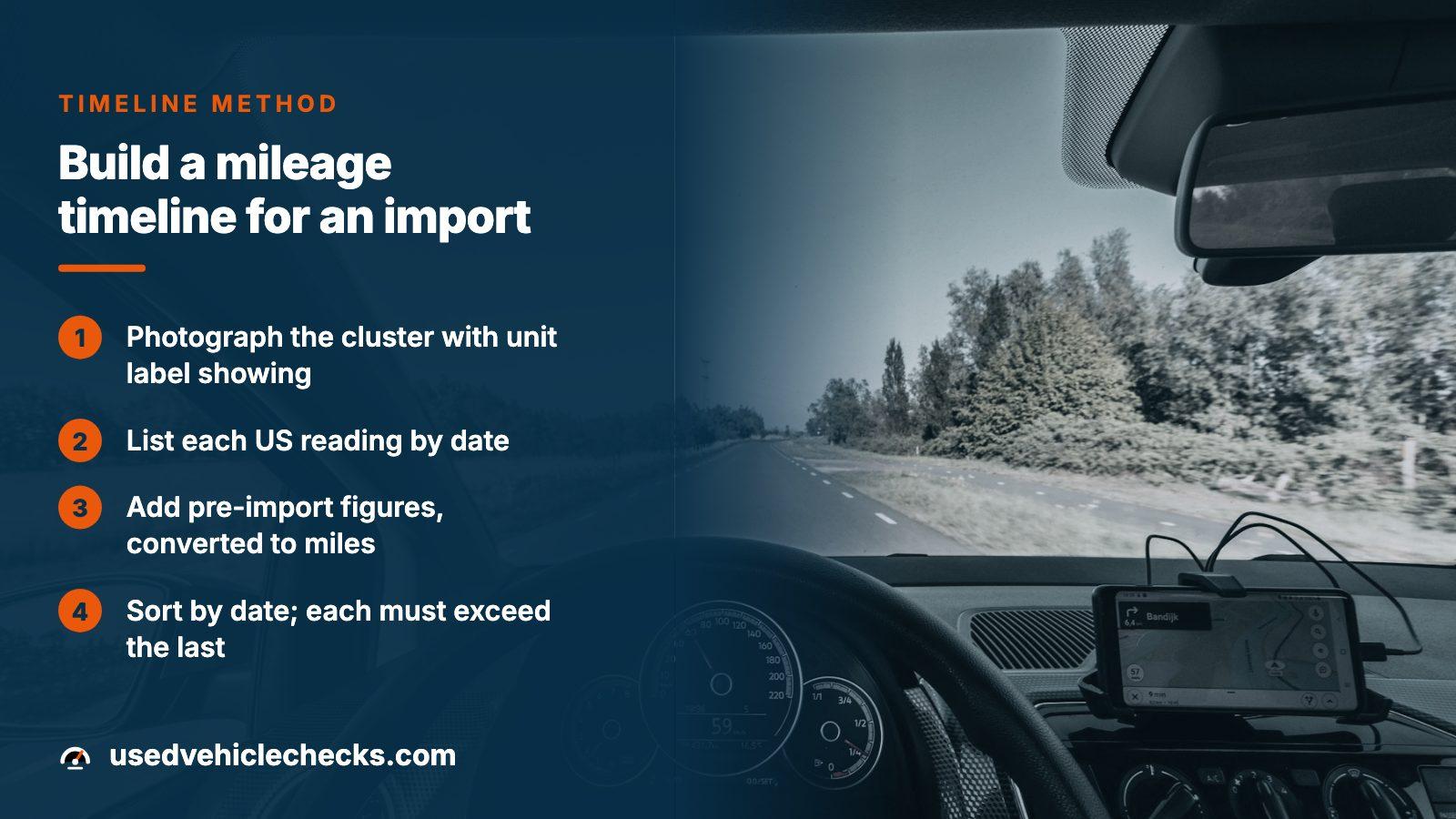
- Photograph today's cluster with the unit label in frame.
- List each US reading by date from the report, including those attached to accident, salvage or auction entries.
- Add figures from pre-import paperwork, converted to miles, and mark which are documents and which are only the seller's word.
- Sort by date. Each figure must exceed the one before it and agree with the dash.
Five patterns in the timeline and your next move
| Pattern | What it may mean | Next move |
|---|---|---|
| Every figure higher than the last, units agreeing | The dash fits the record | Move on to wear and a shop inspection |
| A converted Japan-side figure above today's dash | Tampering, or a cluster swapped without notice | Ask for the invoice and the door-frame notice; walk if neither exists |
| A US figure far above the converted paperwork figure | Kilometers copied down as miles | Ask which unit the statement used |
| No US reading, or an exempt label | Nobody had to certify the number | Treat the mileage as unverified and price it that way |
| Long gap, or readings that never change | Storage, a stopped odometer or thin records | Ask for service invoices covering the gap |
Then test the number against the car. Pedals worn smooth beside a low reading argue with the display.
Swapped clusters and the door-frame notice
Replacing an odometer is lawful. When a replacement unit cannot be set to the old reading, it must start at zero, and the owner or an agent must stick a note on the left door frame stating the mileage before the work and the work date. Removing that notice to deceive is banned, as is resetting, altering or disconnecting an odometer to change what it reads.
- A near-zero cluster on an old car with no notice in the door opening is the finding to chase.
- A notice with a mileage and date should match a repair invoice.
What a mileage check does not settle
Odometer history is separate from the import itself. NHTSA's declaration rules allow an importer to declare a car at least 25 years old, and EPA applies its own tests built on manufacture dates and certificate holders. Neither text mentions the odometer, and a mileage report cannot show customs entry. Those filings belong to the importer, so the seller is the person to ask. Put the import papers to them as a second question, and treat a tidy timeline as one answer, not all of them.
What the law gives you if the number was false
The tampering ban reaches every car. A seller who breaks it with intent to defraud owes the buyer three times the actual loss, with $10,000 as the minimum, and the court adds costs and a reasonable attorney's fee. The suit must start within 2 years after the claim accrues. A knowing and willful violation can also bring up to 3 years in prison, and the government may seek a civil penalty of up to $10,000 per violation.
Report cost and where to go from here
Nobody has to pay or commit before opening the preview. A report is charged once, and packs of 3, 5 and 10 suit buyers comparing several imports; nothing renews. The pricing page lists amounts.
If the figures disagree
Before buying, keep the listing and your converted figures, ask for an explanation in writing, and walk if you do not get one. After buying, keep everything together and see a consumer attorney promptly, because the clock is 2 years.
Where this information comes from
- eCFR: 49 CFR part 580, odometer disclosure — Supports the miles wording on transfer statements and the age exemptions from the mileage statement.
- eCFR: 49 CFR 591.5, import declarations — Backs the declaration that a vehicle is at least 25 years old.
- U.S. Code, Title 49, Chapter 327: Odometers — Statute text for the tampering ban, the replacement notice, the penalties and the buyer's damages claim.
- NMVTIS: understanding a vehicle history report — Describes where the federal title data comes from and why the odometer reading is one of its indicators.
- Texas DMV: odometer brands — A state example of the exempt and not-actual brands printed on titles.
- NIST SP 811 appendix B: conversion factors — The exact kilometers-per-mile factor used for every conversion.
- NHTSA vPIC VIN decoder — The public decoder behind the chassis-number test described above.
Sources and photos: Facts checked against the sources above in November 2026. Photos by Jacob McGowin, Sander Jeurissen and Annika Wischnewsky on Unsplash; diagrams by UsedVehicleChecks.
Keep reading
- Odometer Rollback Check by VIN: Run the Mileage Test Before You PayRun the rollback test on the readings once your timeline is built.
- Mileage Check by VIN: What the Recorded Odometer Readings ShowSee what the recorded readings behind a VIN look like and why some lists are short.
- Odometer Discrepancy Check: Find a Mileage Mismatch Before You PayWhat to do when two numbers on the same car disagree.
- Title Check by VIN: A Step-by-Step Check, Odometer Entries FirstThe brands and title events that sit beside the odometer readings.
Frequently asked questions
Can a VIN check show the mileage a JDM car had in Japan?
Not from US records. A VIN report reads American title, salvage, auction and insurer data, so it starts where the car entered an American record. Mileage from before the export has to come from paperwork you ask for, converted from kilometers. Treat the report as the US half of your timeline.
How do I convert JDM kilometers to miles?
Divide the kilometer figure by 1.609344, or multiply by roughly 0.621371. A car showing 100,000 km has covered roughly 62,137 miles. Convert every figure from the Japan side before comparing it with a US reading, and write the unit beside each number so nothing is read as miles by mistake.
Does a clean report mean a Japanese import's odometer is accurate?
No. It means no recorded US reading contradicts the dash. A rollback made before the car reached an American record leaves nothing to find, and an exempt old car may carry no certified reading at all. Add pre-import paperwork, and have someone who knows the model inspect the car.
Do I need an odometer disclosure when selling an old import?
Usually not under federal rules. A car of model year 2010 or earlier needs no mileage statement a decade after its model year starts, and a later model needs none after two decades. Skipping the statement is lawful; changing the odometer is not. Check your own state's title rules as well.
What can I do if a JDM car's mileage turns out to be false?
Gather the listing, the paperwork, your converted figures and the report, then see a consumer attorney quickly. Where intent to defraud is proven, the buyer can recover three times the actual loss or $10,000, whichever is higher, plus fees, but the suit must begin within 2 years after the claim accrues.
Now check the car itself
The guide explains what to look for. The report shows what this VIN has on record.