THE SHORT ANSWER
Of the Optima model years from 2008 to 2020, 2013, 2015, 2012 and 2016 carry the heaviest complaint records. The lightest belong to 2010, 2009 and 2008. The engine is named in 3,139 complaints, more than any other area. A flag on a year means checking the repair history, dated mileage and title brands of the car in front of you, rather than ruling it out.
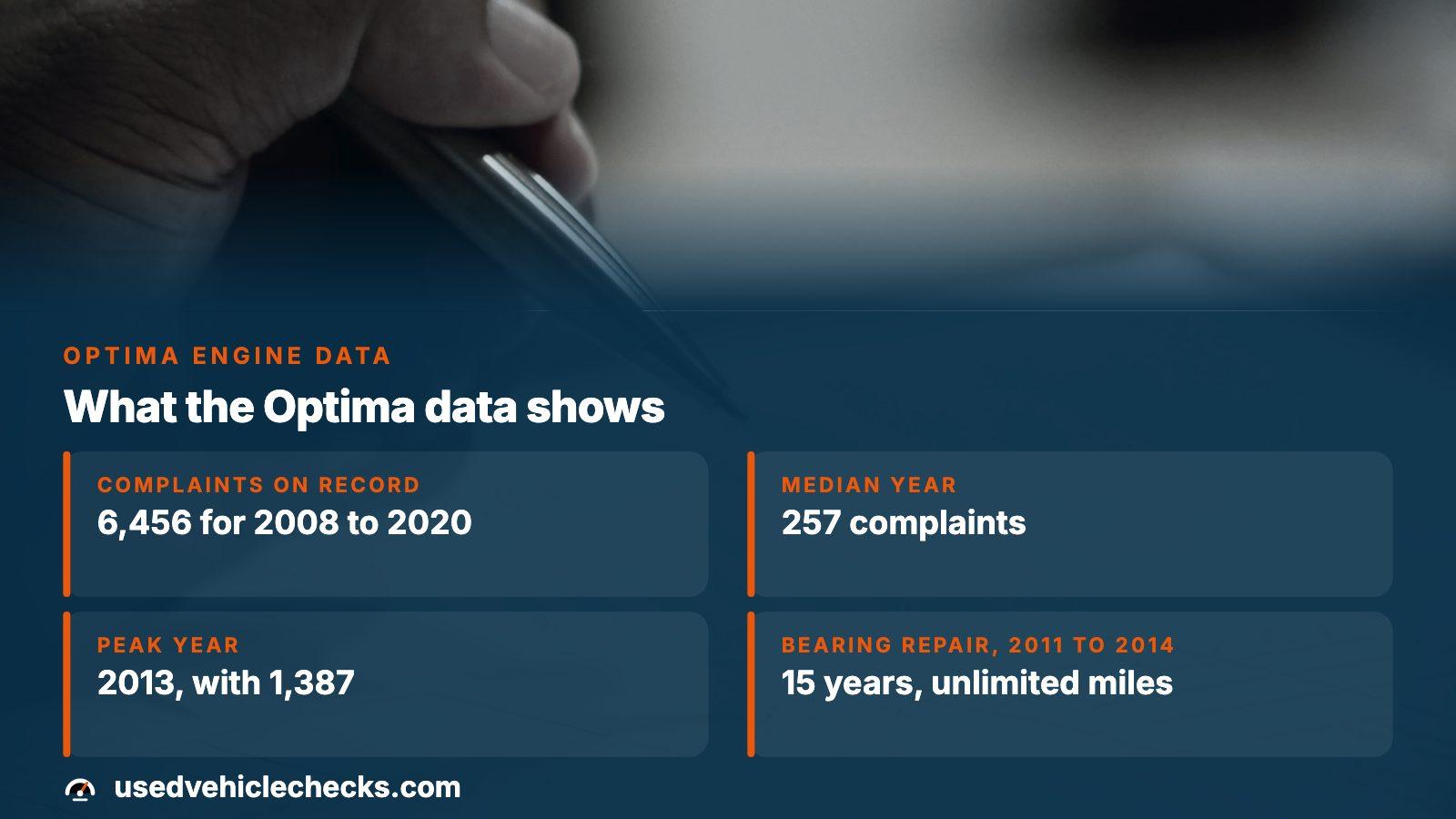
- Complaints on record
- 6,456 for 2008 to 2020
- Median year
- 257 complaints
- Peak year
- 2013, with 1,387
- Bearing repair on 2011 to 2014 cars
- 15 years, unlimited miles
Six Optima years sit well above the median
NHTSA's public database holds 6,456 owner complaints on the Optima sedan for model years 2008 to 2020. The middle year logs 257, so each year is measured against that, not against other cars. Six stand far above it, and the engine is the area named most in every one.
| Model year | Complaints | Times the median | Recalls | Engine named |
|---|---|---|---|---|
| 2013 | 1,387 | 5.4 | 9 | 614 |
| 2015 | 1,010 | 3.93 | 4 | 623 |
| 2012 | 921 | 3.58 | 5 | 399 |
| 2016 | 761 | 2.96 | 5 | 427 |
| 2011 | 594 | 2.31 | 5 | 256 |
| 2014 | 591 | 2.3 | 7 | 284 |
The lightest records are 2010 with 75 filings, 2009 with 116 and 2008 with 144. Hybrids sit under a separate name and are left out. Each count is one owner's unverified account, not a ruling on any car.
2011 to 2014: a bearing recall and a mileage limit that moved
Recall 17V224 covers 2011 to 2014 Optimas with the 2.4 liter or 2.0 liter turbo direct-injection engine, about 443,825 cars. Kia's question-and-answer sheet blames metal debris left in the crankshaft oil passages for starving the rod bearings. A worn bearing knocks, can light the oil-pressure warning and may end in a stall. Dealers inspect the engine and fit a new long block where one is needed.
The mileage rule moved. An earlier extension on these engines stopped at 10 years or 120,000 miles, while the recall sheet says the repair for this condition is now free for 15 years with unlimited miles. Age becomes the deciding number, and the earliest cars in the range are near it. Quote the VIN to Kia and ask how it counts those 15 years.
What mileage the failing cars showed
Among engine filings that state a mileage, the middle figures land a little under the old 120,000-mile line.
| Model years | Engine filings giving a mileage | Middle figure | At 120,000 or more |
|---|---|---|---|
| 2011 to 2014 | 403 | 109,000 | 162 |
| 2015 and 2016 | 231 | 100,000 | 66 |
That is a sample, not a failure rate, since owners round off and many filings omit mileage. Even so, most sit below 120,000 miles, so a modest reading does not clear an Optima; it only calls for dated records.
2013: the heaviest year, with nine recalls
Engine is named in 614 of the 1,387 filings for 2013, and owners ticked the fire box on 114. The nine recalls include the engine bearing campaign, a fuel pipe check for cars that had an engine swap, two on a fuel hose that can crack from heat, and three on a brake control unit prone to an electrical short and an engine-bay fire. Campaigns are tied to build dates, so the VIN settles it.
From an NHTSA owner complaint
A buyer who filed in January 2016 had bought a 2013 Optima used, showing 24,952 miles, and had oil changes done away from the dealer. At 56,337 miles the engine began to clatter and the light came on. The dealer blamed sludge, said the oil looked overdue and refused warranty cover, though the owner said every change was done.
The dispute came down to oil-change history, so ask a seller for dated invoices, or ask the servicing shop for its files.
2015 and 2016: engine complaints, no engine recall
The engine is named in 623 of the 1,010 filings for 2015 and 427 of the 761 for 2016, yet neither year has an engine recall. Their recalls cover brake control unit fire risk, a fuel pipe check after engine swaps, air bags, an axle shaft and a trunk latch, so a clean lookup says little about the engine.
Kia chose software instead. A July 2018 dealer notice describes a knock sensor update for 2015 to 2018 Optimas with the 2.4 liter or 2.0 liter turbo engine, with a matching one for 2011 to 2014 cars. It senses early bearing wear and drops the car into limp mode. The notice promises lifetime engine cover for that single fault, for new and used owners, once the update is done. Ask Kia if the VIN shows it.
A 2015 where the scan tool and the dealer disagreed
From an NHTSA owner complaint
An owner who filed in June 2025 bought a 2015 Optima EX that the dealer had sold as having 101,000 miles. Inside two months the check engine light was flashing, a replaced valve timing part had metal on it, and the car kept dropping into limp mode and knocking. A scan at an auto parts store, the owner said, showed 150,000 miles, and a mechanic called for a new engine.
That 150,000 is an owner's report of a scan reading, not a verified figure, but it is the kind of gap a dated mileage history exists to expose. Compare every past entry with the dash before settling on a price.
A swapped engine leaves the odometer where it was
Recall 18V907 covers 2011 to 2017 Optimas that had an engine replaced under the bearing recall, under warranty or in the knock sensor campaign. The replacement can leave the high-pressure fuel pipe damaged or loosely fitted, so fuel can leak. Kia's filing counts 50,051 Optimas from 2011 to 2014 in that group, so a swap is not rare, and the dash counts miles on the body, not the engine. Ask for:
- The repair order for any engine replacement, with its date and the odometer reading that day.
- Proof that the fuel pipe check was done on a car that had a swap.
- Whether the knock sensor update was installed, and when.
Branded titles and recall repairs
Kia's question-and-answer sheet for the bearing recall lists no eligibility restrictions. Some owners tell NHTSA otherwise: several filings say a dealer refused recall work on a salvage or rebuilt title. Those are owner accounts, not a published Kia rule, yet they justify a title check before buying a car whose main risk is the engine.
From an NHTSA owner complaint
The owner of a 2011 Optima filed in October 2026 after the car cut out as a family member drove out of a parking lot, with a burning smell and a clicking starter. Kia and the dealer both declined the recall repair, citing a salvage title. The failure came at 77,500 miles.
The lesson for a buyer: see the title brand first, since it may decide whether a dealer will touch recall work. NMVTIS, the Justice Department's title database, keeps each car's brand history from every state, alongside odometer, total loss and salvage records.
Before you pay for one particular Optima
- Match the VIN stamped on the car to the advert, then confirm the model year it decodes to.
- Search NHTSA's recall lookup, which costs nothing, and see whether 17V224 and 18V907 are open or done.
- Open the preview here; if the car stays in contention, buy the report and read the odometer entries oldest first, beside any title brands.
- Ask for engine repair orders and dated oil-change invoices, and ask Kia what the VIN is covered for.
- Have a mechanic listen for a knock, read the codes and drive it on hills, a highway and in traffic.
Nothing renews here. The preview is open to anyone, a report is bought once, and amounts are on the pricing page.

Where this information comes from
- Kia recall SC147 questions and answers, filed with NHTSA — The bearing recall's cause, the 443,825 cars and the move from 10 years or 120,000 miles to 15 years.
- Kia dealer notice PI1802, filed with NHTSA — The knock sensor software update and the lifetime coverage Kia ties to it.
- Kia recall 18V907 report, filed with NHTSA — The fuel pipe recall for cars that had an engine replaced, with the number of Optimas involved.
- NMVTIS: understanding a vehicle history report — The five indicators in the federal title report, odometer reading and brand history among them.
- NHTSA owner complaint 10819616 — owner experience, paraphrased
- NHTSA owner complaint 11666850 — owner experience, paraphrased
- NHTSA owner complaint 11769738 — owner experience, paraphrased
Sources and photos: Facts checked against the sources above in November 2026. Photos by Willian Cittadin, John Kakuk and Masjid MABA on Unsplash; diagrams by UsedVehicleChecks.
Keep reading
- Mileage Check by VIN: What the Recorded Odometer Readings ShowWhat dated odometer readings show for one VIN before money changes hands.
- Odometer Discrepancy Check: Find a Mileage Mismatch Before You PayWhat to do when a past reading disagrees with the dash or a scan tool.
- Title Check by VIN: A Step-by-Step Check, Odometer Entries FirstHow salvage, junk and flood brands show up, and why they matter for recall repairs.
- Hyundai Sonata Years to Avoid, and the Mileage That MattersThe Hyundai sedan with a similar bearing recall and its own mileage line.
Frequently asked questions
Which Kia Optima years should I avoid?
Start with 2013, 2015 and 2012, which drew 1,387, 1,010 and 921 filings against a median year of 257. The 2016 year follows at 761. Good cars exist in each, so a flag calls for a recall lookup, repair records and an inspection, not a flat no.
Is the 2013 Kia Optima a bad car?
It has the heaviest record: 1,387 filings, 614 naming the engine and nine recalls. Confirm the bearing recall was handled, find out if the engine has been swapped, and check the fuel hose and brake unit campaigns. The VIN shows which apply.
Which Optima years are the most reliable?
Complaint counts measure filings, not reliability, but 2010, 2009 and 2008 are the lightest at 75, 116 and 144. Newer cars look tidy partly because fewer owners have had time to file, so those years still need a title and odometer check.
Does high mileage end Kia's Optima engine cover?
For bearing wear on 2011 to 2014 cars, Kia's recall sheet gives 15 years with unlimited miles, replacing the earlier 10 years or 120,000 miles. For 2015 to 2018 cars, the knock sensor notice describes lifetime cover for one fault once the update is done. Terms change, so ask Kia about the VIN.
Do more complaints mean a worse Optima?
Only in part. Sales volume and age inflate raw counts, so each year here is set against the Optima's own median of 257, not against a different model. A recall is another matter, because Kia accepted the fault. For a specific car, its repair history and title carry the answer.
Now check the car itself
The guide explains what to look for. The report shows what this VIN has on record.