THE SHORT ANSWER
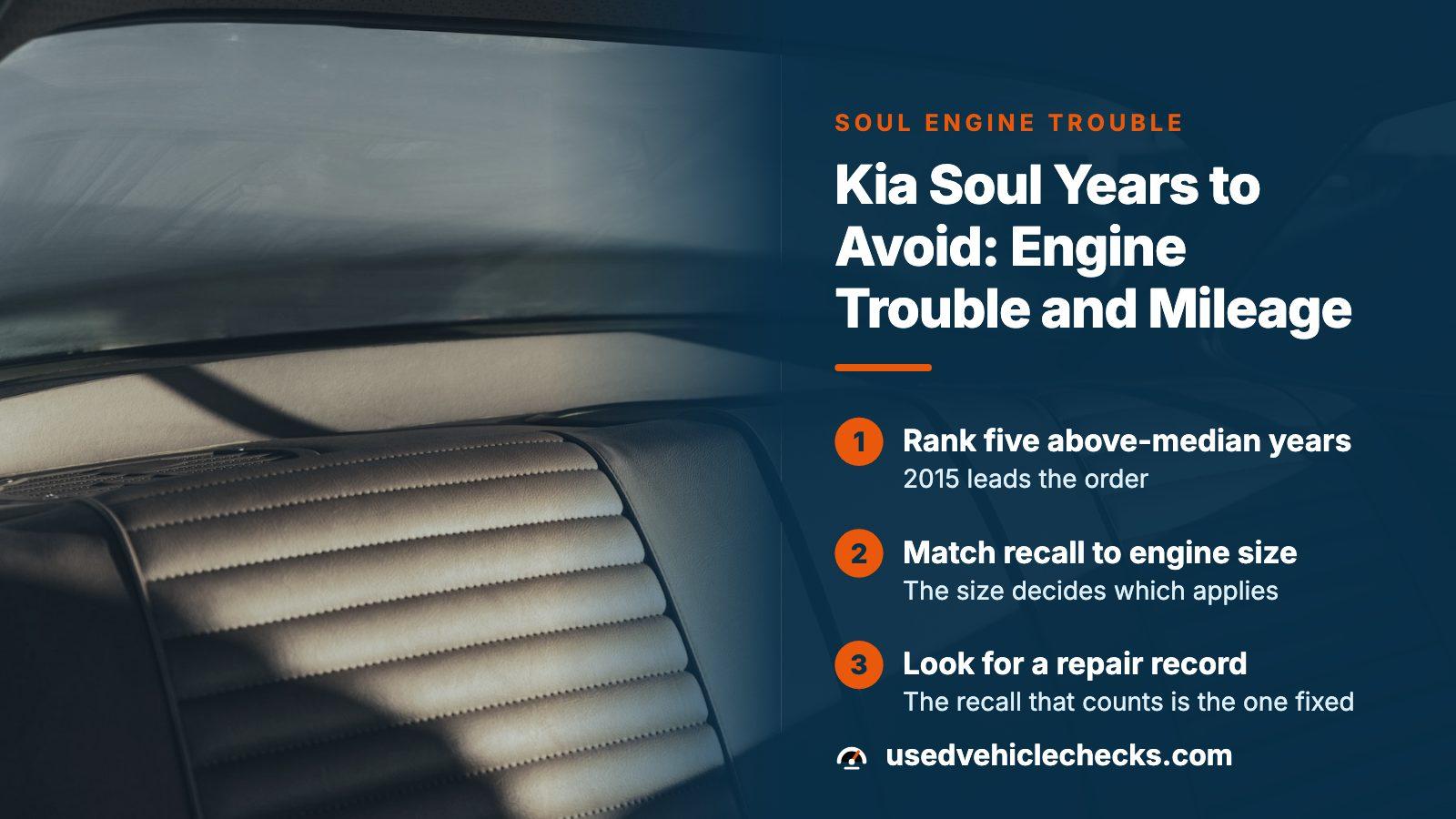
Five Soul model years rise above the model's median of 288 complaints: 2015, 2014, 2016, 2013 and 2012, in that order. Engine complaints lead in every one. Cars from 2017 to 2019 carry much lighter records, though 2020 and 2021 have piston ring recalls of their own. A flagged year is a reason to read the recall work and mileage history of one car, not to refuse it.
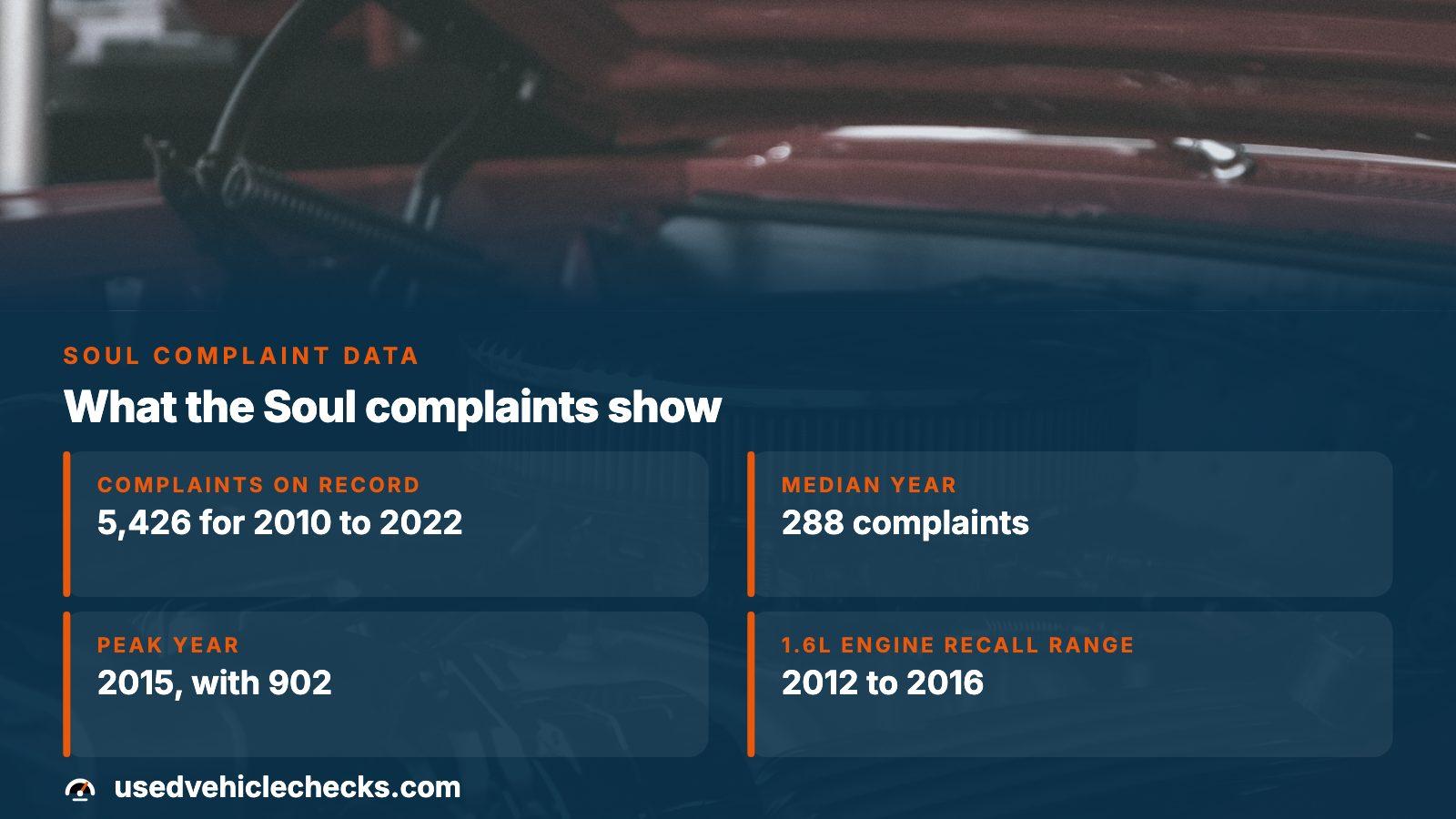
- Complaints on record
- 5,426 for 2010 to 2022
- Median year
- 288 complaints
- Peak year
- 2015, with 902
- 1.6L engine recall range
- 2012 to 2016
Five Soul years rise above the median
NHTSA holds 5,426 owner complaints on the Soul across 2010 to 2022, and the middle model year has 288. The table below lists the five years above that line and how many recall campaigns NHTSA files under each.
| Model year | Complaints | Times the median | Recalls listed |
|---|---|---|---|
| 2012 | 514 | 1.78 | 3 |
| 2013 | 660 | 2.29 | 3 |
| 2014 | 894 | 3.1 | 5 |
| 2015 | 902 | 3.13 | 4 |
| 2016 | 805 | 2.8 | 2 |
Note the step from 193 complaints for 2011 to 514 for 2012. The 1.6L direct injection engine recall covers 2012 to 2016, so filings begin climbing where that recall range begins. Counts rise with sales volume and age as well as with defects, and every filing is an owner's own unverified account, current to mid-August 2026. A flagged year describes a population of cars, not the Soul in the seller's driveway.
Where the odometer sat when engines gave out
In the 2012 to 2016 engine complaints read for this page, the mileage owners quoted ran from 55,000 to 146,500, and most figures fell between 78,388 and 146,500. One 2015 owner reported a replacement engine failing after only 3,568 miles.
Treat that as a pattern in owner stories, not a failure schedule, since plenty of Souls pass 146,500 miles without drama. It does show where to dig: a 2012 to 2016 Soul with six figures on the dash needs its engine service history on the table before money moves.
Engine size decides which recall applies
Fueleconomy.gov shows two four-cylinders for the Soul, 1.6L and 2.0L, in each year from 2010 to 2019, plus a 1.6L turbo from 2017 on. NHTSA words its engine recalls around particular engines, so the VIN decode matters as much as the year in the advert.
| Model years | Engines listed | Engine campaigns in NHTSA's lookup |
|---|---|---|
| 2010 to 2011 | 1.6L, 2.0L | None |
| 2012 to 2013 | 1.6L, 2.0L | 19V120000, 1.6L direct injection only |
| 2014 to 2016 | 1.6L, 2.0L | 19V120000 for the 1.6L; 20V750000 for 2014 and 2015 |
| 2017 to 2019 | 1.6L, 2.0L, 1.6L turbo | None |
| 2020 to 2022 | 2.0L, 1.6L turbo | 21V259000 for 2020 and 2021; 25V099000 for 2021 and 2022 |
From an NHTSA owner complaint
The owner of a 2015 Soul with the 2.0L engine wrote that heavy oil use ruined the catalytic converter at 106,000 miles. The engine recall leaves a 2.0L out, the owner notes, although the symptoms look the same as on the 1.6L cars. Two mechanics confirmed the blocked converter, the owner adds.
Take from this that recalls are sorted by engine. Match the engine a VIN decodes to against each campaign before deciding a car is covered, or exposed.
The recall that counts is the one with a repair order
Recall 19V120000 reaches 378,967 Souls with the 1.6L direct injection engine: dealers upgrade the engine-control logic, swap out a damaged catalytic converter and, if the damage runs deep, replace the engine. Recall 20V750000 takes in the 2014 and 2015 Soul alongside other Kia models, with a leak inspection, an engine test and an update to the Knock Sensor Detection System software.
From an NHTSA owner complaint
An owner who bought a 2013 Soul used, in late 2019, says no one ever notified them of the software update. At 132,179 miles they saw smoke on the drive home, and a shop found a hole in the block and a broken connecting rod. Kia refused the repair, the owner reports, citing a class action they could not join because the knock sensor update had never been done.
The lesson is practical: if the update is not on a dated repair order, treat that engine as unprotected and price it that way, or walk. NHTSA's lookup lists no knock sensor campaign for a 2013 Soul, so ask a Kia dealer for every service step on file for the VIN, not only the recalls.
Odometer checks to run on one Soul
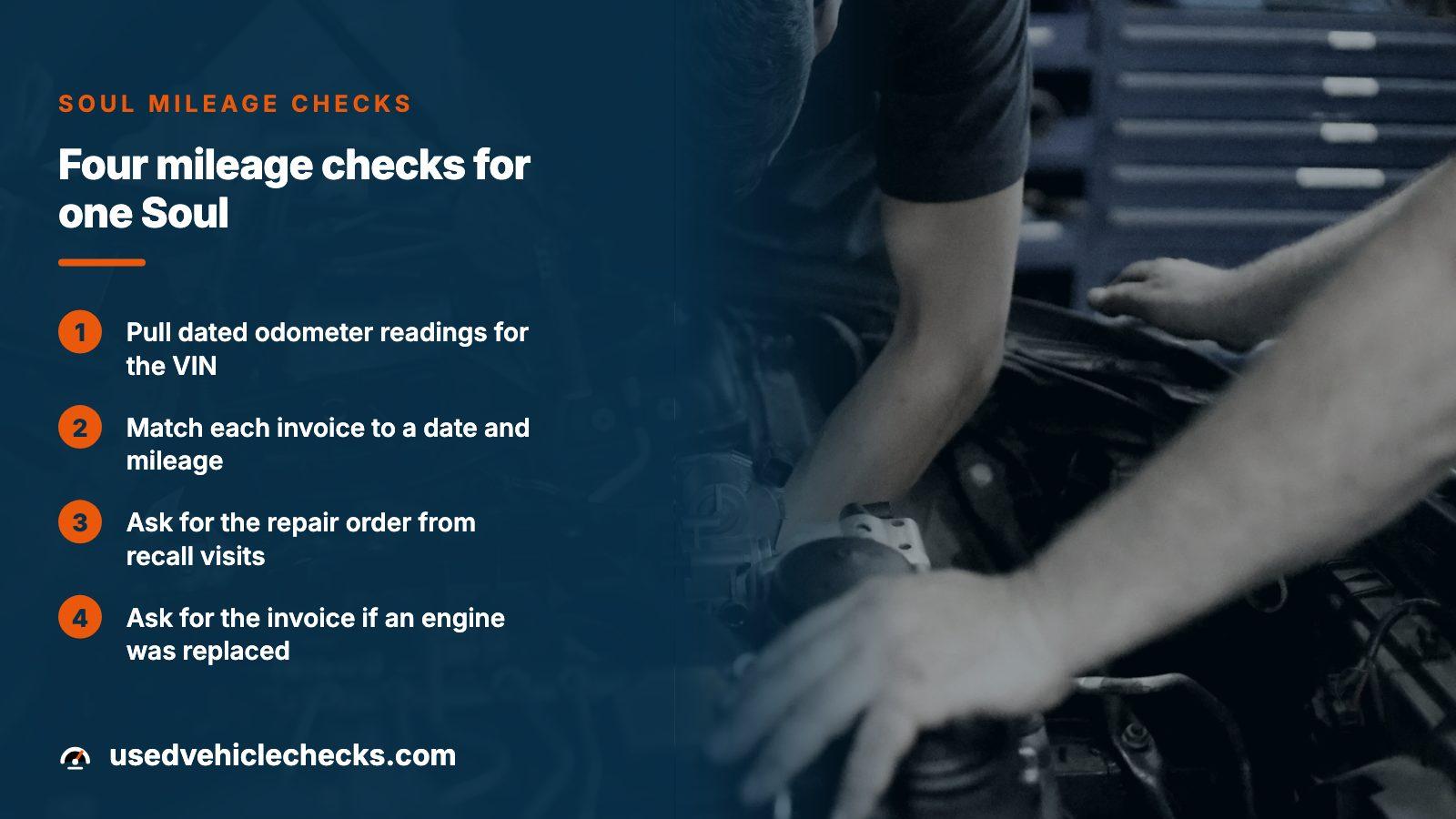
Engine work leaves a trail of dates, and the odometer ties it together. Work through these on any 2012 to 2016 car:
- Pull the dated odometer readings for the VIN and look for a reading that drops or stalls between two dates.
- Match each service invoice to a date and a mileage, and confirm the numbers climb at a believable pace.
- Ask for the repair order from any engine recall visit and note the mileage printed on it.
- If an engine was replaced, ask for that invoice too: a new engine does not reset the dash reading.
NMVTIS, the federal title database, counts the odometer reading among its five indicators and says checking it helps buyers catch discrepancies. A reading that falls backward between dates is a rollback question, not a Soul question.
2020 to 2022: light counts, piston ring recalls
The complaint table flatters the newest Souls. The 2020 model has 369 complaints, ranked around the median at 1.28 times, yet NHTSA files two piston oil ring campaigns in this stretch. Recall 21V259000 covers 147,249 Souls and Seltos fitted with the 2.0L Nu MPI engine, and 25V099000 covers 137,256 Seltos and Souls from 2021 to 2023.
From an NHTSA owner complaint
A 2020 Soul owner reported total engine failure at about 102,420 miles, a few months after a Kia dealer had done the piston ring recall work. The dealer found low compression and called the failure outside warranty and recall, a verdict the owner disputes.
A completed recall counts in a car's favor but proves little about the engine's condition today. A 2020 or 2021 Soul with six-figure miles still needs the oil-use and compression questions.
The quieter years, and what crash tests add
The 2017, 2018 and 2019 models draw 288, 216 and 137 complaints, with one air bag control unit recall each (22V031000, covering 410,619 vehicles across several Kia models). Crash tests add a twist: the three heaviest complaint years, 2014 to 2016, all earn five stars.
- NHTSA overall rating: 4 stars for 2011 to 2013, 5 stars for 2014 to 2019, and 4 stars again for 2020 to 2022.
- Driver aids: no forward collision warning through 2015 and an option from 2016; lane departure warning is an option from 2017.
So a flagged 2014 or 2015 with proof of recall work and a fair price can still make sense. A 2017 to 2019 car without paperwork is not a safe bet just for its low count.
Where a VIN report fits
A model year describes thousands of cars; a VIN describes one. The UsedVehicleChecks report for a VIN puts the odometer readings in date order, shows recalls still open, and lists the factory specs that reveal which engine is fitted, with title and accident records alongside. The preview is free and shows what turns up first. The full report is bought once, not subscribed to, and the pricing page lists the options. Order it before any deposit changes hands, then read it next to the repair orders the seller provides.
Where this information comes from
- NHTSA: recall lookup by vehicle — Recall campaigns, vehicle counts and remedies for each Soul model year.
- NHTSA: 2014 Kia Soul ratings, recalls and complaints — Crash-test stars and driver-assist listings by year.
- Fueleconomy.gov: 2015 Kia Soul — Which engines were listed for each Soul year.
- NMVTIS: understanding a vehicle history report — The five title-record indicators, odometer reading included.
- NHTSA owner complaint 11697728 — owner experience, paraphrased
- NHTSA owner complaint 11692223 — owner experience, paraphrased
- NHTSA owner complaint 11771433 — owner experience, paraphrased
Sources and photos: Facts checked against the sources above in November 2026. Photos by Brandon Russell, Mustafa Sheikhmouss and Victor Hughes on Unsplash; diagrams by UsedVehicleChecks.
Keep reading
- Mileage Check by VIN: What the Recorded Odometer Readings ShowHow dated odometer readings for one VIN show whether the mileage holds together.
- How Many Miles Is Too Many on a Used Car? Age, Pace and ProofWhere mileage starts to weigh on the price when a Soul shows six figures.
- Odometer Rollback Check by VIN: Run the Mileage Test Before You PayWhat a reading that drops between dates looks like, and what to do about it.
- Kia Optima Years to Avoid, Judged by Engine Failures and MileageThe same year-by-year read for another Kia, with its own engine and mileage clues.
Frequently asked questions
Which model years of the Kia Soul are worth skipping?
The three heaviest by NHTSA complaints are 2015 (902), 2014 (894) and 2016 (805), against a typical year's 288, with 2013 and 2012 above that line too. Each of those years includes sound cars, so let the flag drive your questions about recall work and service records, not an automatic no.
Which problem do Kia Soul owners report most?
The engine, by a wide margin: 3,063 reports name it, against 455 for the electrical system and 344 for steering. Owners describe heavy oil use, failing catalytic converters, stalling and rod knock. Whether one Soul is exposed depends on its engine size and recall history.
Is a high-mileage Kia Soul a bad buy?
Not automatically, but mileage changes the risk on 2012 to 2016 cars, since most mileages quoted in the engine complaints read for this page run from 78,388 up. A six-figure Soul with dated repair orders for recall work sits in better shape than the same car with no records. Verify the odometer history first.
Are newer Kia Souls free of the engine problem?
No. The 2020 and 2021 Souls with the 2.0L Nu MPI engine fall under recall 21V259000, and 25V099000 covers Seltos and Soul models from 2021 to 2023. The 2017 to 2019 years sit nearer the median with a single air bag recall each. Run the VIN for open campaigns in any year.
What should I run on one Kia Soul before I pay?
Look the VIN up in NHTSA's recall tool, then ask the seller for dated repair orders showing recall work and mileage. Add the odometer history and title brands, and pay a mechanic to test compression and oil level. The preview is free, so see what a VIN report turns up before buying the full one.
Now check the car itself
The guide explains what to look for. The report shows what this VIN has on record.