THE SHORT ANSWER
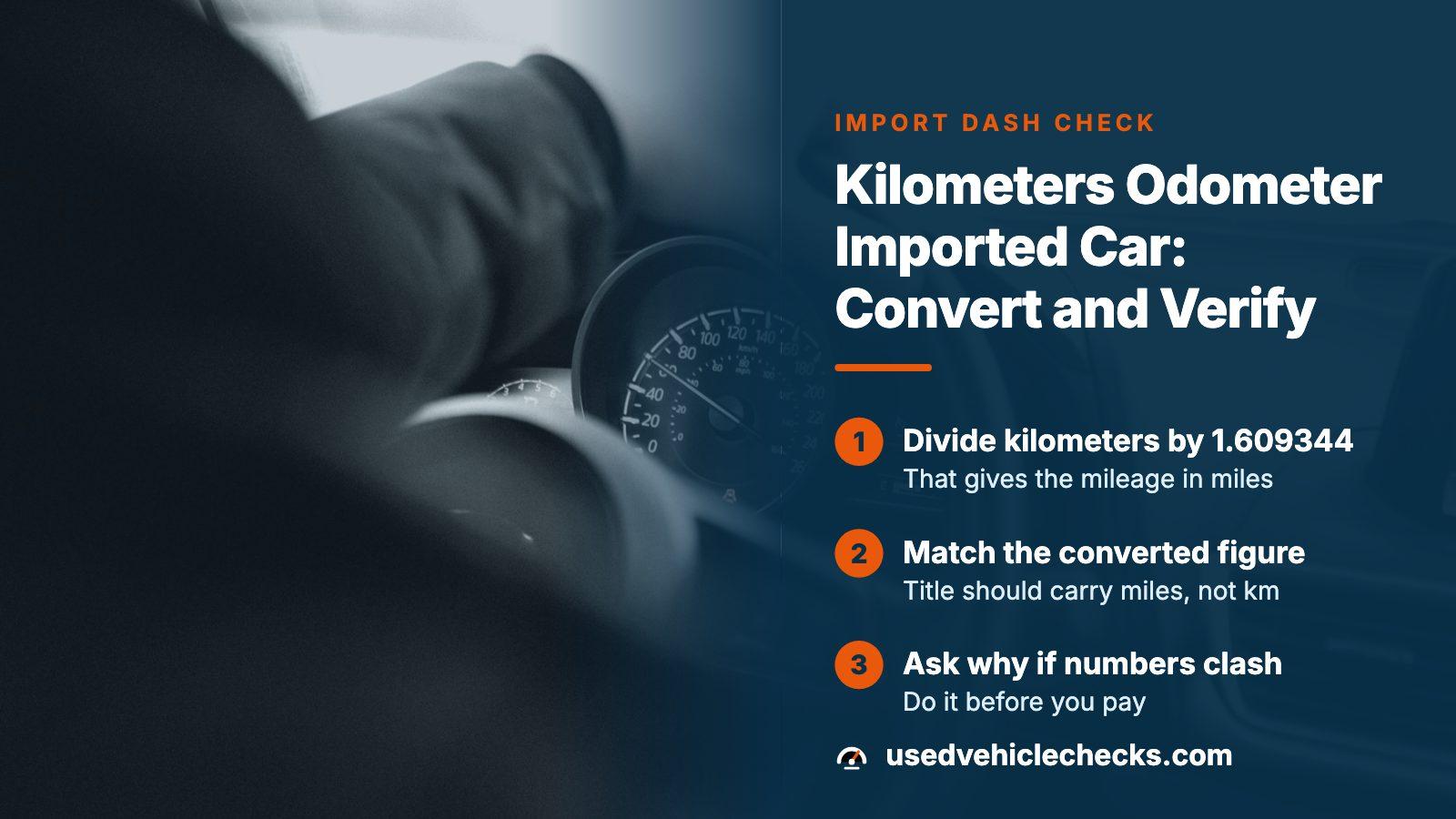
A dash that counts kilometers does not mean the car was tampered with. Convert by dividing kilometers by 1.609344: a dash showing 100,000 km equals roughly 62,137 miles. The US title is supposed to carry miles. If the title figure is far lower than the converted dash, or the same number as the raw kilometers, ask why before paying.
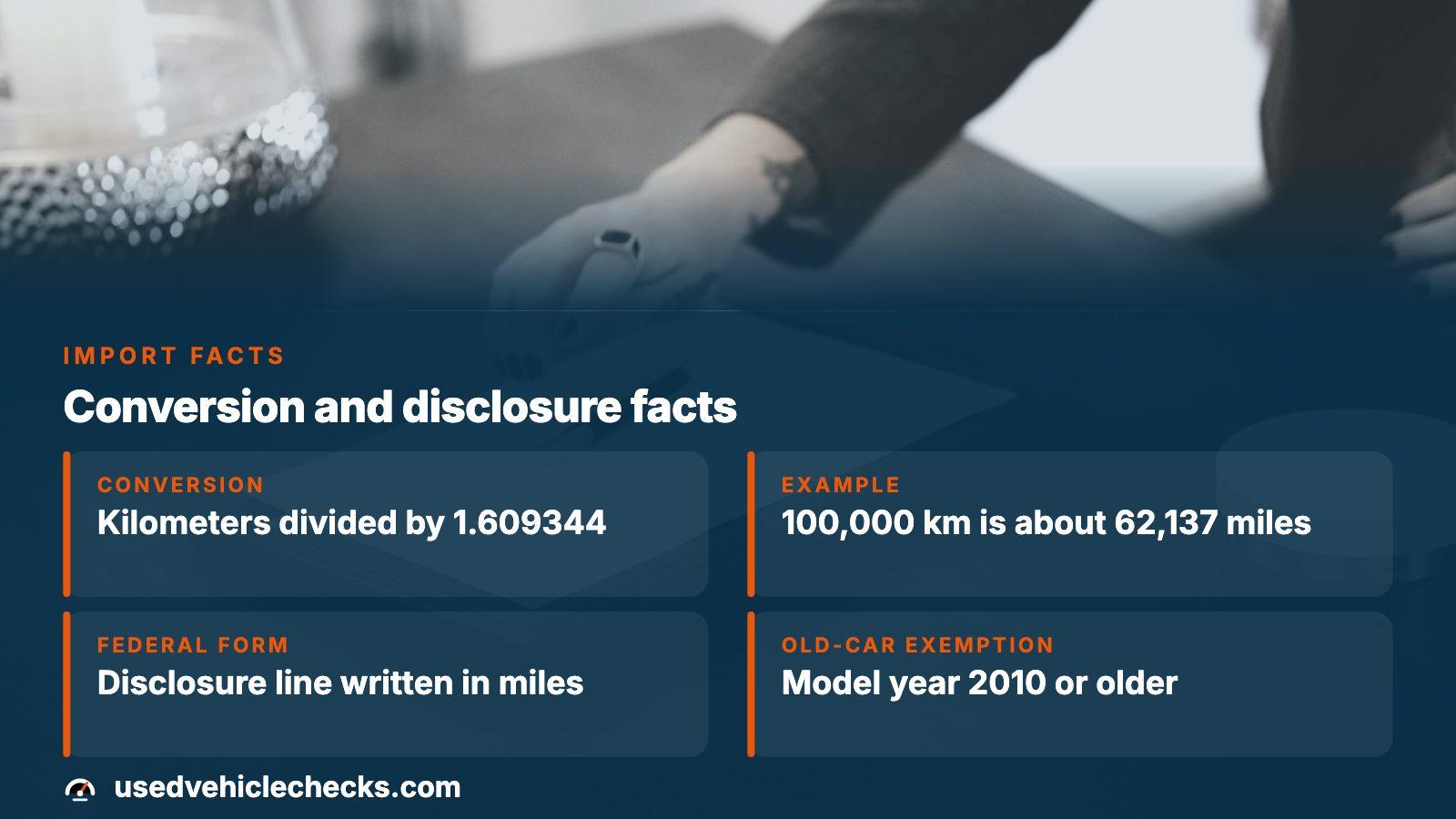
- Conversion
- Kilometers divided by 1.609344 gives miles
- Example
- A 100,000 km dash equals roughly 62,137 miles
- Federal form
- The disclosure line is written in miles
- Old-car exemption
- Model year 2010 or older: exempt after 10 years
Why an imported dash counts in kilometers
Outside the United States most dashboards are calibrated in kilometers, so a car shipped here keeps the cluster it left the factory with. A few owners swap in a mile-based cluster; most do not. When you open the door and see a figure with a small km mark beside it, you are looking at a normal foreign-market display, not a defect.
The trouble starts later, on paper. A title, a bill of sale and an advertisement all have to speak in miles, and somewhere between the dash and the title a number can get copied across without being converted. Sometimes that is an honest slip. Sometimes it is convenient for the seller.
Do the conversion yourself before you talk price
NIST lists the international mile as exactly 1.609344 kilometers. Take the dash figure, divide by that factor, and miles come out; multiplying by it runs the conversion backward. Do it on your own phone, not from a number the seller hands you.
| On the dash (km) | In miles, roughly |
|---|---|
| 100,000 | 62,137 |
| 150,000 | 93,206 |
| 200,000 | 124,274 |
The gap between the two columns is the whole point. A listing that says 100,000 miles for a car showing 100,000 km is overstating wear by a wide margin, which is harmless to you. A listing that says 62,137 for that same car is accurate. A listing that shows 62,137 when the dash says 150,000 km is a problem.
What the federal disclosure form asks for
The federal odometer rule has the seller sign a form at handover. It wants the mileage on that day, who is selling and who is buying, and enough detail to pin down the car, VIN included. Tenths are dropped, and the mileage line is worded in miles. Kilometers are never mentioned.
The seller also vouches for the figure in one of three ways: it is true mileage, it has rolled past what the gauge was built to show, or it is wrong and must not be trusted. Choosing the last one obliges the form to warn you that the numbers disagree. Check which choice was made before you add your own signature.
Older imports may skip the statement altogether
Many imported cars are old, and old cars are often exempt. For a model year 2010 or older car, the statement is dropped once the sale happens 10 or more years past January 1 of that model year. Cars from model year 2011 on get the same pass after 20 years.
- An exempt transfer means no signed mileage figure, so the dash may be the only number in the deal.
- Heavy vehicles over 16,000 pounds gross weight rating are exempt as well.
- Exempt does not mean the mileage is unimportant; it only means nobody has to certify it.
With no statement to compare, you lean harder on the other evidence: the VIN records, the wear, and the service history.
Lining the dash up against the paper trail
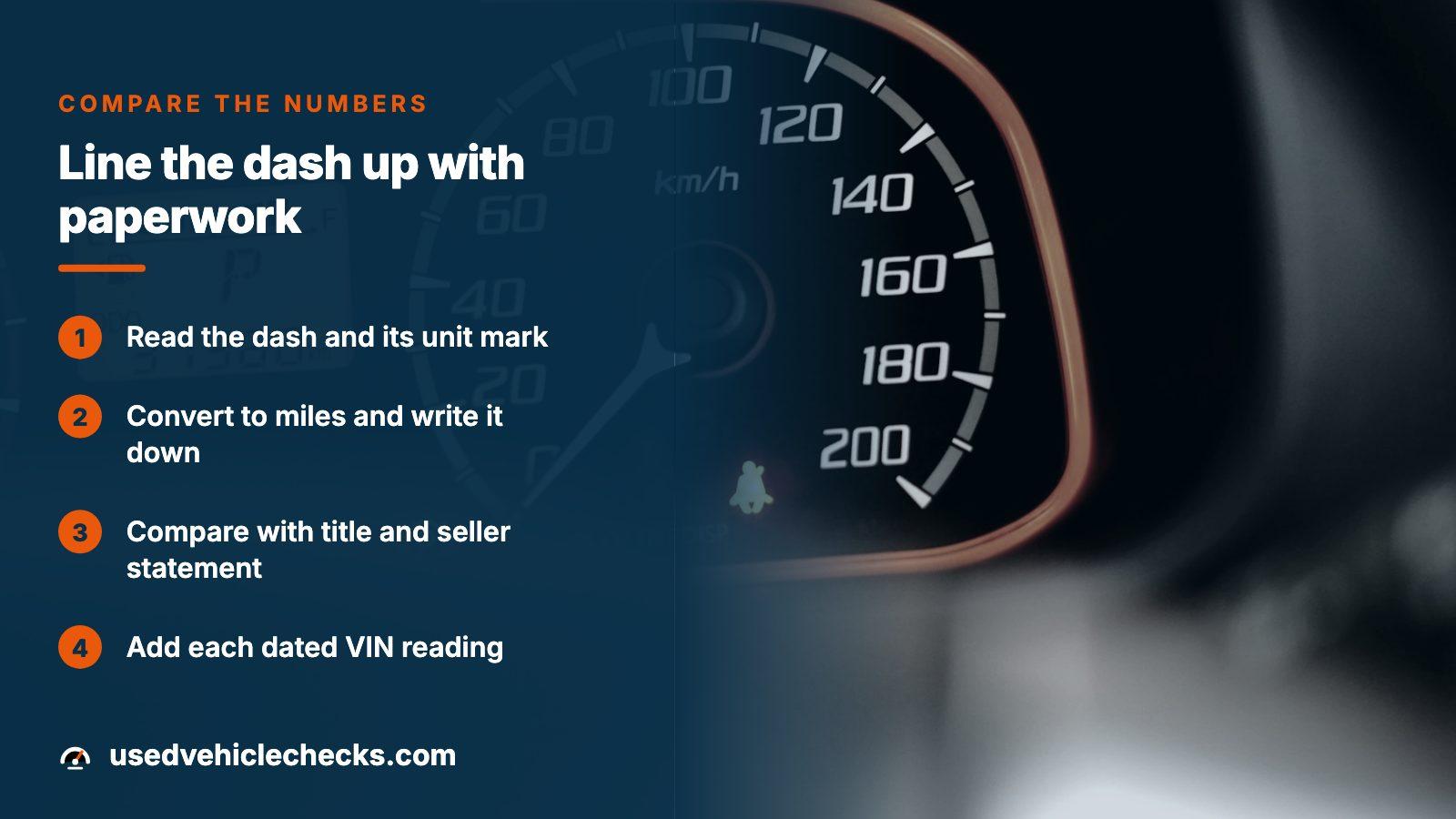
Write down every dated reading you can find and put them in one unit. The dash converted to miles goes in the list next to the title figure, any readings printed on earlier titles, inspection or emissions records, and service invoices. Dates should climb and so should the numbers.
- Read the dash and note the unit mark beside it.
- Convert to miles and write the result down.
- Compare with the figure on the title and the seller's signed statement.
- Pull the VIN records and add each reading with its date.
- Ask about any reading that drops, repeats exactly, or sits far from the rest.
Where a VIN check helps on an import, and where it stops
Justice Department guidance on the federal title database lists five indicators it aims to cover: where the title sits and when it last changed, brands, mileage, total loss and salvage. Data flows in from state titling offices, scrap and salvage operators, recyclers and insurers. The mileage indicator is there because a mismatch is how buyers spot fraud, which can mean overpaying or driving something unsafe.
The limits matter on an import. Records only start when the car is titled in a US state. Whatever happened to the dash overseas, including a rollback, sits outside that history, so the earliest US reading is a starting point and not proof of the car's true past. A VIN report from UsedVehicleChecks lists odometer readings by date alongside title brands, and the preview is free to run.
Signs the number is not what it seems
Walk-away signals
A title reading that equals the dash in kilometers with no conversion. A title reading far under the converted dash. A seller who cannot say which unit the cluster uses. A statement ticked as not reflecting actual mileage with no explanation attached.
Physical wear is the second witness. Pedal rubber, the driver's seat bolster, the steering wheel and key wear should fit the story. A converted figure of about 62,137 miles on a car with a shiny, worn wheel and sagging seat deserves a hard look from an independent mechanic.
What to do before you pay
Convert the dash, ask for the signed disclosure or the exemption explanation, and run the VIN through a history report before any deposit. A 17-character VIN is what the tools need; a short chassis number from foreign paperwork will not decode as a US vehicle. If the numbers disagree and the seller shrugs, that disagreement is your answer.
Where this information comes from
- eCFR: 49 CFR 580.5, odometer disclosure — what the seller must state and certify, written in miles
- eCFR: 49 CFR 580.17, exemptions — age and weight exemptions from the mileage statement
- NMVTIS: understanding a vehicle history report — the five indicators, data sources and why the odometer matters
- NIST SP 811 appendix B: conversion factors — the exact kilometers-per-mile factor
Sources and photos: Facts checked against the sources above in November 2026. Photos by Miles Loewen, muhammad dennisa and Annika Wischnewsky on Unsplash; diagrams by UsedVehicleChecks.
Keep reading
- JDM Odometer Check: Verify the Mileage on a Japanese ImportThe same conversion problem for Japanese-market cars.
- Odometer Disclosure Statement: What the Seller Signs and What to CheckWho signs what when mileage is declared.
- Mileage Check by VIN: What the Recorded Odometer Readings ShowPull dated readings for a car by its VIN.
- Odometer Exempt Vehicles: Which Cars Need No Mileage StatementWhich cars need no mileage statement.
Frequently asked questions
Is it illegal for a car to show kilometers?
The sources I read do not ban a kilometer dash. The federal disclosure rule is about the figure a seller states at transfer, and that line is written in miles. The dash can keep its foreign calibration, but the number on the paperwork must be an honest mileage figure.
How do I turn kilometers into miles quickly?
Divide by 1.609344. A 100,000 km dash works out to roughly 62,137 miles. Hold to one unit through the whole comparison so a stray kilometer figure cannot slip into a list of miles.
What if the title shows the same number as the dash?
Then the kilometer reading may have been copied without conversion. That can overstate the mileage, which is usually in the buyer's favor, but it still makes the paperwork wrong. Ask the seller and the titling office to explain it, because the odometer line you sign should be accurate.
Does an old import need an odometer statement?
Often not. A model year 2010 or older car drops out after 10 years, and a model year 2011 or newer car after 20. In an exempt sale nobody certifies the mileage, so the VIN history and the wear on the car carry more weight.
Will a VIN report show the kilometers from before import?
Not reliably. US title records begin when the car is titled in a state, so earlier foreign readings are usually missing. The report gives you US readings with dates. Ask the seller for any foreign paperwork and convert it yourself.
Now check the car itself
The guide explains what to look for. The report shows what this VIN has on record.