THE SHORT ANSWER
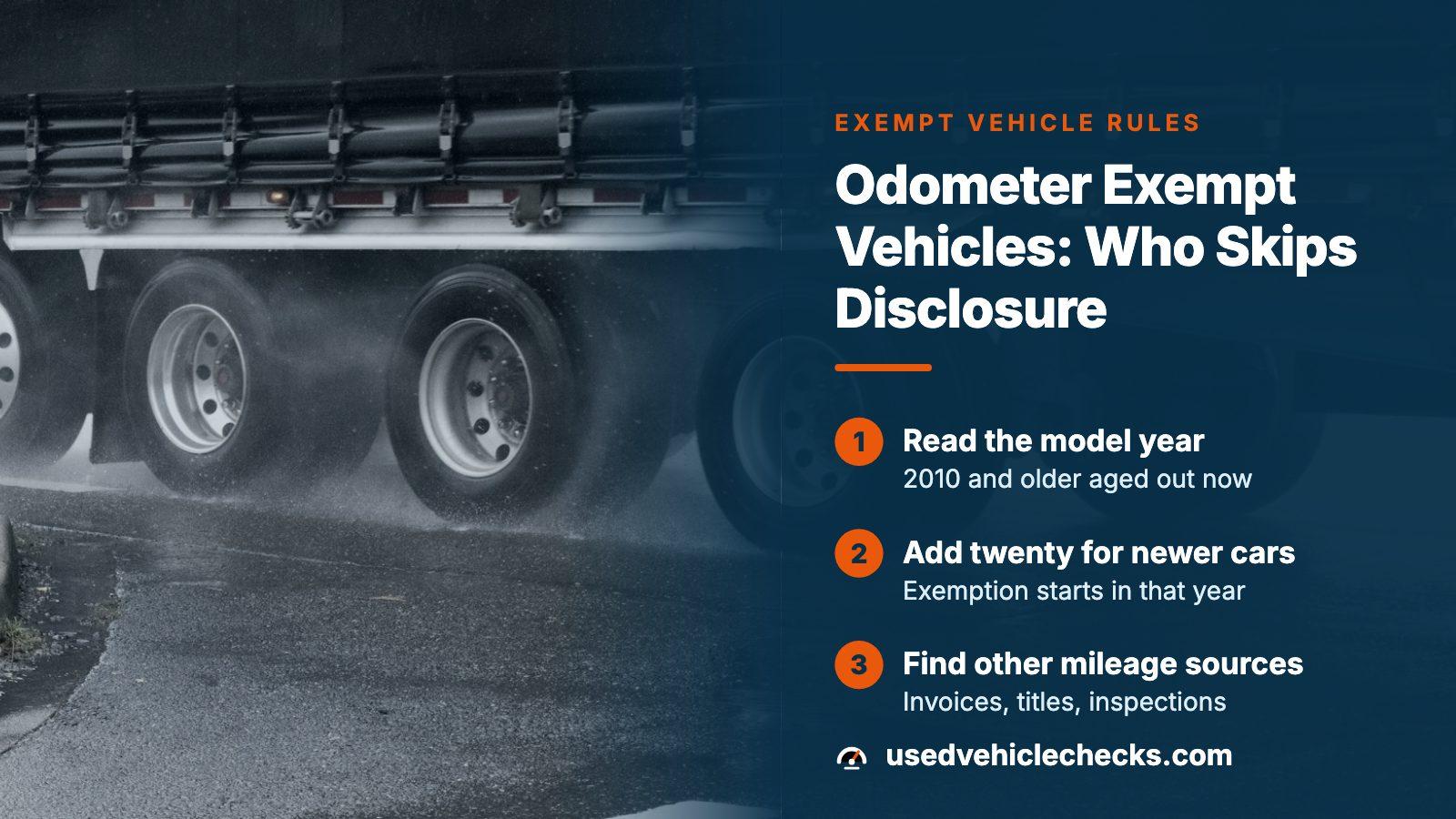
Exempt means no mileage statement is required at sale. Three groups matter most: vehicles rated above 16,000 pounds, vehicles with no engine of their own, and cars that have aged out. Model year 2010 and older age out after a decade, newer ones after two. Exempt never means the dash number can be trusted.
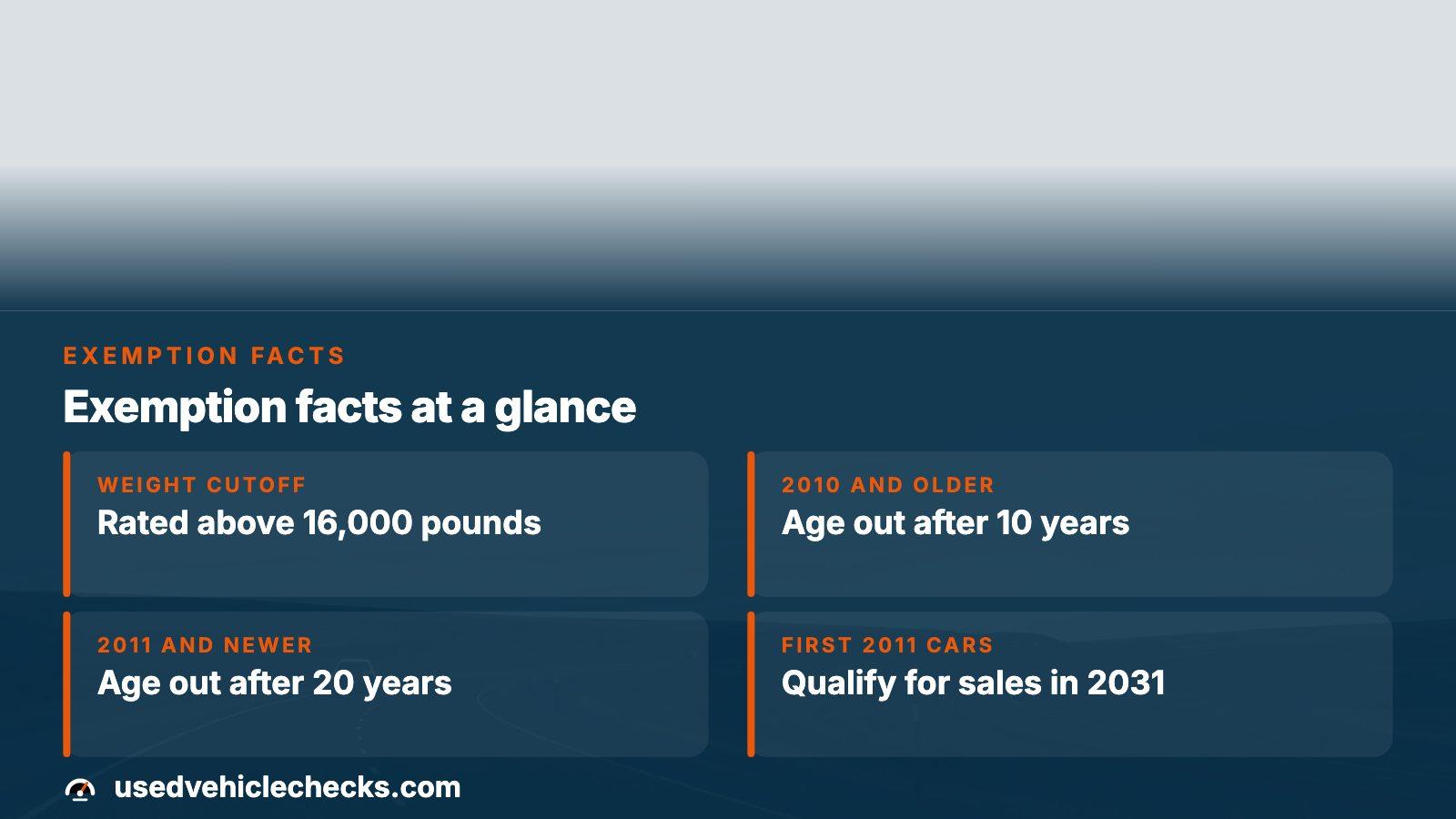
- Weight cutoff
- Rated above 16,000 pounds
- Model year 2010 and older
- Age out after 10 years
- Model year 2011 and newer
- Age out after 20 years
- First 2011 cars to qualify
- Sales in 2031
What an exemption actually removes
An exemption removes one thing: the seller's obligation to put a mileage figure in writing at sale. The odometer still turns and the dash still shows a number. Nothing in the federal text makes that number more or less honest on the day a car becomes old enough to qualify.
The source is the statute plus one regulation. The disclosure law covers every transfer unless the Secretary of Transportation carves out a class by regulation, and the carve-outs live in section 580.17 of Part 580. No loophole to hunt for here, just a short published list, which the next section lays out.
The classes on the federal list
Section 580.17 says the seller, or a lessee, need not state mileage for the vehicles below. Match your purchase against each row.
| Class | Exempt when |
|---|---|
| Heavy vehicle | Rated by its maker at more than 16,000 pounds gross |
| No engine of its own | Pulled or carried, such as a utility trailer |
| Model year 2010 or earlier | Sold in or after the tenth year, counting from the start of its model year |
| Model year 2011 or later | Sold in or after the twentieth year, counting from the start of its model year |
| Government purchase | Delivered by the maker directly to a federal agency under a contract |
A separate paragraph deals with brand-new vehicles. The first sale of a new vehicle to a retail buyer, as opposed to a sale for resale, needs no disclosure. A lessor also need not warn a lessee of the duty when the leased vehicle is exempt.
Working out the age rule for a specific car
Two windows apply, and the model year decides which. Cars from model year 2010 and back use a ten-year clock that begins on the first day of their model year. All of them cleared it long ago; the rule's own illustration uses 2020.
Newer cars wait far longer. From model year 2011 on, the clock runs twenty years, and the rule's illustration for sales in 2031 says model year 2011 and earlier will qualify that year. A sedan from the mid-2010s has no exemption to lean on, and a seller who claims one is mistaken.
- Read the model year off the title or registration.
- If it is 2010 or earlier, the age exemption applies now.
- If it is 2011 or later, add twenty to that year and you have the year the exemption begins.
- For anything heavy or unpowered, settle the weight rating or trailer status on its own.

What a state DMV tells its own customers
States issue the titles, so the working rule is what your DMV prints. Oregon gives a clear example. It says a vehicle from model year 2011 on, under 20 years old, needs a disclosure, then names the cases that do not: cars built without an odometer, model year 2010 and older, trailers and campers, anything rated above 16,000 pounds, Class I ATVs and snowmobiles.
Oregon adds one more line. If a title changes hands while at least one owner stays on it, no disclosure is needed, and the DMV declines to record a reading nobody had to give. Other states word this their own way, so open your DMV's page before assuming it matches.
When the title has no mileage to compare
Normally you hold the dash up against the figure on the title and look for a gap. With an exempt vehicle the gap test fails for want of a second number. A blank or old entry on the title proves nothing, and a seller can truthfully say they were never required to write one.
Do not read silence as a red flag or a clean bill
A missing mileage line on an exempt vehicle is ordinary. Treat it as a missing document, not as evidence in either direction, and go find readings recorded at earlier events instead.
Be wary of the opposite case too. If the seller offers a reading on a car that did not require one, ask where it came from. A written figure on an exempt car carries no federal disclosure weight, so it deserves the same skepticism as a number spoken aloud.
Where other mileage figures can come from
You want dated readings that the seller never controlled. The federal title-records system keeps the latest odometer figure it received, alongside title and brand data. It is patchy: states report unevenly, and its consumer page notes that some states excuse older vehicles from titling. Treat a gap as a limit of the data, not a verdict.
- Earlier titles and registrations, where a previous owner or state recorded a figure.
- Dated service invoices and oil-change stickers inside the door frame or on the windshield.
- Inspection or emissions paperwork the seller kept.
- Auction and insurance records tied to the VIN, which often carry a reading and a date.
- Wear on the pedals, seat, steering wheel and shifter, compared with the claimed distance.
Two dated readings give you a rate. If an old record shows a modest figure and the dash now shows less, the dash is the odd one out. If the dash has climbed at a believable pace since the last record, the story holds together.
Putting the VIN to work
With an old car and a blank mileage line, a VIN lookup is the cheapest route to readings from earlier events. Look through the glass at the driver's end of the dashboard, then at the registration and title. Copy the number from the car and from the paper, and confirm they match character for character.
Our preview shows what a VIN returns before you pay. The full report is one purchase and lists odometer readings by date, next to title brands and any salvage or auction record; the pricing page has the details. The FTC advises a mechanic's inspection on top of any history report.
Exempt from disclosing, not from lying
Federal law still punishes odometer fraud, and the penalties come from the statute, not the exemption rule. A person who acts knowingly and willfully faces a prison term of up to 3 years, a fine, or both, and a civil penalty of up to $10,000 can attach to each violation.
A private buyer who sues must show intent to defraud. A win pays three times the actual loss or $10,000, whichever is larger, with court costs and attorney's fees. The window to file is 2 years from when the claim arises. Whether a car was exempt would be argued case by case, so keep every message and receipt.
Where this information comes from
- GovInfo: 49 CFR Part 580, section 580.17 Exemptions — the list of exempt classes, the age windows and the rule's examples
- GovInfo: 49 U.S.C. 32705, odometer disclosure on transfer — shows that exemptions are granted by regulation under the statute
- Oregon DMV: Odometer Disclosure — one state's version of the same cases, with extra no-disclosure classes
- NMVTIS: Information for consumers — what the national title database holds and where state reporting differs
- GovInfo: 49 U.S.C. 32710, civil actions by private persons — private lawsuit terms: intent, damages and filing window
- FTC: Buying a Used Car From a Dealer — history report is not a replacement for a mechanic's inspection
Sources and photos: Facts checked against the sources above in November 2026. Photos by fr0ggy5, Owen Michael Grech and John Kakuk on Unsplash; diagrams by UsedVehicleChecks.
Keep reading
- Odometer Disclosure Statement: What the Seller Signs and What to CheckWhat the seller signs when the car is not exempt, line by line.
- Check Mileage Without an Odometer: What to Do When the Dash Is DeadWays to estimate distance when the dash gives you nothing to read.
- Mileage Check by VIN: What the Recorded Odometer Readings ShowHow a VIN lookup turns up dated readings from earlier owners.
- Odometer Rollback Check by VIN: Run the Mileage Test Before You PaySigns that a dash number was wound back, on any car.
Frequently asked questions
Is a 2010 car exempt from odometer disclosure?
Yes. Federal rules take model year 2010 and older vehicles out of the mileage statement once ten years have run from the start of that year, and the rule's own illustration says this has held since 2020. Your state's title form may still carry a mileage line.
When does a 2015 car become exempt?
Newer model years use a twenty-year window counted from the start of the model year, so a 2015 car qualifies in 2035. That year is simple arithmetic from the rule, not a figure printed in it. Until then the seller completes a normal mileage statement.
Can a seller write the mileage on an exempt car anyway?
Nothing in the federal rule forbids it, but some DMVs will not record a reading nobody was required to give. If you are shown a figure, ask what it was based on, and compare it with service records or a VIN-based history before relying on it.
Do trailers and campers need an odometer statement?
A vehicle with no engine of its own is exempt, so a utility trailer or towed camper needs none, and Oregon's DMV names trailers and campers. A motorhome moves under its own power, so it follows the age and weight rules instead.
Does an exempt car still show up in a history report?
It can. A report draws on title, auction, insurance and other records tied to the VIN, and any of them may carry an odometer reading with a date. Coverage depends on the states and sources involved, so a short list of readings on an old car is common.
Now check the car itself
The guide explains what to look for. The report shows what this VIN has on record.