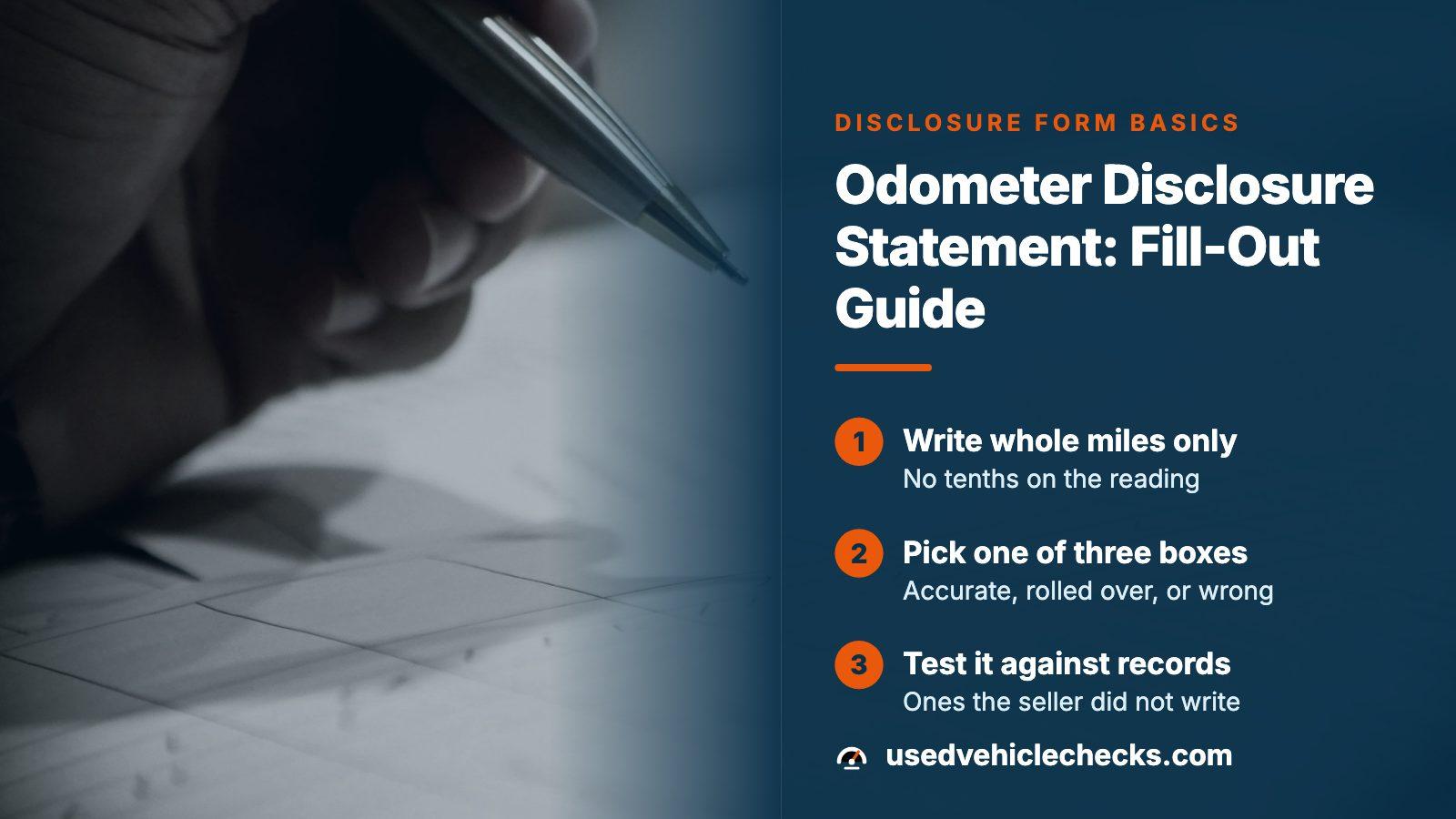
THE SHORT ANSWER
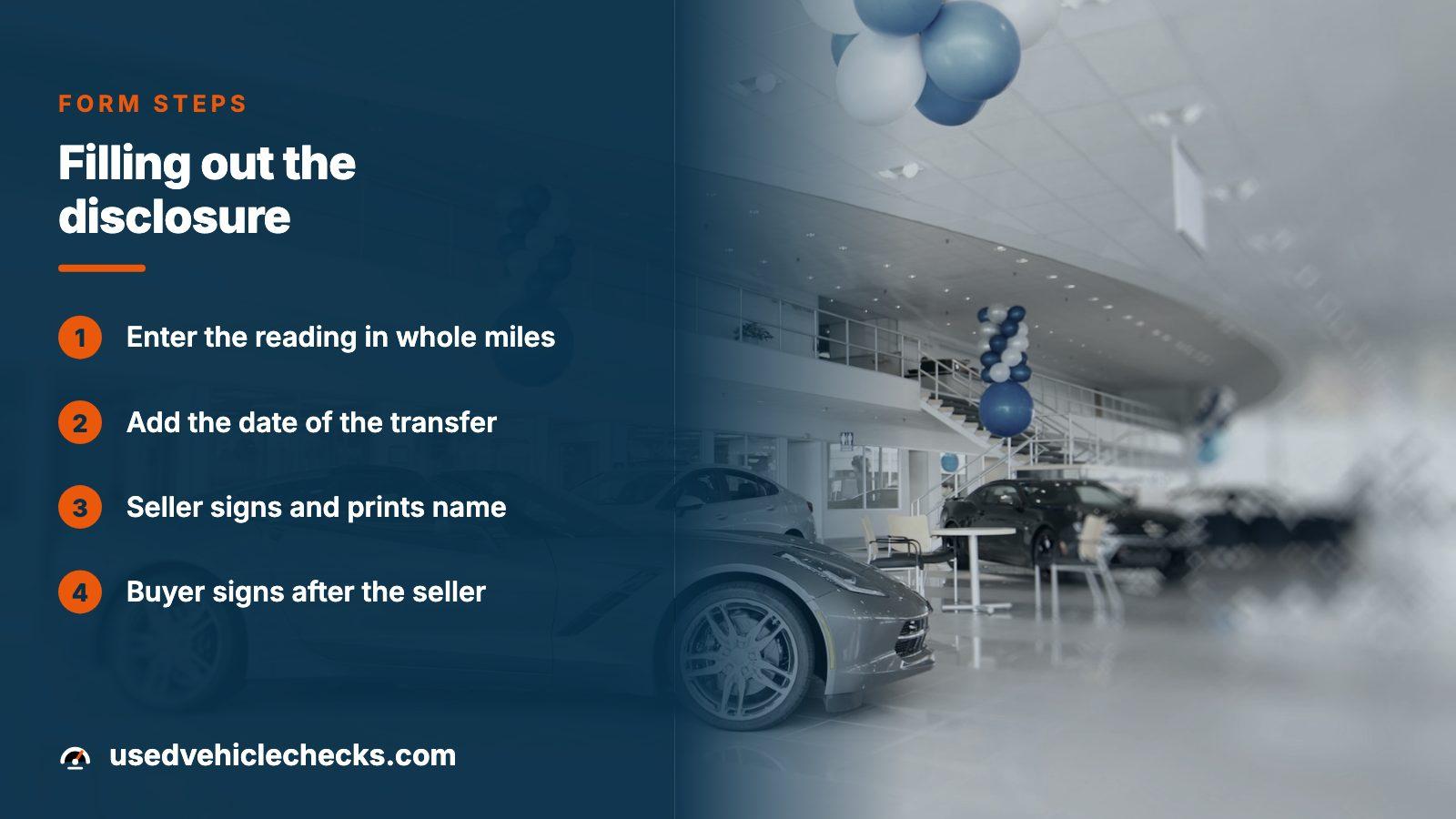
The seller enters the reading on the title, signs, prints a name and dates it, and the buyer signs after. The seller also picks one statement: the number is accurate as far as they know, the counter has rolled past its limit, or the number is wrong and unreliable. Old and heavy vehicles are exempt. Check the figure against a VIN-based mileage history before paying.
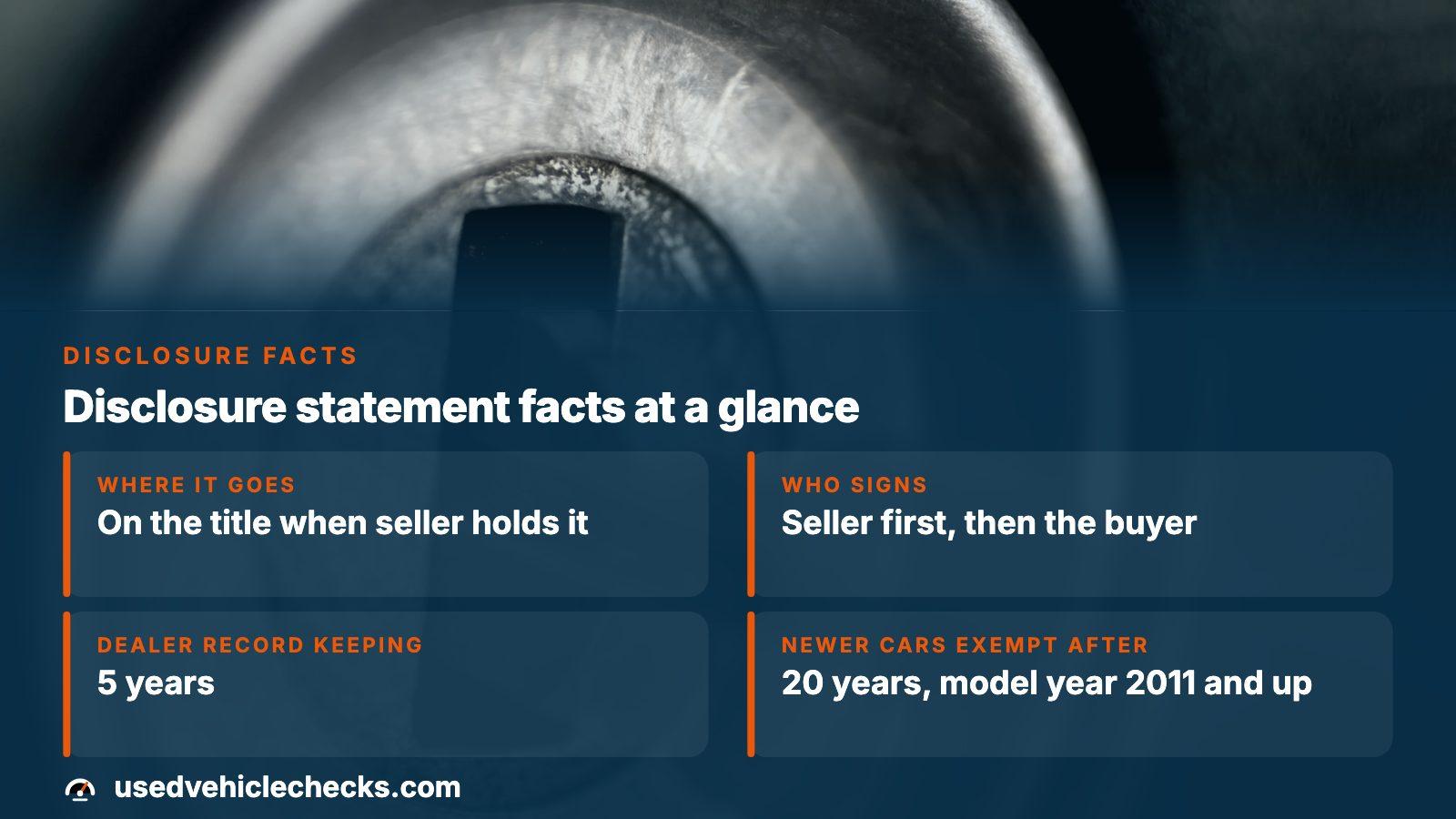
- Where it goes
- On the title, not a loose sheet, when the seller holds the title
- Who signs
- Seller first, then the buyer
- Dealer record keeping
- 5 years
- Newer cars exempt after
- 20 years (model year 2011 and up)
A mileage promise written at the moment of sale
Think of the statement as a sworn snapshot. When a car changes owners, the person handing it over must put a mileage figure in writing and stand behind it. The federal rule behind this, Part 580, says the aim is to give the next owner something to judge condition and value by, and to leave a paper trail investigators can follow if the number proves false.
That paper trail matters to you in one specific way. Every owner who sold the car signed a figure, so the title history is a chain of claims, each one dated. If one link in that chain reads lower than the link before it, somebody wrote something untrue, or the dash was tampered with between sales.
Every line the form has to carry
A disclosure missing a required item is incomplete, and a buyer who accepts one for resale is breaking the statute. Before signing, run down the form and confirm each of these is filled in.
- The reading at the time of sale, in whole miles with no tenths.
- The date of the transfer.
- The seller's signature, printed name and current address.
- Your printed name and current address.
- Which car it is: maker, model, year, body style and VIN.
- On paper forms, a notice citing federal law and warning that a blank or false entry can mean fines or prison.
With joint owners, one seller's signature is enough. A rule that is easy to miss: the same person cannot fill both the seller line and the buyer line, except in the power-of-attorney cases below.
The three boxes a seller can tick
Beyond the number, the seller certifies something about it. The rule offers three versions, and which one appears tells you a lot.
| Certification | What it means for you |
|---|---|
| Reading is accurate, as far as the seller knows | The normal case. Verify it anyway, because it only states what the seller believes. |
| Mileage is past the odometer's mechanical limit | The counter has rolled over. Common on older analog dashes, and it means the true figure is higher than displayed. |
| Reading is wrong and should not be trusted | The seller knows of a gap bigger than normal calibration error. A warning to the buyer must go with it. |
The third box is not a deal-breaker by itself, since a replaced instrument cluster can honestly produce it. It does mean the dash figure has no value as evidence, so the price has to rest on other proof.
On the title, and when a separate sheet is allowed
A seller whose name appears on the title must write the mileage right there, paper or electronic, and may not use a reassignment sheet for it. A separate document or electronic entry is for a car never titled. Texas shows the practice: its DMV tells sellers to hand over a signed title carrying the sale date and odometer reading, plus the signed Form 130-U showing the sales price.
Look at the title in good light before you hand over money. Overwriting, correction fluid, and numbers that crowd the box are all reasons to stop. The Justice Department's tips for used car buyers add two more: a seller who will not produce the title at all, and a title that was newly issued, especially from another state.
When the seller does not have the title in hand
A lender may hold the title on a financed car, or the seller may have lost it. Where state law permits, the seller can name the buyer as attorney-in-fact solely to record the mileage, on a form issued by the state where the sale happens. The same option covers an electronic title that a lienholder controls or that cannot be reached.
That is a legitimate workaround, but you end up holding a mileage entry you wrote on the seller's behalf. Lean harder on outside records, and confirm the payoff arrangement with the lender before paying.
Which vehicles never need one
The exemption list is short, and the age rules split into two tracks.
- Vehicles rated above 16,000 pounds, and anything not self-propelled.
- Model year 2010 and older, once ten years have passed since January 1 of the model year at the time of transfer.
- Model year 2011 and newer, once twenty years have passed on the same count. The rule's own example: in 2031, model year 2011 and older cars are exempt.
- Vehicles the maker sold directly to a federal agency, and a new car before its first sale for any reason besides resale.
A used pickup that is recent enough to fall outside both age rules still needs a written disclosure, even though many sellers assume otherwise. If a seller waves off the form on a car that fits no exemption, take that as information about the seller.
Who keeps the paperwork afterward
Once the seller signs, the buyer adds a signature and printed name, and the seller keeps a copy. Dealers and distributors hold on to the statements they issue and receive for 5 years, filed at their main office. A lessor does the same for a lessee's statement after the car is transferred, and states retain electronic-title disclosures at least that long. Keep your own photo of the signed title page as well.
Testing the written figure against records the seller did not write
A signature creates liability, not accuracy. A seller who rolled back a dash will happily sign it. NHTSA tells buyers to compare title mileage with the dash, look at service records and door-frame stickers, and get a history report through the VIN if the seller has none.
This is the natural moment for a VIN check. Enter the number in the box on this page; the preview is free, and the full report, one payment, lists dated odometer readings beside title brands, so each reading can be set against what each seller signed. A recorded reading above the figure on your title is the mismatch the form exists to prevent. NMVTIS notes that not every state reports, so a quiet report is not proof, and a mechanic's inspection still belongs in the plan.
Quick comparison to run
Write down the mileage on the title, the mileage on the dash, and the latest dated reading in the history. If the dated reading is higher than either of the other two, stop and ask the seller to explain before any money moves.
If the statement turns out to be false
Knowing, willful violations can end in a fine, a prison term of up to 3 years, or both, and civil penalties reach $10,000 per violation. A buyer suing privately must prove intent to defraud, and can then collect triple the real loss or $10,000, whichever is higher, with costs and attorney's fees covered on a win. The deadline is 2 years from when the claim accrues.
Your signed copy and the dated history are what a lawyer will ask for first. NHTSA's odometer office says it does not pursue claims for individual consumers and recommends a private attorney.
Where this information comes from
- eCFR text via GovInfo: 49 CFR Part 580 — Required contents, the three certifications, power of attorney, record keeping and exemptions.
- U.S. Code, 49 U.S.C. 32705: disclosure on transfer — The statute behind the written mileage duty and the ban on false statements.
- U.S. Code, 49 U.S.C. 32710: civil actions by private persons — Damages, intent requirement, fee award and the filing window.
- NHTSA: odometer fraud — Buyer tips and what the agency does and does not handle.
- Texas DMV: buying or selling a vehicle — One state's instructions to sellers about the signed title and Form 130-U.
- NMVTIS: information for consumers — What the federal title database reports and where it falls short.
Sources and photos: Facts checked against the sources above in November 2026. Photos by Masjid MABA, Richard R and Derek Nelson on Unsplash; diagrams by UsedVehicleChecks.
Keep reading
- Odometer Exempt Vehicles: Which Cars Need No Mileage StatementA longer look at which cars a seller can legally skip the form for.
- Odometer Discrepancy Check: Find a Mileage Mismatch Before You PayWhat to do once the written figure and the records disagree.
- Mileage Check by VIN: What the Recorded Odometer Readings ShowRun the dated mileage lookup that tests what the seller signed.
- Can You Sue for Odometer Fraud? What Federal Law Gives a BuyerHow the civil claim works when the statement was false.
Frequently asked questions
Do I need an odometer disclosure statement for a private sale?
Yes, if the vehicle is not exempt. The duty covers any transfer of ownership, whether sale or gift, not only dealer deals. The seller enters the figure on the title and signs, then the buyer signs too. Check the exemption list for very old or very heavy vehicles first.
What if the odometer is broken or was replaced?
The seller should not certify the reading as accurate. The rule provides a statement that the reading does not reflect true mileage and should not be relied on, with a warning to the buyer. A replaced cluster can honestly cause this, so ask for the repair invoice and look for dated readings elsewhere.
Can a buyer sign the statement for the seller?
Only through the power-of-attorney route, and only where state law allows it: a lienholder has the title, the title is lost, or an electronic title cannot be reached. The form must come from the state where the sale takes place. Otherwise one person cannot act as both parties.
How long do dealers keep these statements?
Dealers and distributors keep each statement they issue or receive for 5 years, filed at their main business location so it can be pulled quickly. Lessors follow the same period after transferring a leased car. States hold electronic-title disclosures for at least that long.
Does a signed statement prove the mileage is real?
No. It proves what the seller claimed and creates legal exposure if the claim was knowingly false. Verify it with the dash, service records, a mechanic and a VIN-based history showing dated readings before you pay.
Now check the car itself
The guide explains what to look for. The report shows what this VIN has on record.