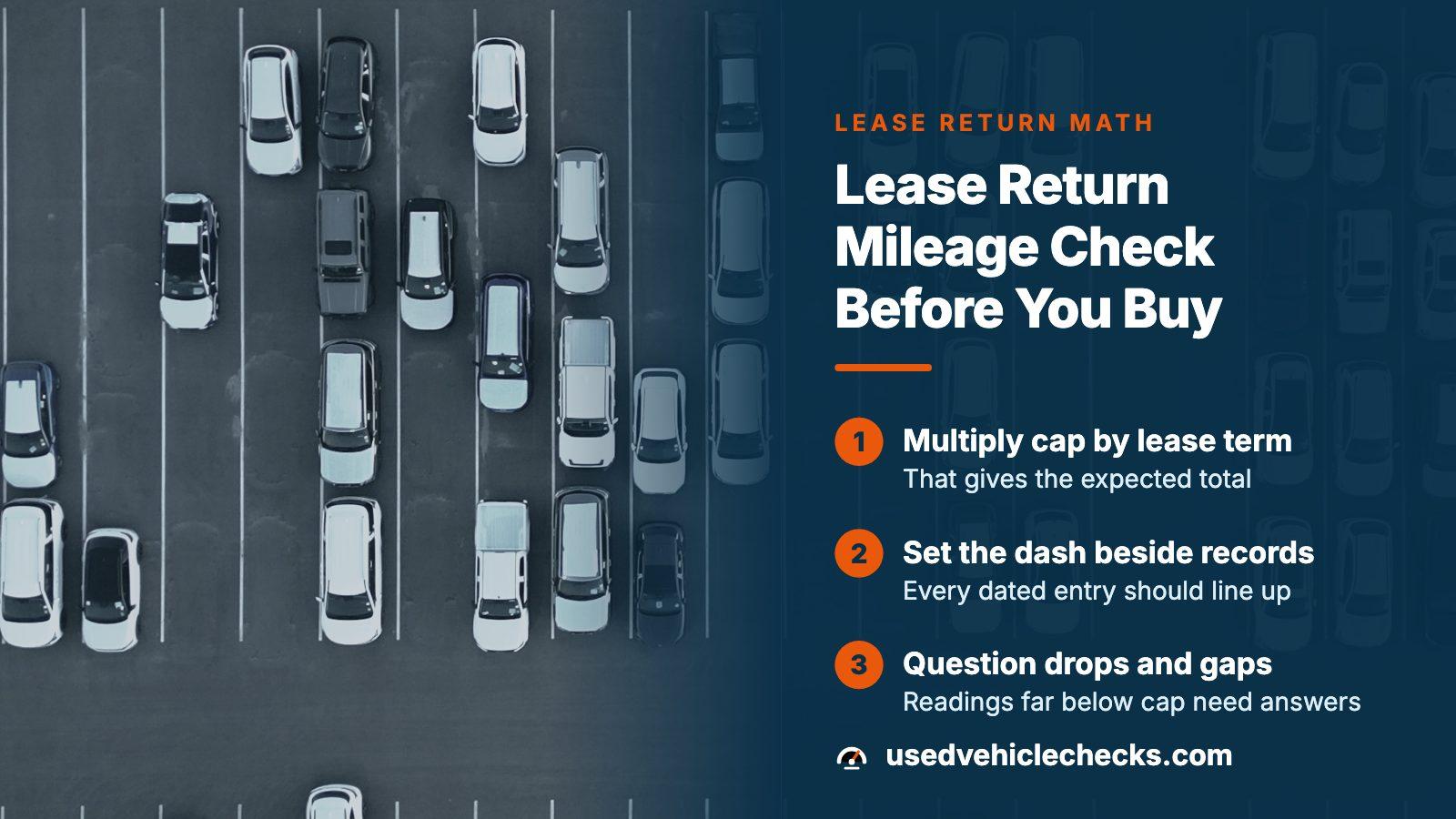
THE SHORT ANSWER
Work out the miles the lease allowed: yearly cap times years of term. Contracts commonly allow 10,000 to 15,000 miles annually, which puts a three-year car near a predictable total. Then run the VIN and set the dash beside every dated entry. A number far below the cap, a drop between readings, or a gap of several years deserves questions.
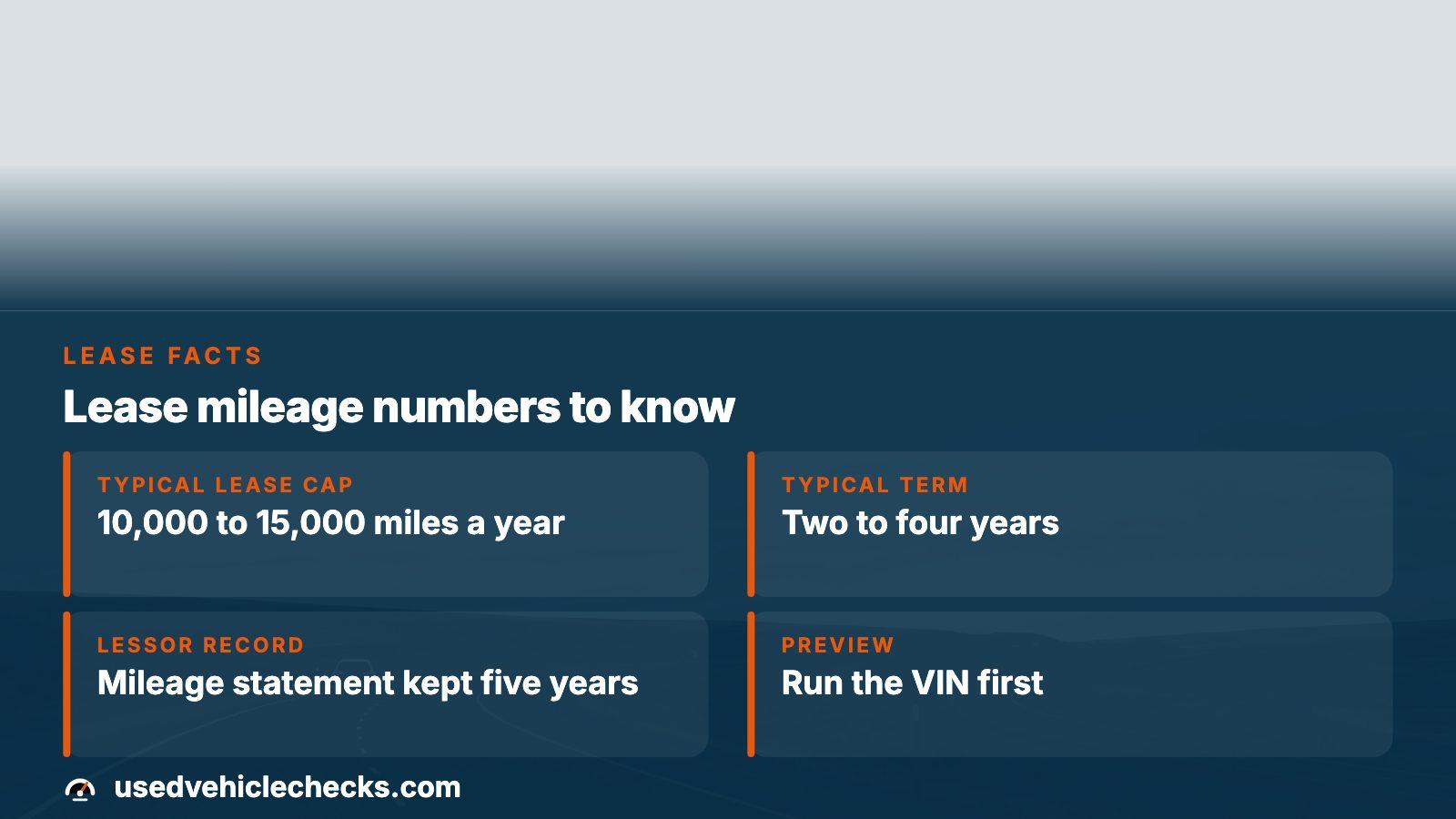
- Typical lease cap
- 10,000 to 15,000 miles a year
- Typical term
- Two to four years
- Lessor record
- Mileage statement kept five years after transfer
- Free preview
- Run the VIN first, buy the report only if it looks right
Why lease miles are easier to test than most
A leased car comes with a built-in yardstick. The lessor priced the contract around an expected distance, and the Federal Reserve explains that the cap exists because the car's value at the end is built on that expected mileage. Drive further and the car is worth less, which is why the lessor charges for the extra.
For a buyer, that yardstick works in two directions. A car that went back with far more than the allowed miles tells you it was driven hard. A car that shows far fewer than the cap allowed, or fewer than the lease term implies, is the one to look at twice, because low numbers are exactly what a tampered cluster tends to show.
Work out the expected total before you inspect the car
Ask the seller for the original lease term and cap, or work from the model year and what the dealer says. Multiply the yearly figure by the years the car was on the road. The Federal Reserve notes that contracts often assume 12,000 or 15,000 a year; the CFPB gives a range of 10,000 up to 15,000 and terms of two to four years.
| Yearly cap | Two-year term | Three-year term | Four-year term |
|---|---|---|---|
| 10,000 | 20,000 | 30,000 | 40,000 |
| 12,000 | 24,000 | 36,000 | 48,000 |
| 15,000 | 30,000 | 45,000 | 60,000 |
Real drivers rarely land on the cap. Some stay well under it, some pay overage. The table is a frame of reference, not a verdict: a reading within a few thousand miles of the frame needs no explanation, while one at a third of it does.
Which extra evidence a VIN lookup supplies
The dash shows one number today. A VIN check shows the readings that were written down along the way, each tied to a date: registrations, title transfers, inspections and similar events. Plot them and a lease car should climb at a fairly steady pace from delivery to turn-in.
- The latest reported reading, to compare with the cluster in front of you.
- Earlier readings with dates, so you can see the pace per year.
- Title brands, because a lease car that was totaled and rebuilt is a different purchase.
- Insurer salvage or total-loss determinations tied to the VIN.
The federal NMVTIS consumer page lists the latest odometer reading and brand history among its data, and it warns that coverage depends on what states and others report, so sparse entries mean you should request paper from the seller. They do not prove fraud.
Reading the pattern: three outcomes
- Steady climb, last reading close to the dash: the usual story. Move on to the condition check.
- A reading that goes down, or a flat stretch followed by a large jump: pause the purchase and get the seller's explanation on paper.
- No readings for years, then a low one: a gap is not an accusation, yet it removes the evidence you were counting on, so rely more heavily on invoices and a mechanic's look.
One more pattern is specific to leases. A lessee who is about to exceed the cap has a reason to want the number to stay low, and a lessor or dealer reselling the car has the opposite reason to present it as low-mileage. Neither motive proves anything. Both are the reason to test the figure instead of accepting it.
The paper trail a lease return should have
Federal odometer rules cover leases directly. When a leased car is about to change hands, the lessor must warn the lessee in writing that a mileage statement is due, and and the lessee signs a statement giving the figure on the dash that day. The lessor keeps that statement for five years after it passes the car on.
So a lease return should be able to produce a signed mileage figure at the moment it left the lessee. Ask the dealer for it, along with the title and the service file. Written statements also carry weight later: federal law lets a buyer who shows intent to defraud collect triple the actual loss or 10,000 dollars, whichever is larger, provided the suit starts within two years.
Ask for these three documents
The mileage statement from the turn-in, the title showing the lessor's release, and the dated service invoices. A seller who cannot produce any of them has told you something.
What the check cannot tell you
None of the official pages we opened says a vehicle report tags a car as a one-time lease, so do not expect a neat banner. The lease shows up through the seller, the paperwork and the pattern of the readings. Reports also miss anything a state never sent in, and a recall search from NHTSA lists unrepaired recalls only.
The FTC states that a mechanic's own inspection is a separate step that no report replaces. Pedal covers, seat bolsters and the driver's door seal wear with real use, and an independent mechanic can compare that wear with the displayed miles in about an hour.
Five moves for the lookup
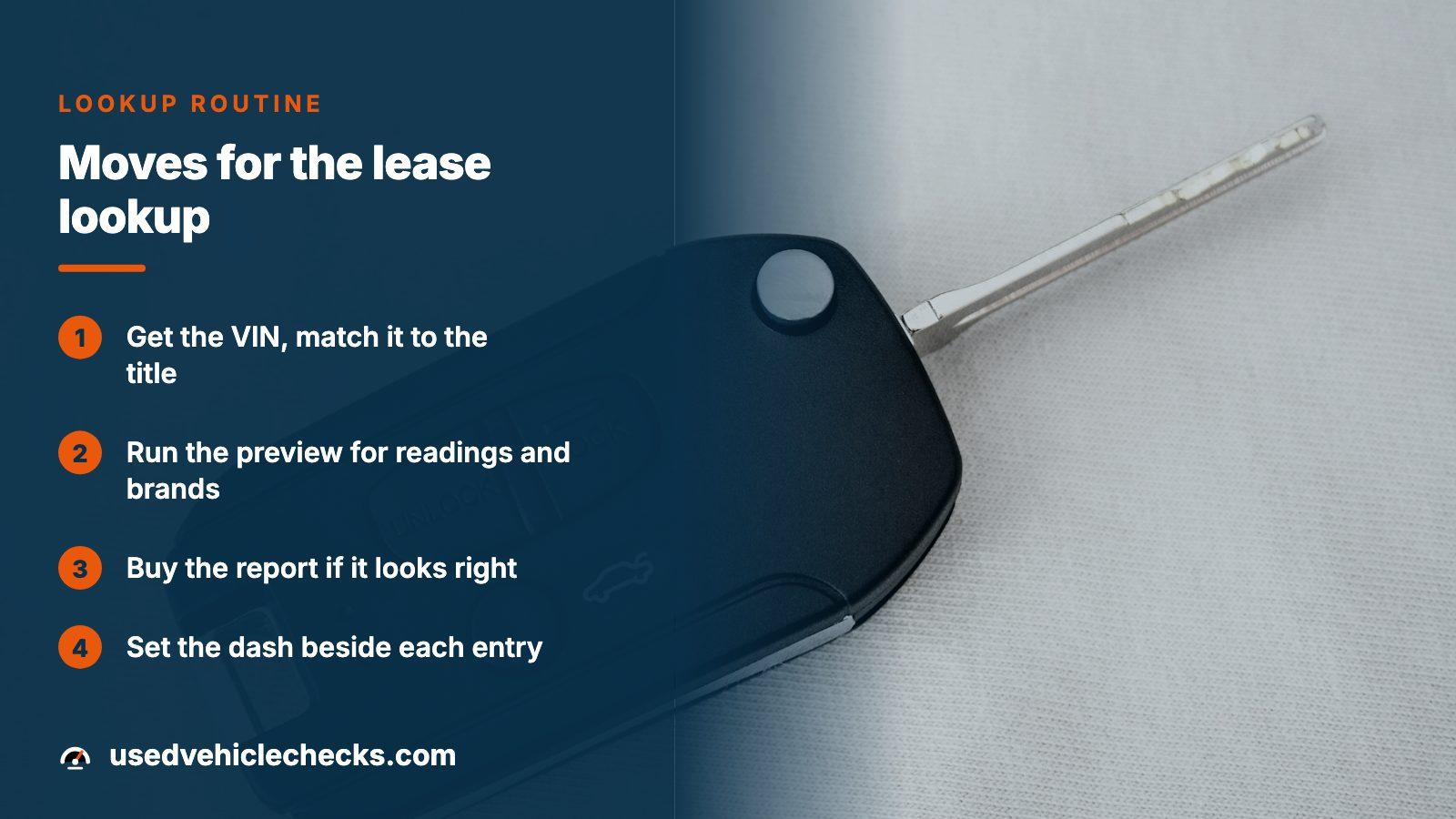
- Get the VIN from the registration or by peering through the glass at the driver's corner, and make sure the title shows identical characters.
- Enter it for the free preview to see whether readings and brands exist.
- If the preview looks promising, order the report, or a larger bundle if you are weighing multiple candidates. Billing is a single charge, never a renewal, and the amounts are on the pricing page.
- Set the dated readings against the lease arithmetic and the dash.
- Take any mismatch to the seller before you sign, and keep the answer in writing.
NICB VINCheck is a free extra for theft and salvage or flood reports from member insurers, limited to five searches a day per address. It does not carry odometer history, so it complements the report rather than replacing it.
Signs the deal should end
- The dash is far below the latest dated reading on record.
- The seller refuses to produce the title or the turn-in mileage statement.
- The title was just issued, above all from another state, with no clear history.
- The cluster was replaced and nobody can show the reading before the swap.
- The price assumes low miles that no document supports.
A good lease return is a fair buy: usually one owner, serviced on a schedule, with a known start and end. The same predictability is what makes a mismatch stand out. If the numbers disagree and the explanation is vague, the next car on your list costs you nothing.
Where this information comes from
- Federal Reserve: Vehicle Leasing FAQ — why leases carry caps and how typical limits are set
- Federal Reserve: Returning a leased vehicle — excess mileage and wear charges at return
- CFPB: Leasing versus buying a car — common mileage ranges and lease terms
- GovInfo: 49 CFR Part 580 — lessor and lessee mileage statements and record keeping
- NMVTIS consumer access page — the federal title database, its contents and its blind spots
- NICB VINCheck tool — no-cost theft and salvage lookup, with its caps
Sources and photos: Facts checked against the sources above in November 2026. Photos by Iain, Shadow Photography and John Kakuk on Unsplash; diagrams by UsedVehicleChecks.
Keep reading
- Mileage Check by VIN: What the Recorded Odometer Readings Showthe general method for pulling mileage records from a VIN
- Odometer Rollback Check by VIN: Run the Mileage Test Before You Paysigns that a reading has been wound back
- Buying a Used Rental Car: Mileage, Records and the Recall Ruleanother fleet-origin car with its own checks
- Odometer Disclosure Statement: What the Seller Signs and What to Checkwhat the written mileage statement must say
Frequently asked questions
How many miles should a lease return have?
Multiply the yearly cap by the term. Where contracts run 10,000 to 15,000 annually for two to four years, a three-year car often lands at 30,000 to 45,000. Individual drivers vary, so treat the figure as a frame and compare it with dated readings.
Can a lease return have low miles for its age?
Yes. Some lessees drive less than the cap allows, and unused miles are not refunded unless the lease says so. Low is only suspicious when the dated readings or service records do not support it, or when the numbers fall between two readings.
Does the report say a car was once leased?
We found no official page stating that reports tag earlier leases. Use the seller's paperwork and the pattern of readings to confirm it. The report is still worth running for odometer entries, brands and salvage records.
Who is liable if the lease return odometer was altered?
Federal law makes false mileage statements an offense, and a buyer able to prove intent to defraud may collect triple the actual loss or 10,000 dollars, whichever is larger. The clock is two years, so act once you spot a mismatch.
Should I still get an inspection on a lease return?
Yes. Paper cannot replace a mechanic's look. Pedal rubber, seat bolsters and the wheel rim should match the displayed miles, and the mechanic can also catch damage the lessee left behind and the lessor never fixed.
Now check the car itself
The guide explains what to look for. The report shows what this VIN has on record.