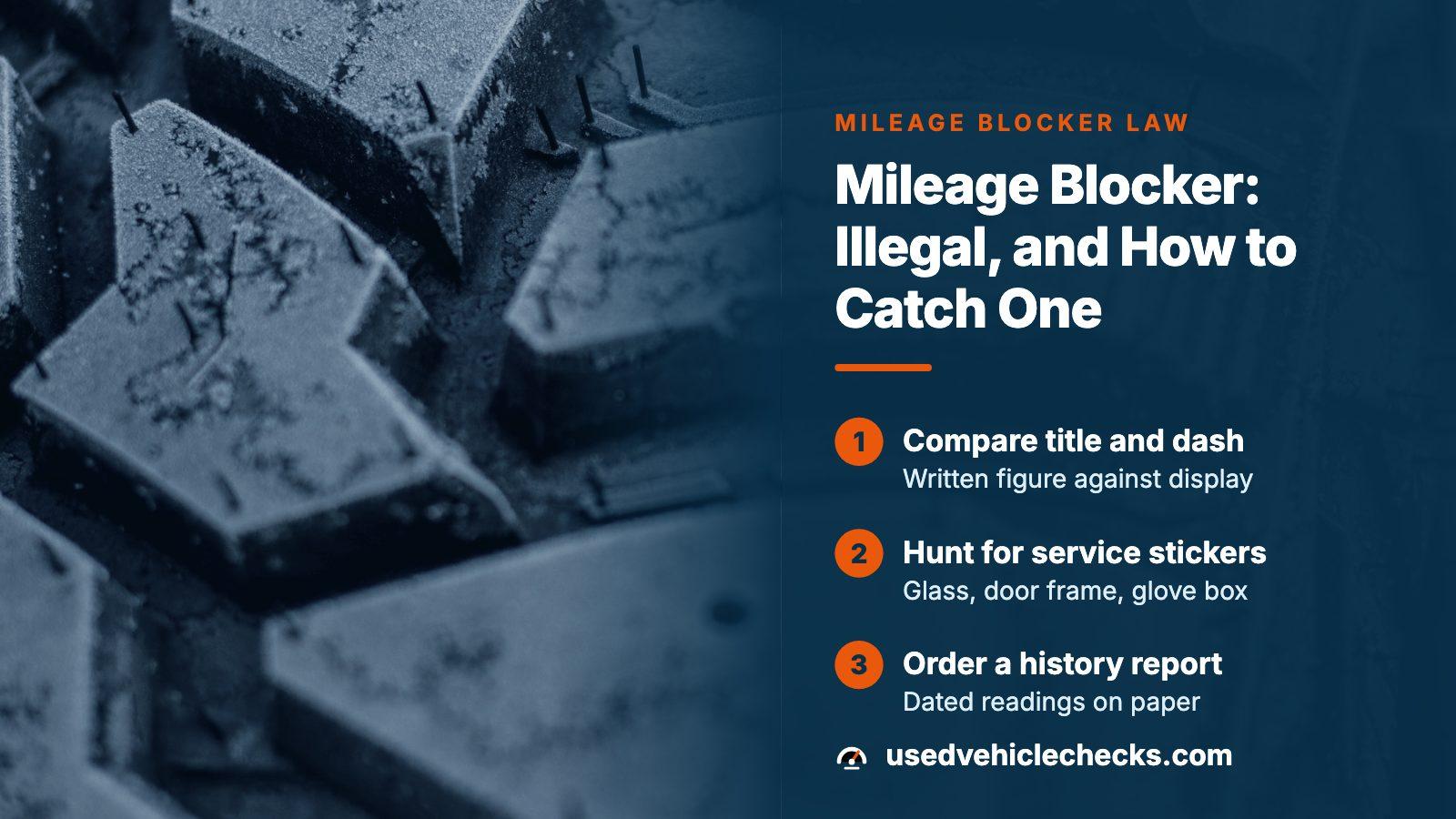
THE SHORT ANSWER
Federal law forbids advertising, selling, installing or using a device that makes an odometer show a different mileage than the car was driven. Penalties run to fines, a prison term of as much as three years, and private lawsuits. A buyer cannot trust the dash alone, so compare it with the title, service records and the odometer readings stored under the VIN.
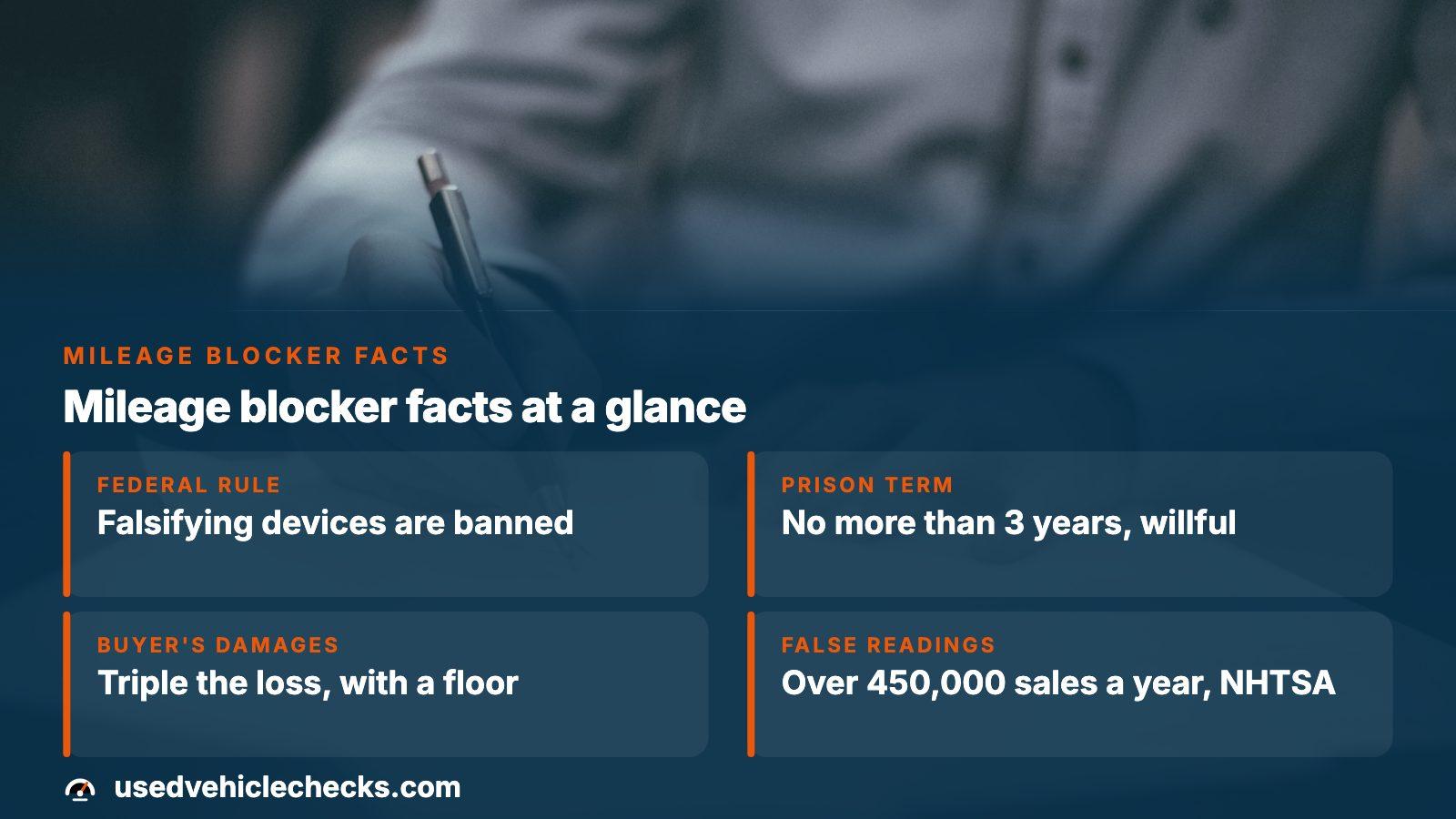
- Federal rule
- Devices that falsify odometer readings are banned
- Prison term
- No more than 3 years for willful violations
- Buyer's damages
- Triple the actual loss, or $10,000 if higher
- False readings
- NHTSA estimates more than 450,000 sales a year
What people mean by a mileage blocker
The phrase shows up in searches from two kinds of people. Some are owners who hope to keep a car's displayed miles low, perhaps to protect a lease allowance or a resale number. Others are buyers who heard a seller say the car has one fitted and want to know what that implies. The answer is the same for both: the idea is to make the dash say something other than what the car did.
No government page uses the term, and none describes how these gadgets are built, so this guide does not either. What matters to a buyer is the legal category they fall into and the trail they leave outside the instrument cluster. A frozen display changes only one record, the one the seller controls.
What federal law says about devices
The odometer chapter of federal transportation law, section 32703, names four prohibited acts. The first fits a blocker closely. Nobody may advertise, sell, use or install a gadget, or pay someone to put one in, if it causes the odometer to register something other than the miles the car covered, measured against the tolerance the odometer maker designed it to.
- Disconnecting, resetting or altering an odometer, or arranging for someone else to, with the aim of changing what it registers.
- Operating a car on a public road, intending to defraud, when you know its odometer is unplugged or dead.
- Conspiring to break this section or the neighboring rules on disclosure and transfer paperwork.
The first ban reaches the seller, the installer and the buyer who orders the work. Anyone who simply drives with the gadget fitted is covered by the word use. The statute carves out nothing for a unit that is switched off for a while.
Penalties for the seller, installer or owner
| Route | What the statute provides |
|---|---|
| Government civil penalty | As much as $10,000 for each violation, counting every vehicle or device separately; a linked series tops out at $1,000,000 |
| Criminal case | A fine, a prison term of no more than 3 years, or both, when the violation is knowing and willful |
| Company officers | Directors and officers who order or carry out the act are exposed to the same punishment |
| Buyer's lawsuit | Triple the buyer's actual loss, or $10,000 if that is larger, and the court adds costs and attorney fees for a winning buyer |
A buyer suing must show intent to defraud, and the claim has to be filed within 2 years of arising. NHTSA adds that it has no authority to chase claims for individual consumers and recommends a private attorney for questions about legal rights.
Why a frozen dash still leaves evidence
A device can hold a display still, but it cannot reach into the paperwork the car generated before. Every title transfer, state inspection, emissions test, dealer service visit and insurance event can record a reading with a date. When those dated numbers stop rising, or jump past what the dash shows, the gap is the tell.
From an NHTSA owner complaint
An owner who filed with NHTSA in October 2026 said a private seller's 2013 Honda Accord showed 120,000 miles at purchase. After the sale, a Carfax report put the mileage at 209,000. The complaint says nothing about how the dash was affected, so treat it as a picture of the problem, not proof of any device.
The lesson for a buyer is simple: the dash was the only source that agreed with the seller. Pull the VIN-based record before money moves, not after the registration office raises a question.
Checks you can make in the driveway
NHTSA says altering an odometer is hard to detect, but not impossible, and lists several practical comparisons. They work on any kind of tampering, so they work on a blocker too.
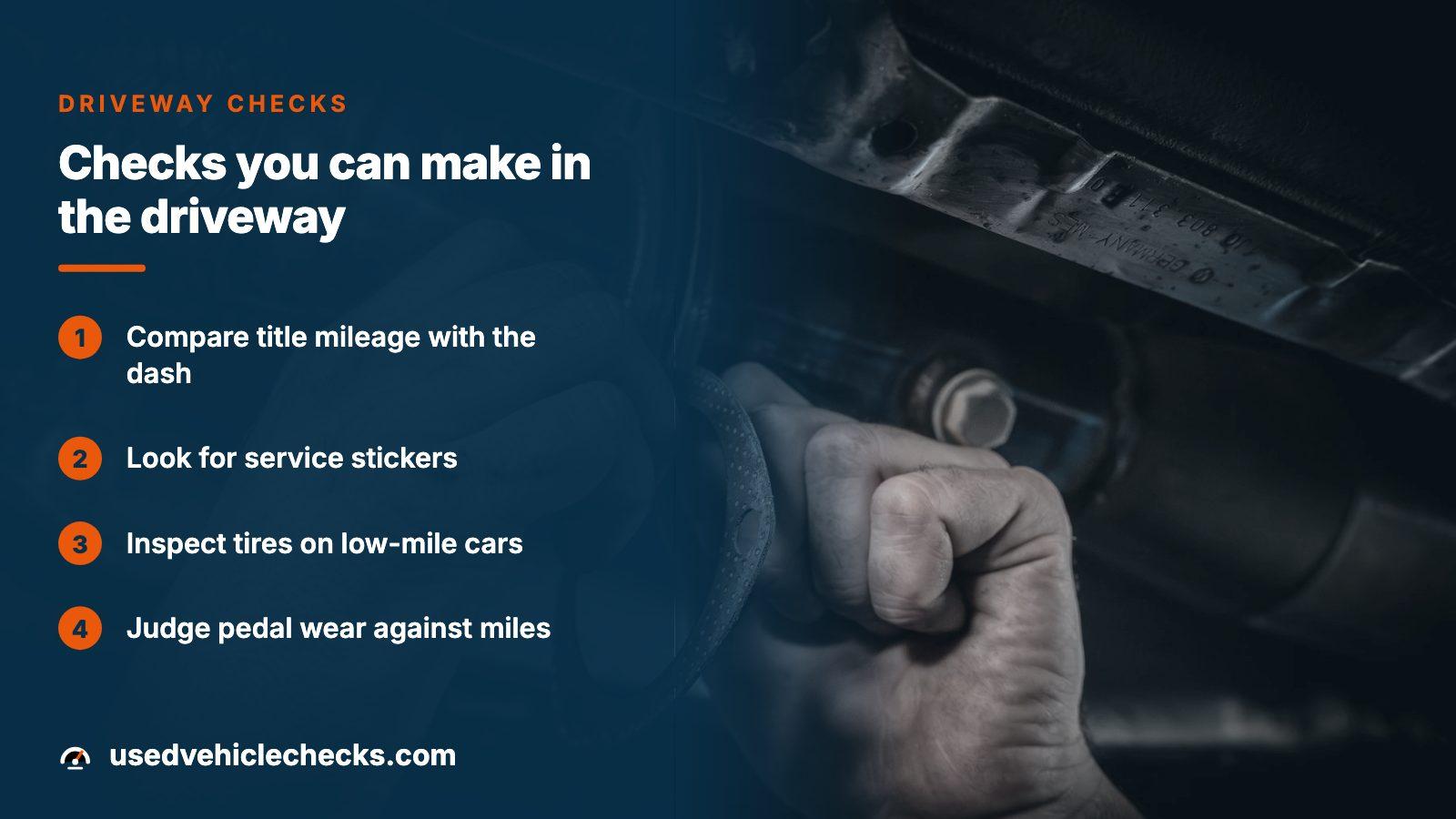
- Read the mileage written on the title and compare it with the dash.
- Look for oil change and maintenance stickers on the windshield, door frame, glove box or under the hood.
- Inspect the tires: a car showing 20,000 miles or fewer should still be on its original set.
- Judge the wear on the gas, brake and clutch pedals against the miles displayed.
- Ask for a vehicle history report, and order one by VIN if the seller has none.
Add one more of your own: a car whose cluster, wiring or fuse area looks recently opened, with loose connectors or mismatched fasteners, deserves a mechanic's look before you go further.
A dead or jumping odometer is a warning too
The same statute also targets intent to defraud while operating a car you know has a disconnected or dead odometer, so a seller who shrugs off a stalled reading is making a statement of his own. Ask when it stopped and what was done about it.
From an NHTSA owner complaint
A buyer's complaint says a used 2013 Accord was advertised and displayed at 156,000 miles, then the odometer went dead on the test drive. According to the owner, the dealer's service department reset it before the sale. After a battery replacement the dash read 453,000, and the owner noticed the ad had been changed.
Take from this that a reading which behaves oddly during a showing is a reason to stop and verify, not to accept a quick reset as a fix.
Running the VIN check before you pay
The strongest answer to a blocker is a record the seller cannot reach. A VIN report on this site lists odometer readings with dates, so you can see whether the numbers climb at a believable pace and whether the latest one is far from the dash. Start with the free preview, then buy the full report if the car is still on your list.
Read the dated readings in order. A long flat stretch followed by a jump is worth a question to the seller. Pair the odometer history with title and accident entries, because a car that was rebuilt or salvaged may also have had its cluster swapped. Details on the price are on the pricing page, and a report is one payment, not a subscription.
If you already bought a car with a falsified reading
- Keep the ad, the bill of sale, the title and every service record that shows a mileage.
- Order a history report so the dated readings are on paper.
- Contact your state's odometer enforcement agency, since NHTSA sends individual cases there.
- Phone NHTSA's Vehicle Safety Hotline, 888-327-4236, only for large-scale schemes.
- Talk to a private attorney about a claim, and mind the 2 year filing window.
Do not sell the car on to recover your money. Passing along a reading you now know is wrong puts you on the wrong side of the same law.
Where this information comes from
- NHTSA: Odometer Fraud — detection tips, exemptions, estimate of false readings and where to report
- 49 U.S.C. 32703, preventing tampering — the ban on devices, disconnecting and altering
- 49 U.S.C. 32709, penalties and enforcement — civil and criminal penalties
- 49 U.S.C. 32710, civil actions by private persons — buyer damages and the filing window
- NHTSA owner complaint 11771405 — owner experience, paraphrased
- NHTSA owner complaint 11681950 — owner experience, paraphrased
Sources and photos: Facts checked against the sources above in November 2026. Photos by Joan, Martin Fennema and Scott Graham on Unsplash; diagrams by UsedVehicleChecks.
Keep reading
- Odometer Rollback Check by VIN: Run the Mileage Test Before You PayHow to test a car for a turned-back reading step by step.
- Can Digital Odometers Be Rolled Back? Yes, and How to Catch ItWhy altered digital displays leave no visible marks.
- Odometer Discrepancy Check: Find a Mileage Mismatch Before You PayWhat to do when the dash and the records disagree.
- How to Report Odometer Fraud: Evidence, Agencies and DeadlinesWhere to send a complaint if you were sold a falsified reading.
Frequently asked questions
Is a mileage blocker legal?
Federal law prohibits advertising, selling, using or installing a device that makes an odometer show a mileage different from the miles driven, and the statute reads no exception for personal use. Ask a lawyer before touching a cluster. Penalties can include prison time.
Can a mileage blocker be detected?
Not always by looking at the dash. NHTSA calls tampering hard but not impossible to detect. Compare the title, service stickers, tire age, pedal wear and dated readings recorded under the VIN. When the outside records disagree with the display, that gap is what you act on.
Does a history report show a blocked odometer?
A report shows the readings that were recorded at past events, with dates. It cannot see inside the car, but a display that stalled while the records kept climbing shows up as a mismatch. No report is a guarantee, so pair it with an inspection.
Who do I report a suspected device to?
NHTSA says individual cases belong with your state's odometer enforcement agency. Its Vehicle Safety Hotline, 888-327-4236, takes reports of large schemes. Because NHTSA does not pursue claims on a single buyer's behalf, consider speaking to a private attorney too.
Do older cars need a mileage disclosure?
NHTSA says written disclosure on the title is required at transfer, but vehicles 20 years old or older, and model year 2010 or older, are exempt. An exempt car can still be misrepresented, so the dated readings and a physical inspection matter even more.
Now check the car itself
The guide explains what to look for. The report shows what this VIN has on record.