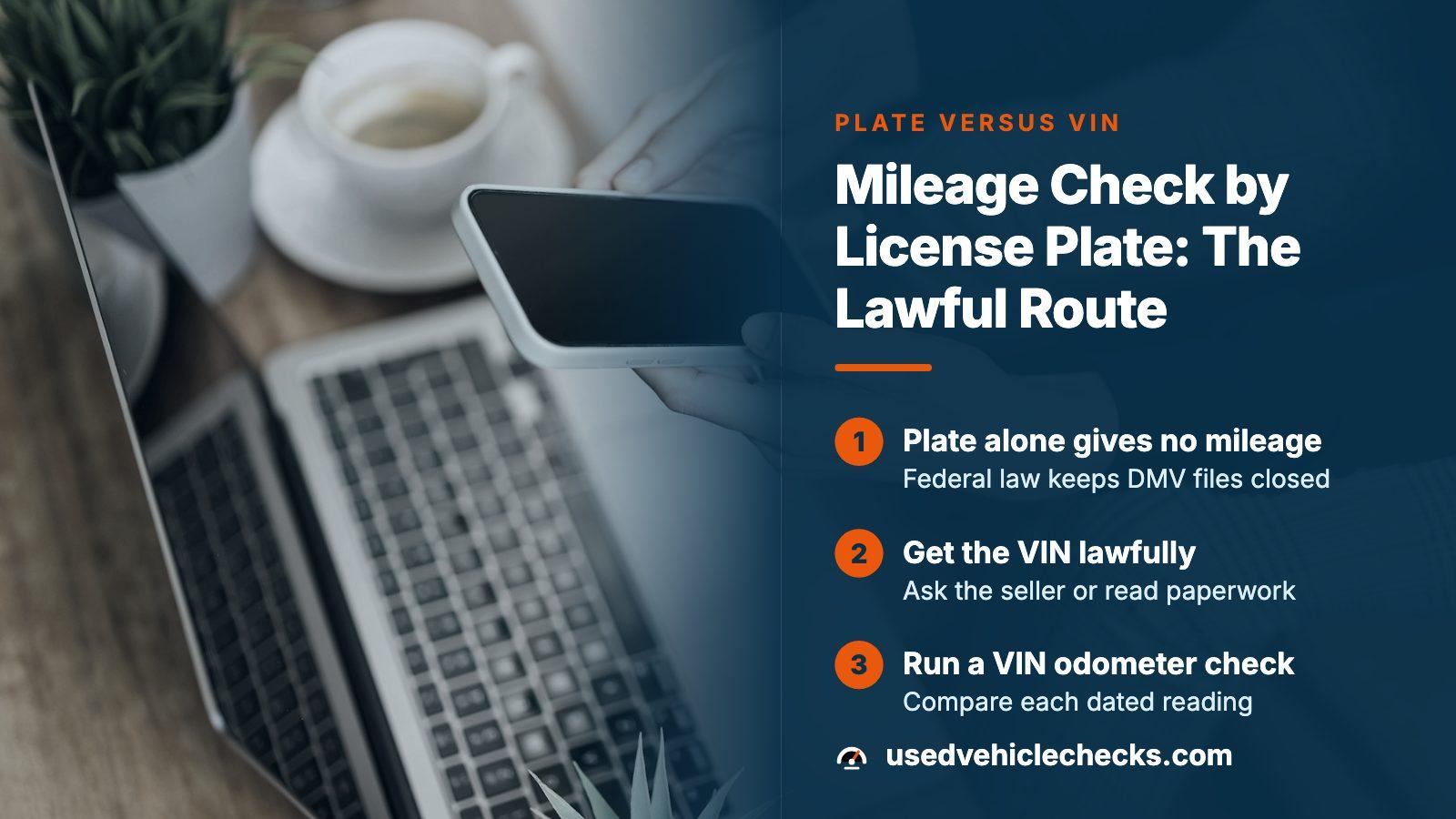
THE SHORT ANSWER
A plate number alone does not give a buyer mileage records, and federal law keeps most of a state DMV's file closed to ordinary requesters. Get the VIN from whoever is selling, or copy it off the car's paperwork. Then run a VIN-based odometer check and compare each dated reading with the dash and the listing.
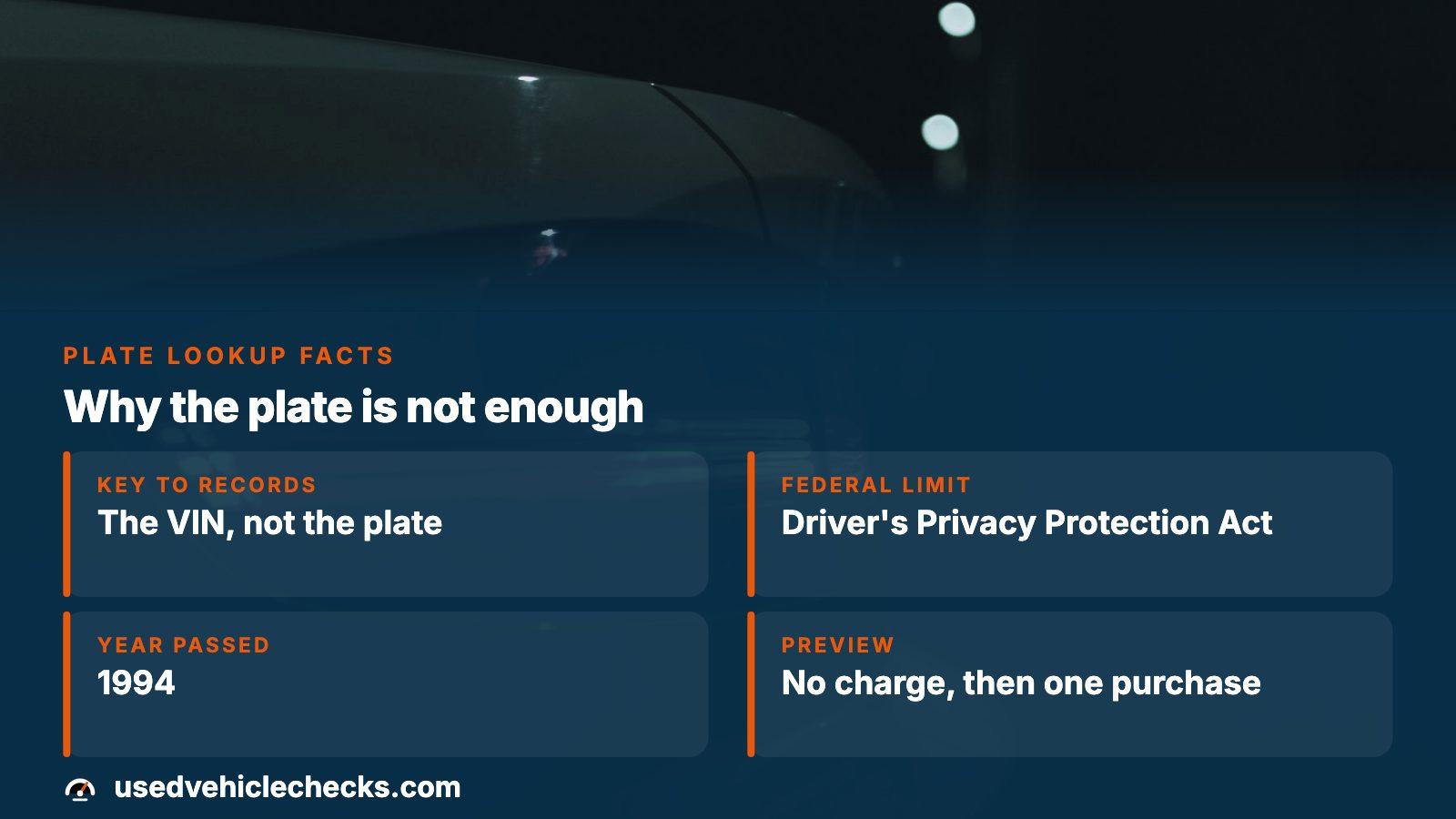
- Key to the records
- The VIN, not the plate
- Federal limit
- Driver's Privacy Protection Act of 1994
- Free step
- Preview at no charge, full report as a single purchase
Why a plate is the wrong key for mileage
Standing at a curb, the plate is all you can read, so that is what gets typed into search boxes. But it is tied to a registration, and registrations travel: owners transfer tags, swap them, surrender them or get new ones. The odometer readings that matter were recorded against the vehicle itself, on titles, inspections and service visits, and those entries hang off the VIN.
So the useful question changes. Instead of asking what the plate can tell you, ask how to get the 17-character number that stays with the car for life. Once you have it, the mileage check is quick. Getting it the right way is the part that deserves attention, and it is also where many buyers drift toward services that promise more than the law lets anyone deliver.
What federal law lets a DMV release
Congress passed the Driver's Privacy Protection Act in 1994, and its text sits in 18 U.S.C. chapter 123. It forbids a state DMV to knowingly hand over personal details held in its records, apart from a short list of purposes. Looking at a used car for sale does not qualify.
- Agencies, courts and police doing their jobs.
- Recalls, theft, emissions and safety programs.
- Insurance companies on a claim, fraud case or underwriting file.
- Lawsuits and hearings, and letters to owners whose cars were towed or impounded.
- A licensed investigator working toward one of those same aims.
- A requester with the record holder's own written permission.
Penalties cut both ways
The same chapter makes it unlawful to obtain such data for an unpermitted use or by false representation. A person whose information is misused can sue in federal court, with liquidated damages of not less than $2,500. Do not claim a purpose you do not have on any records form.
Four lawful ways to get the VIN
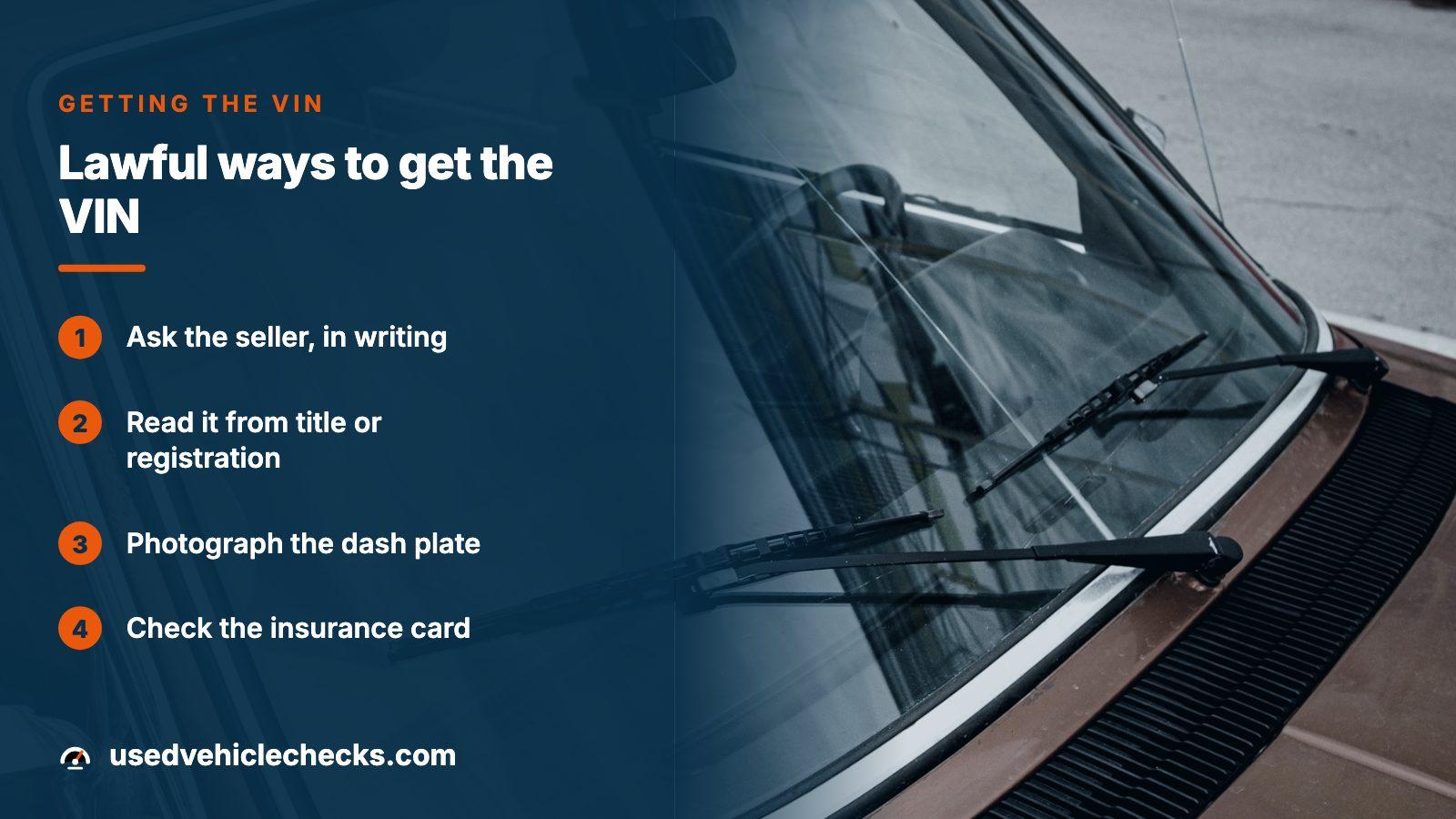
For a car you are actually considering, the shortest path is the plainest one. A seller who is serious will give you the number, and a seller who refuses has told you something before any report does.
- Ask the seller, in writing if you can, so the number in the ad and the number you check are the same.
- Read it from the title or the registration card, both of which carry it and which a seller can show you without handing them over.
- The number is repeated on your insurance card or policy page.
- Copy the number stamped on the vehicle and compare it with each document. If they disagree, stop there.
If the car is in a driveway and the owner is unreachable, resist the urge to chase the number through a lookup site. Whatever such a site returns, it is not the registered owner's file, which the law keeps from ordinary requesters.
What a DMV records request looks like in practice
Some people do have a permitted use, such as an insurer working a claim or someone with the owner's written consent. For them, the state agency has a formal route, and Texas shows how strict it can be. Title histories and registration details are requested only on Form VTR-275. It goes by post or to a Regional Service Center counter, and email is not accepted.
Attach a photocopy of your driver's license or passport, and any extra papers page 2 of the form asks for. Any fee shown on the form is paid with a personal check, a money order or a cashier's check payable to TxDMV; cash is refused. TxDMV also says it follows the federal chapter and a state transportation code chapter when it releases records, and it may redact personal details before sending anything.
Other states run their own forms, fees and permitted-use checkboxes, so look up your state agency's page before you plan around any of this. For an ordinary purchase, expect the records route to be slower than asking the seller.
Running the odometer check once you have the VIN
Enter the VIN into the preview first. It confirms the car's year, make and model, which catches a typo or a mismatched number before you pay anything. The full report then lists the odometer readings on record with their dates, next to title brands, accident and salvage entries and other history that explains an odd number.
The point of an odometer check is the sequence, not any single figure. A reading is useful because of the date attached to it and the readings on either side. Pull the dated list and put the dash number at the end of the line.
You pay once per report, with no recurring charge, and the pricing page shows the amount. Nothing about the plate is needed at this stage; the VIN does the work.
Reading the readings and spotting trouble
| Pattern in the record | Possible explanation | Your next move |
|---|---|---|
| Readings climb steadily over the years | Normal use | Compare the last one to the dash |
| A later reading is lower than an earlier one | Rollback, a typo, or a replaced cluster | Ask for service records and an explanation |
| Long gap with no readings, then a big jump | Records missing for a stretch | Ask where the car was and who had it |
| Dash shows far fewer miles than the last record | Strong sign of tampering | Walk away or have a mechanic inspect it |
| Title marked not actual or exceeds limits | The mileage cannot be relied on | Treat the figure as unknown and price accordingly |
A brand, total loss or salvage entry matters here too. The federal title system the Department of Justice runs lists brands as labels states apply, such as junk, salvage and flood, and it warns that a car with one may be unsafe. A damaged car with a suspiciously low reading is the combination to worry about most.
Checking the title before you pay
The paper side of the deal still counts. In Texas, the signed title should show the sale date and a mileage figure, and the state suggests visiting the county tax office together with the seller. Staff there can tell you whether the title carries salvage or legal flags before you file.
Other states have their own versions, so ask your local office. Line the title reading up against the history report and the dash. All three should tell the same story. A deadline applies as well: Texas gives the buyer a 30-day window after the sale to get the title transferred.
When the plate, the VIN and the story do not match
Occasionally the tag on the bumper was issued for another vehicle than the one in the paperwork. That can be innocent, such as a seller who moved an old tag onto a newer car, or it can signal a problem. Either way, decide from the number on the car and the number on the title, never the plate.
- Seller will not share the VIN: stop here.
- VIN on the car differs from the VIN on the title: stop here.
- Report shows readings that run backwards: get an explanation in writing or leave.
- Report is thin on readings: weigh service records and an independent inspection more heavily.
The federal title report is deliberately short and covers five indicators, so a clean one is good news but it will not catch everything. Use the full history, an inspection and the seller's records together.
Where this information comes from
- govinfo: federal law on release of motor vehicle record data — what a state agency may release and the penalties for misuse
- TxDMV: Open records and Form VTR-275 — how one state handles a motor vehicle records request
- TxDMV: Buying or selling a vehicle — title signing, county office check and the titling deadline
- NMVTIS: Understanding a vehicle history report — the five indicators and what brands mean
Sources and photos: Facts checked against the sources above in November 2026. Photos by Jakub Żerdzicki, Max Tokarev and Johnathan Kaufman on Unsplash; diagrams by UsedVehicleChecks.
Keep reading
- Mileage Check by VIN: What the Recorded Odometer Readings ShowThe direct method once you hold the VIN.
- Odometer Rollback Check by VIN: Run the Mileage Test Before You PayHow to test the dated readings for a backwards step.
- Odometer Discrepancy Check: Find a Mileage Mismatch Before You PayWhat to do when the dash and the record disagree.
- Where Is the Mileage on a Title, and What Should It Say?Reading the mileage printed on the title itself.
Frequently asked questions
Can I check a car's mileage with just the license plate?
Not reliably. Readings are logged against the VIN, and federal law narrows what state agencies give out. Request the number from the seller or copy it from the title, registration or insurance papers, then run the check on it.
Is it legal to look up who owns a plate?
Only for the purposes the Driver's Privacy Protection Act lists, such as government work, insurance claims, safety matters or court proceedings. Curiosity about a seller or a driver is not on that list, and false claims of a purpose are unlawful.
The seller is dodging the VIN question. Now what?
Treat it as a warning. Ask to see the title or registration instead, or look at the number on the car. A seller who refuses all three is asking you to pay without checking, and you should decline.
Does the free preview show mileage?
The preview confirms the vehicle behind the VIN so you can catch a typo before paying. The dated odometer readings sit in the full report, bought once with no plan attached. See the pricing page for the cost.
Can a DMV records request replace a history report?
Rarely, for a buyer. The route needs a permitted use, ID and often a mailed form and check, and the state may redact personal details. A VIN-based report is faster and built for the question of whether the mileage adds up.
Now check the car itself
The guide explains what to look for. The report shows what this VIN has on record.