THE SHORT ANSWER
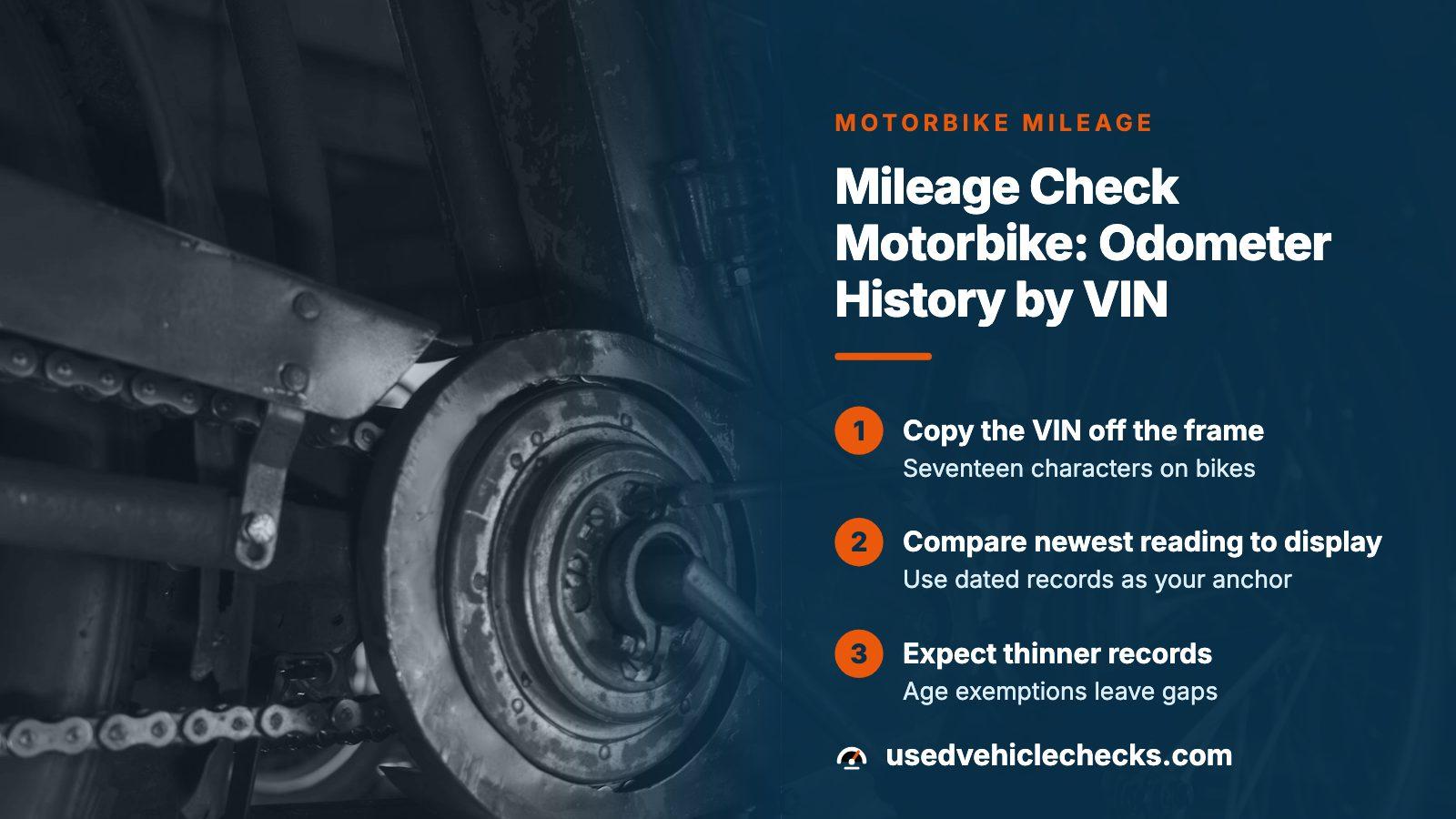
To check a motorbike's mileage, copy the VIN from the frame, put it through the preview, then purchase the report once the bike survives your first look. The report lists dated odometer readings. Set the newest beside the display and the advert. A display lower than an earlier reading is a stop sign, while a thin list says little alone, so ask for the title and service invoices too.
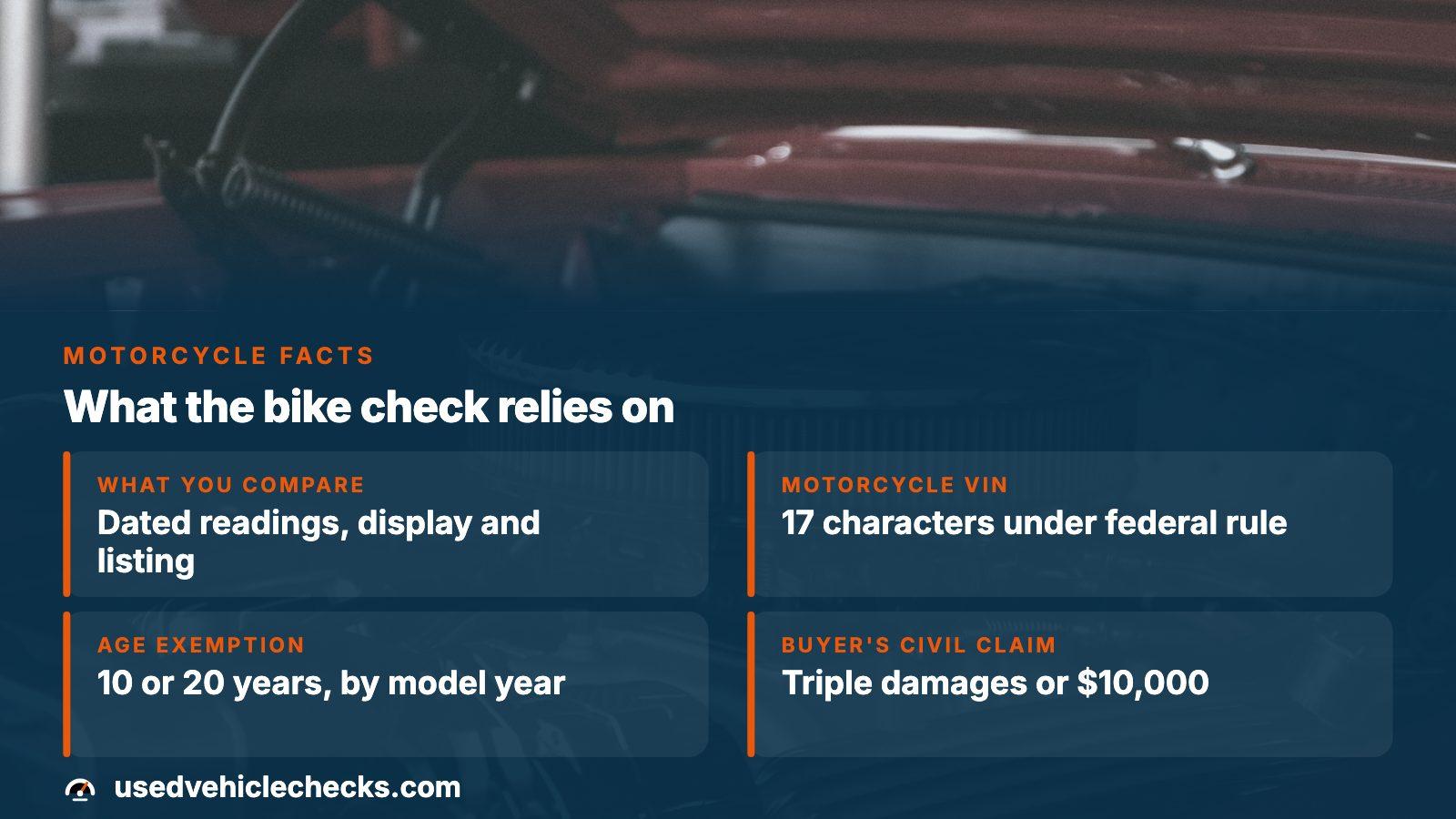
- What you compare
- Dated readings on record against the bike's display and the advert
- Motorcycle VIN
- 17 characters under the federal VIN rule
- Age exemption
- 10 years past model year for 2010 and older, 20 years for 2011 and newer
- Buyer's civil claim
- Triple the damages, or $10,000 when that is larger
What a motorbike mileage check puts in front of you
UsedVehicleChecks was built around odometer checks, so the mileage list is the first thing to read in a bike's report. Every reading carries a date, which turns one number on a display into a line you can follow from an earlier owner to the person selling today.
- Odometer readings in date order, so you see the slope as well as the latest figure.
- Title brands and any note that a reading is not actual, which can explain an odd number.
- Total loss, salvage and auction entries near a date, which sometimes account for a stall or a jump.
The federal title-records site makes the odometer reading one of five key indicators and says it helps expose discrepancies.
Why a bike's record can run thinner than a car's
Federal title records do include motorcycles; the Justice Department's FAQ lists them beside cars, buses, trucks and motor homes. Reporting is the weak spot. The duty to report is written for common automobiles, and the agency adds that several states may send in motorcycles and other vehicles too. In some states, older machines need no title at all.
So a short list of readings means less on a bike than on a car. States also take part to different degrees, and when a lookup returns nothing, the agency's likeliest explanation is that participating states reported nothing, not that the bike is clean. Treat the readings as one input; the machine and its paperwork are the others.
Running the check before any money moves
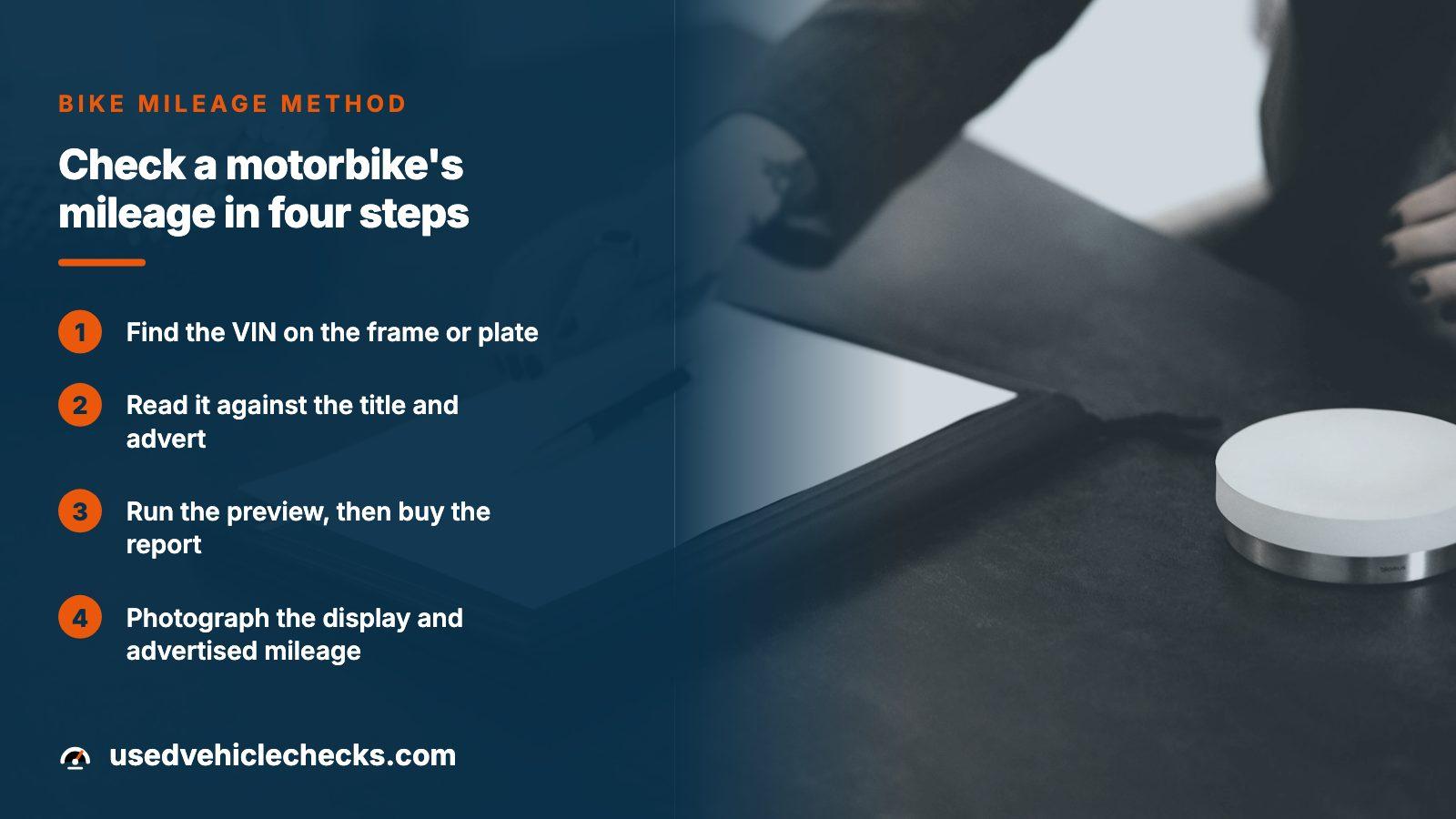
- Find the VIN stamped into the frame or carried on a plate attached to it. Federal rules want that number permanently affixed to a component that is not designed to be taken off except for repair, so a number on a part that simply unbolts needs an explanation.
- Read it against the title and the advert. A mismatch, even by one character, means the paperwork may describe a different bike; settle that before you think about mileage.
- Run the number through the preview. Nothing is charged at this stage.
- If the bike survives that, purchase the report and read the odometer readings from oldest to newest.
- Photograph the display and the advertised mileage the same day; adverts get edited once questions start.
Motorcycle VINs run to 17 characters under the federal rule, so a different length on a recent machine calls for questions.
Reading the list: five patterns and your move for each
| What the readings show | What it may mean | Your move |
|---|---|---|
| A steady climb ending near the display | Record and bike agree | Go on to the inspection and the invoices |
| An earlier reading above the display | A swapped or altered display | Ask for the repair invoice; no paperwork, no deal |
| The same figure at several events | A dead odometer, or events that never recorded it | Look for a not-actual note and ask what failed |
| Few readings and long gaps | A seasonal bike, or a state that wrote little down | Ask for invoices that cover the gap |
| Status says not actual, or past mechanical limits | An honest label on a bike with a known odometer problem | Price it as unknown mileage |
A low total is ordinary for a bike ridden a few months a year; a figure that contradicts a dated record is the real warning. Whatever the list says, have a mechanic inspect the machine, as the federal title-records site advises.
When the title and the display tell different stories
The title is where the mileage statement lives. A title issued to a new owner must carry the reading the seller disclosed at transfer. The seller signs one of three statements: the reading is actual to the best of their knowledge, the mileage is past what the odometer can show, or the reading should not be relied on, in which case the buyer gets a warning that a discrepancy exists.
From an NHTSA owner complaint
An owner who bought a 2012 Harley-Davidson FLHRC from a private seller reported odometer fraud to NHTSA. The bike read 12,000 miles when it was bought. Documents the owner later obtained from the DMV put the mileage on the title at about 50,000.
That title figure existed before the sale. The moment to compare it with the display is in the seller's garage, with the title in your hand and the VIN already run.
What to check on the machine itself
Begin with which counter you are reading. The federal definition of an odometer leaves out any trip device the rider can reset, so a figure that drops to zero under a held button is a trip meter and says nothing about the bike's total. Then ask whether the instrument cluster looks newer than the rest of the machine.
Replacing an odometer is lawful when the mileage carries over. When it cannot, the unit is set to zero and a written notice goes on the left door frame with the old mileage and the date. A motorbike has no door frame, so there is no standard place to look; ask the seller for the shop invoice recording both figures.
What the federal rules mean for a used bike
The odometer rules cover motor vehicles, which federal law defines as vehicles built mainly for public roads. A street-legal bike fits that wording; a machine made for trails and tracks may not, so a dirt bike can change hands with no mileage statement at all. Age matters too.
- Model year 2011 and newer: a statement is required until the bike is 20 years past its model year.
- Model year 2010 and older: the duty ended at 10 years past the model year, so a missing statement on a vintage machine proves nothing alone.
- Dealers and distributors keep the statements they give and receive for 5 years.
A false statement is illegal, and private sellers are bound as much as dealers. A buyer who can show intent to defraud can sue for triple the damages, or $10,000 when that sum is bigger. Winning buyers also get costs and a reasonable attorney's fee. The clock is 2 years from when the claim accrues.
What the report costs and what to do next
Opening the preview is free and commits you to nothing. The full motorcycle report is a one-off charge with no repeat billing. Anyone weighing up more than one bike can buy reports in multi-packs of 3, 5 or 10. The pricing page lists today's amounts.
If the readings and the display disagree
Before buying, stop, screenshot the advert and the readings, and ask the seller to explain in writing. After buying, keep the title, the advert and the readings together, and ask the state titling agency for a copy of its title record, the route the federal title site names to the full state file. Owners do file odometer complaints with NHTSA, as the record above shows.
Where this information comes from
- NMVTIS: frequently asked questions — Names motorcycles among the vehicles in the database, lists what consumer records hold, explains empty results and how to get a state's title record.
- NMVTIS: for consumers — Says the reporting duty covers common automobiles only, that several states report motorcycles anyway, and that some states exempt older vehicles from titling.
- 49 CFR part 580: odometer disclosure requirements — Title contents, the three seller statements, the five-year retention rule and the age exemptions.
- 49 U.S.C. chapter 327: odometers — Odometer defined without trip devices, the repair and replacement rule with its door-frame notice, the written statement and the buyer's damages.
- 49 U.S.C. chapter 321: general provisions and definitions — Section 32101 defines a motor vehicle as one built primarily for public streets, roads and highways.
- 49 CFR part 565: vehicle identification number requirements — Covers motorcycles; 17 characters, and the part or plate the number must sit on.
- NHTSA owner complaint 11711501 — owner experience, paraphrased
Sources and photos: Facts checked against the sources above in November 2026. Photos by Haberdoedas, Annika Wischnewsky and Victor Hughes on Unsplash; diagrams by UsedVehicleChecks.
Keep reading
- Mileage Check by VIN: What the Recorded Odometer Readings ShowThe same mileage check explained for any car, truck or bike.
- Odometer Rollback Check by VIN: Run the Mileage Test Before You PayTesting a list of readings for a step backward.
- Odometer Discrepancy Check: Find a Mileage Mismatch Before You PayYour options when the records and the display part ways.
- Title Check by VIN: A Step-by-Step Check, Odometer Entries FirstThe brands and status notes that sit beside a mileage entry.
Frequently asked questions
How do I check the mileage on a motorbike?
Take the VIN from the frame, run the preview, and buy the report for any bike still on your list. Compare the newest dated reading with the display, and ask the seller to produce the title along with any invoice that records a mileage.
Why did my motorbike mileage check come back with no readings?
The federal title site's likeliest explanation is that participating states reported nothing for that VIN. Reporting is uneven and its legal duty covers common automobiles only, so a bike can slip through. Read an empty list as unknown, not clean, and lean on paperwork and an inspection.
Do dirt bikes and trail machines have mileage records?
Not always. Federal odometer law covers vehicles built mainly for public roads, and a trail or track machine may sit outside it. Whether your state titles the bike, and what it says about mileage, is the state's call, so ask its titling agency.
What if the seller says the bike's odometer stopped working?
A seller who knows the display is wrong has to say so in writing; the statute calls for a written note that the true mileage is unknown. Price the bike as unknown mileage and ask for the invoice from any repair or replacement of the unit.
Why does an old bike have no mileage statement on its title?
Federal disclosure ends once a bike is old enough: 10 years past its model year for 2010 and older, 20 years for 2011 and newer. A missing statement on a vintage machine is not suspicious alone, though the display still needs the same careful look.
Now check the car itself
The guide explains what to look for. The report shows what this VIN has on record.