THE SHORT ANSWER
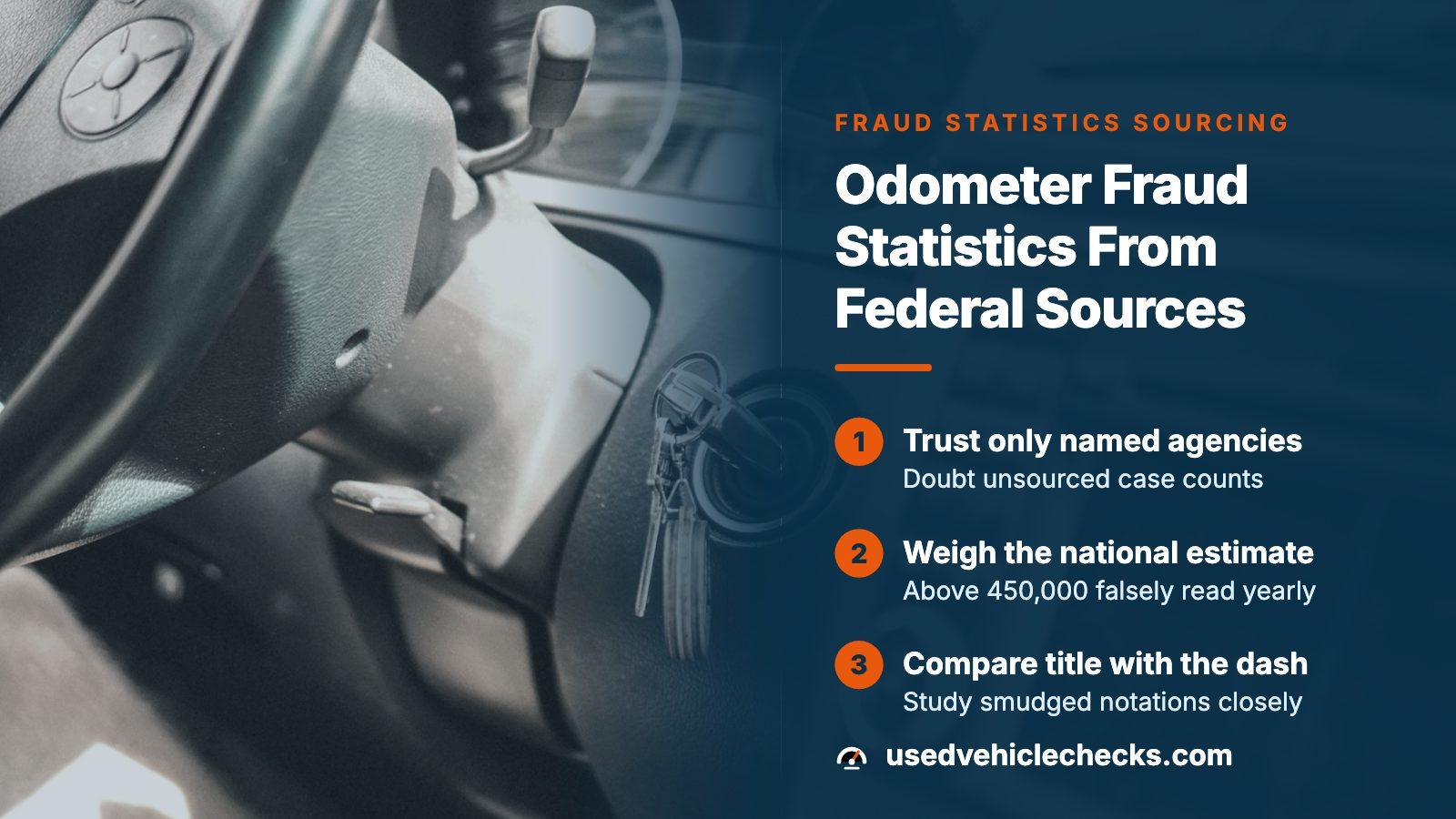
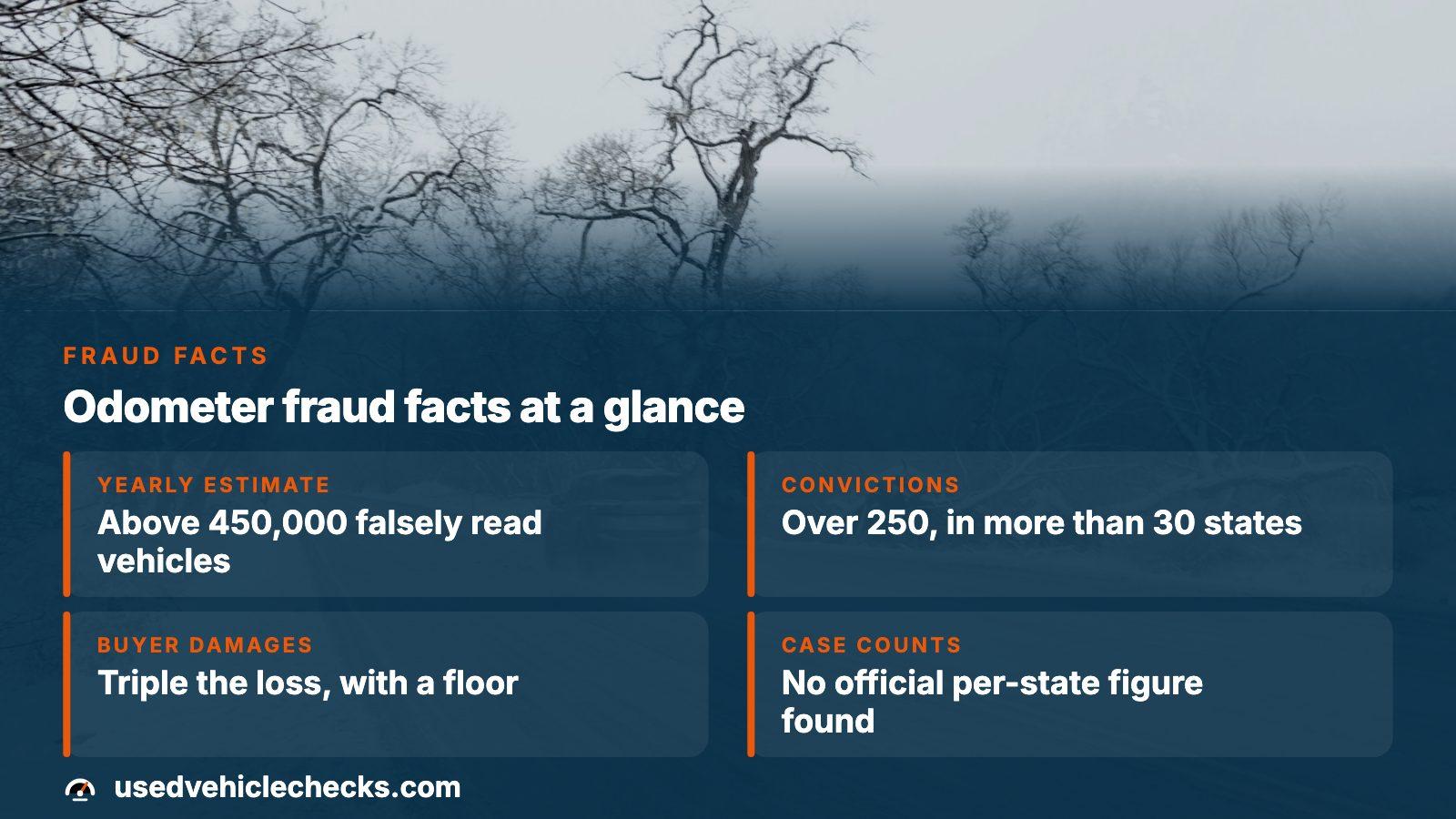
The national estimate is above 450,000 falsely read vehicles per year, from NHTSA. Its investigators report over 250 convictions, brought in more than 30 different states. Courts ordered fines past $2.8 million and restitution past $15 million. We found no official page counting cases per state or per year, so distrust any other figure until it names an agency.
- Yearly estimate
- Above 450,000 falsely read vehicles
- Convictions
- Over 250, in more than 30 states
- Civil penalty
- $10,000 maximum per violation, $1,000,000 for a series
- Buyer damages
- triple the loss, with a $10,000 floor
The one national incidence figure
Only one number describes how widespread this is, and it sits on NHTSA's odometer fraud page: above 450,000 sales each year involve a falsified mileage reading. The agency defines the offense as unhooking, zeroing or altering an odometer so that it displays fewer miles than the car has driven.
Look at what kind of number it is. It is a projection, not a count of reports filed, and the page does not lay out how it was derived. A cost box on the same page links to a source paper on the incidence rate. That paper arrived as a file download rather than a readable page, so we left it alone and do not repeat its dollar figure.
For a shopper the lesson is plain. Tampered cars are common enough that you may meet one, and uncommon enough that most listings are honest. That uneven odds picture is exactly why a VIN lookup earns its keep on the car that seems priced too well.
What federal investigators have actually closed out
Inside NHTSA, an Office of Odometer Fraud Investigation covers the country through four regional offices: Northeast, Southeast, Midwest and Western. Every office has a single criminal investigator and some administrative help, a thin field force beside a market this big.
| What NHTSA tallies | Figure |
|---|---|
| Convictions won | Over 250 |
| States involved | More than 30 |
| Shortest and longest prison terms | One month and 10 years |
| Fines imposed | Above $2.8 million |
| Restitution ordered | Above $15 million |
NHTSA presents these as cumulative results and gives no date range, so nobody can convert them into an annual rate. Its cases are assembled for Justice Department prosecutors, and the office lends a hand to state agencies that apply their own odometer statutes.
Why a conviction count understates the problem
Put an estimate of 450,000 yearly sales beside a few hundred convictions overall and the mismatch jumps out. A conviction records only what investigators proved against a seller they managed to identify. It reveals little about how many buyers drove away with a doctored dashboard.
The agency admits its boundaries too. It cannot take up claims for individual consumers, and it urges anyone harmed to consult a private lawyer. A big multi-car operation belongs with the Vehicle Safety Hotline, 888-327-4236; a single bad purchase belongs with the state enforcement agency.
A caution about statistics you find elsewhere
Percent-of-used-cars claims, state league tables and average loss per buyer are all over the web. None of the federal or state pages we read published a state-by-state or year-by-year case count, so we cannot verify such figures and leave them out.
Penalty figures written into federal law
Chapter 327 of Title 49 carries the dollar amounts, and this is statute wording, not guesswork. The Transportation Secretary may levy up to $10,000 for every violation, with each car or device counted separately. A related series of violations tops out at $1,000,000.
- A knowing and willful violation can mean a fine, a prison term of up to 3 years, or both.
- Directors, officers and agents of a corporation who order or perform the act are exposed to the same penalties as the firm.
- The Attorney General may also go to court to halt violations, beyond collecting money penalties.
Notice the gap between the statute's limit of 3 years and the 10 years NHTSA gives as the longest sentence in its cases. The page does not explain the 10, and we have not tried to square the two.
What a defrauded buyer can claim
Here the numbers become personal. A buyer who shows the violation was done intending to defraud can collect triple the real loss, and never less than $10,000. A buyer who wins also gets court costs and a reasonable lawyer's fee paid by the other side.
Two details deserve attention. The case has to be filed inside 2 years from when the claim accrues, a tight window if you only discover the problem when you resell. And the flat sum was $1,500 until a 2012 law lifted it to $10,000 from October 1, 2012, so older write-ups quoting the smaller amount are stale.
Proving intent is the hard step. A wrong reading by itself does not win the case, which is why dated records behind a car matter so much to any later claim.
Where the paper trail thins out
Under federal law the person handing over a car must give the new owner a written mileage statement. Where the seller knows the number differs from the distance actually driven, the statement has to say the true mileage is unknown. A dealer or other reseller buying the car may not take an incomplete statement.
An age cutoff applies. According to NHTSA, the written disclosure is waived for cars at least two decades old, and for model year 2010 and earlier. On those cars no mileage statement is owed, so the seller's word is all you hold at the table and any independent record carries extra weight.
Why digital odometers make the data harder
NHTSA cautions that an altered digital odometer is harder to spot than a mechanical one, since nothing visible moves out of line. It is one reason that the yearly estimate may be less obvious to the eye than before: the proof has shifted from the dash into the records.
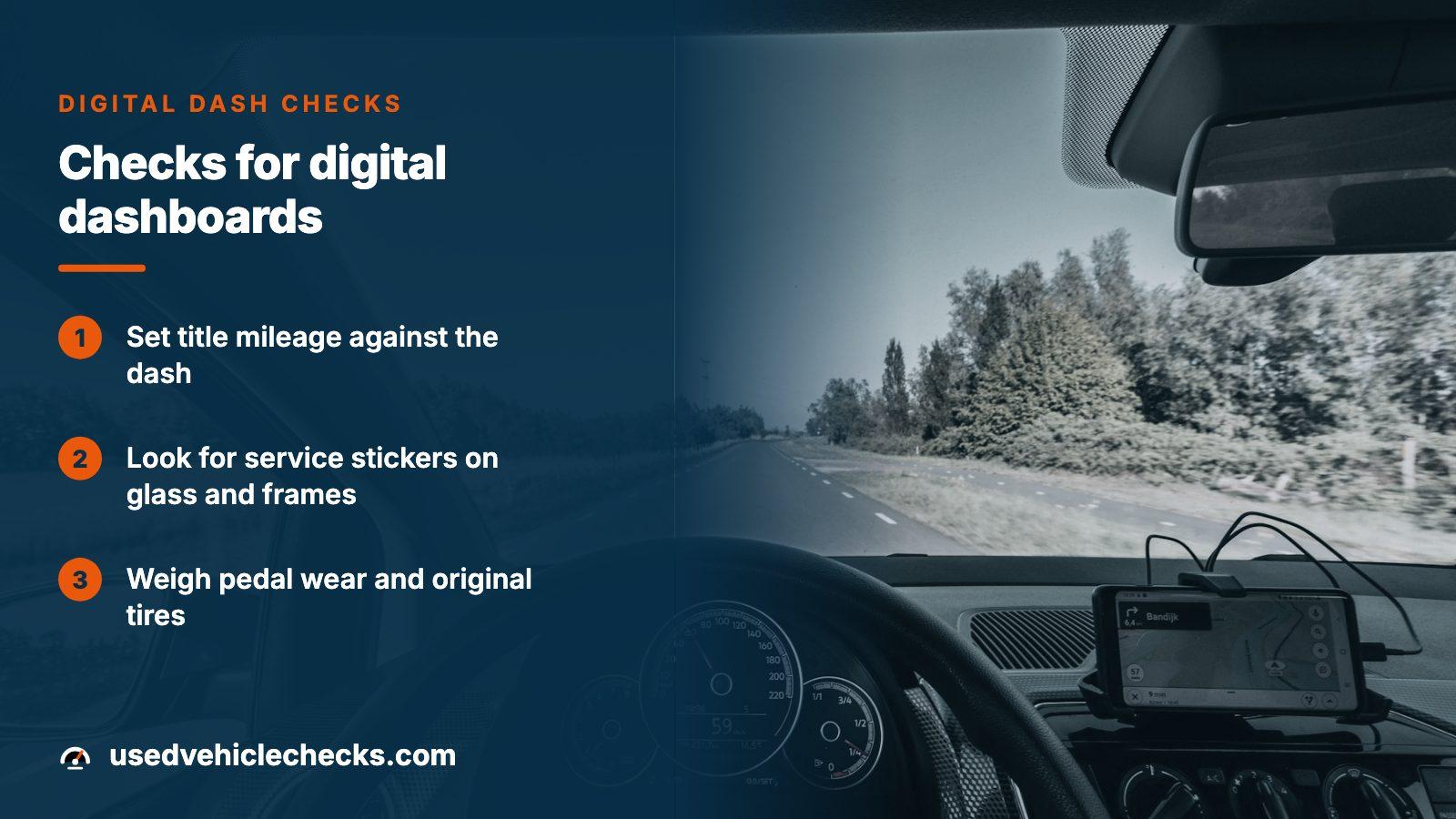
- Set the title mileage against the dash, and study the title with care when the notation is smudged.
- Look for oil change and service stickers on the glass, door frames, glove box and under the hood.
- Weigh pedal wear against the displayed miles, and expect the original tires on a car showing 20,000 or less.
Putting the numbers to work before you pay
Federal buyer advice lands in one place: obtain a vehicle history report to look for odometer discrepancies, and order one using the VIN when the seller has nothing to show. The national title system, NMVTIS, lists the latest reported odometer readings alongside brand history, insurer salvage decisions and transfers to salvage yards.
Know its limits. The report is deliberately concise, and more than half of the states report into the system, so a search can come back with a false negative. A clean result means no recorded reading disagrees; it does not prove the dash is honest, and the page urges consumers to request the real state title record.
UsedVehicleChecks lets you run the VIN for a free preview first. If the car is worth pursuing, the full report is a single payment, and the dated readings inside it are what you hold up against the title and the dash. Our odometer rollback check page shows how to test those readings for a step backward.
Where this information comes from
- NHTSA: Odometer Fraud — The yearly estimate, conviction totals, the buyer tips, the exemption ages and the digital odometer warning.
- 49 U.S.C. 32709, penalties and enforcement — Civil penalty amounts, the cap for a series, and the criminal penalty.
- 49 U.S.C. 32710, civil actions by private persons — Treble damages, the flat minimum, the filing deadline and the 2012 change.
- 49 U.S.C. 32705, disclosure on transfer — What the seller's written mileage statement must say.
- NMVTIS: Information for consumers — What a title-system search returns and where its data comes from.
Sources and photos: Facts checked against the sources above in November 2026. Photos by tim, Sander Jeurissen and Zoshua Colah on Unsplash; diagrams by UsedVehicleChecks.
Keep reading
- Odometer Rollback Check by VIN: Run the Mileage Test Before You PayHow to test a car's recorded readings for a step backward.
- How to Report Odometer Fraud: Evidence, Agencies and DeadlinesWho takes a report, and what to gather first.
- Can You Sue for Odometer Fraud? What Federal Law Gives a BuyerThe private suit in more detail.
- Can Digital Odometers Be Rolled Back? Yes, and How to Catch ItWhy electronic dashboards are harder to judge by eye.
Frequently asked questions
How common is odometer fraud?
NHTSA estimates that above 450,000 vehicles per year are sold with false readings. It is the sole national incidence figure we found on an official page, and it is an estimate. It is not split by state, vehicle type or sales channel, so it shows the risk is real without sizing it for your purchase.
How many people have been convicted of odometer fraud?
NHTSA's investigators cite over 250 convictions across more than 30 states, with prison terms running from a month up to a decade. The page gives no years for those totals. They reflect cases the office worked alongside prosecutors, not every case that state agencies brought alone.
What is the penalty for rolling back an odometer?
Federal law allows up to $10,000 per violation in civil penalties, capped at $1,000,000 for a related series. A knowing, willful violation can bring a fine, up to 3 years behind bars, or both. A buyer may also sue for triple the damages, with $10,000 as the minimum.
Do older cars have to come with a mileage statement?
Not always. NHTSA says the written disclosure is waived for cars two decades old or more, and for model year 2010 and earlier. For those cars, lean on service records, the title and recorded readings instead of anything the seller jots down.
Does a clean history report prove the mileage is right?
No. The federal title system calls its reports intentionally concise, and more than half the states report into it, so a missing record can hide a real one. A clean result means no recorded reading disagrees. Pair it with a look at the title, service stickers and pedal wear.
Now check the car itself
The guide explains what to look for. The report shows what this VIN has on record.