THE SHORT ANSWER
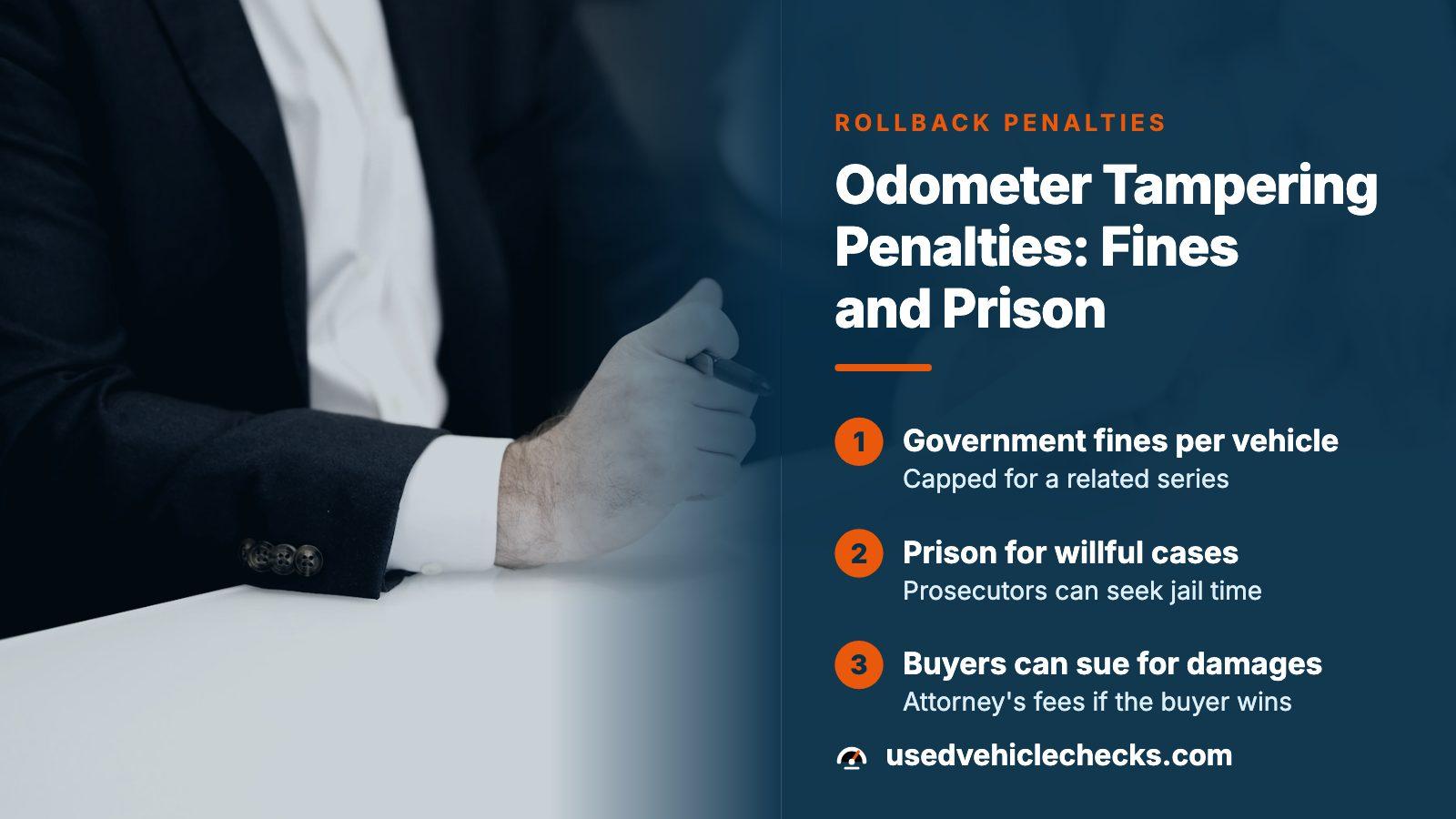
Three layers of penalty apply. The government can fine a violator up to $10,000 per vehicle, capped at $1,000,000 for a related series. Prosecutors can seek prison of up to 3 years. A defrauded buyer can sue for 3 times actual damages or $10,000, with attorney's fees if the buyer wins. State odometer laws can add their own penalties on top.
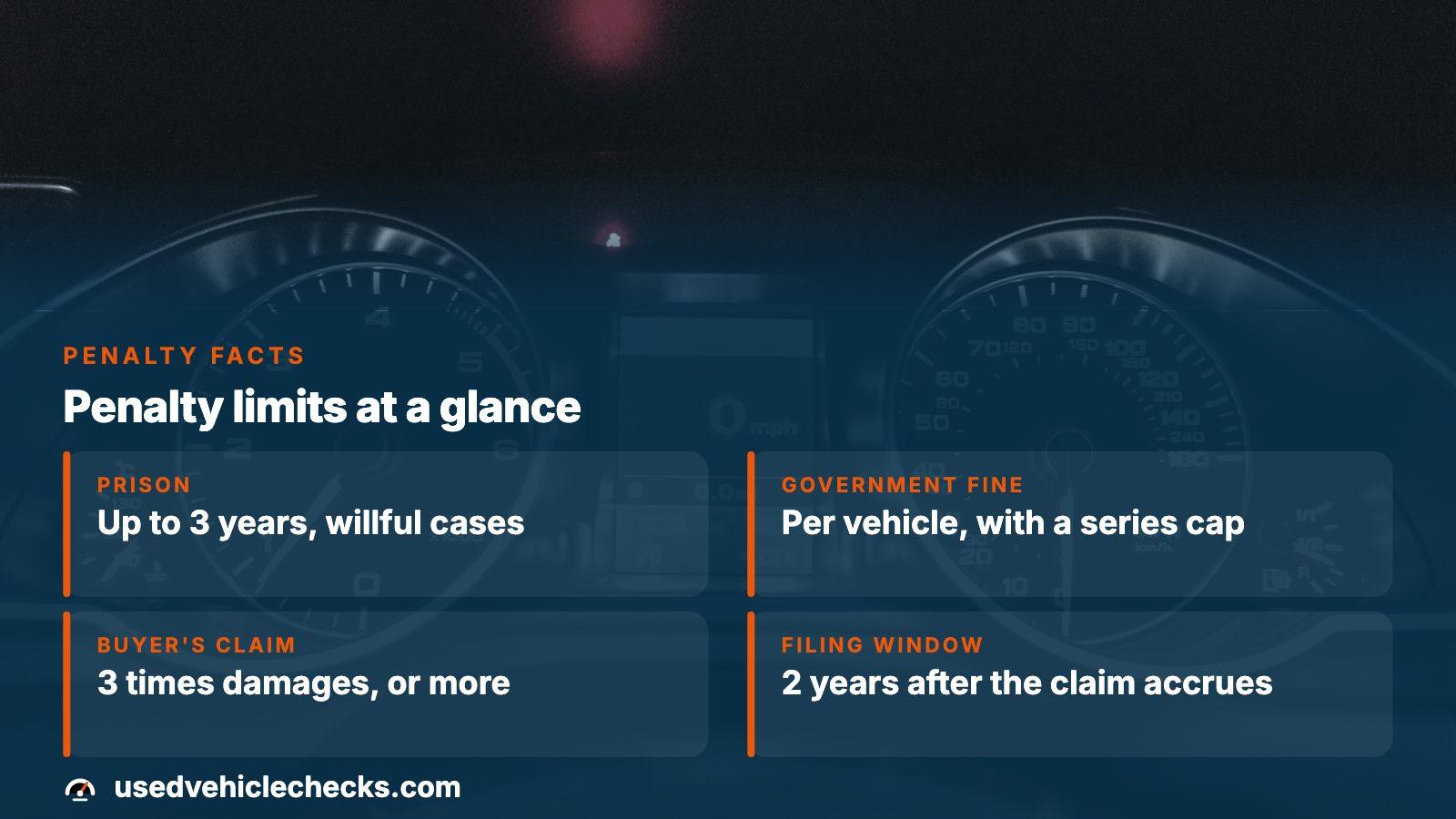
- Prison
- Up to 3 years, knowing and willful violations
- Government fine
- Up to $10,000 per vehicle
- Buyer's claim
- 3 times damages or $10,000, if higher
- Filing window
- 2 years after the claim accrues
Three ways the law punishes a rollback
The federal odometer statute sits in the transportation title of the U.S. Code, and its penalty sections run on separate tracks. One track is a civil fine paid to the government. One is a criminal case, with a prison term on the table. The third is a private lawsuit that lets the person who got cheated collect money.
The tracks do not cancel each other out. A dealer could face a fine from the Department of Transportation and a buyer's lawsuit over the same sale, and a prosecutor can still decide to charge the person who turned back the dial. Which ones apply depends on what the seller knew and what the buyer can show.
Prison and criminal fines
Section 32709(b) covers anyone who knowingly and willfully breaks the odometer chapter or a rule under it. The sentence can be a fine set under Title 18, up to 3 years behind bars, or both. The word that matters is willfully: a seller who honestly did not know the dash was wrong stands in a different place than one who ordered the change.
A company does not shield the people running it. Directors, officers and agents who personally order or carry out the act can be punished apart from the business. A lot owner cannot point at the entity and walk away.
The civil fine paid to the government
Separate from any criminal case, a violator can owe the United States as much as $10,000 for every violation. A separate violation is counted for each car or gadget involved, which is how a few cars become a large number. For a related series of violations, the ceiling is $1,000,000.
The Secretary of Transportation imposes this fine and the Attorney General sues to collect. Before sending a claim over, the Secretary may settle for less and must give the accused a chance to show the violation never happened. Congress set those dollar figures in 2012, replacing much smaller ones.
| Penalty | Who brings it | Ceiling |
|---|---|---|
| Civil fine | Transportation Department, collected by the Attorney General | $10,000 per vehicle, $1,000,000 for a series |
| Criminal case | Federal prosecutors | Fine plus up to 3 years in prison |
| Buyer's lawsuit | The person defrauded | 3 times damages or $10,000, whichever is more |
What a defrauded buyer can recover
Section 32710 gives the buyer a direct claim. Anyone who violates the chapter with intent to defraud is liable for triple the actual damages, or a flat $10,000 if that is more. Say your proven loss is modest: the tripled amount may land under the floor, and the $10,000 figure applies instead.
Winning also shifts your costs. When judgment goes to the person who sued, the judge has to add court costs and lawyer fees that are reasonable. That fee rule is why lawyers take these cases on thin facts less often than you might think, yet more often than a plain breach-of-sale claim would justify.
Intent to defraud is the hinge
The buyer's claim turns on intent. A wrong number alone is not enough; you need to show the seller meant to deceive. Dated readings from outside the seller's control are the usual way to show it.
What counts as tampering under the statute
Section 32703 is broader than rolling back digits by hand. The banned acts include:
- Disconnecting, resetting or altering an odometer, or paying someone to do it, with the aim of changing the mileage shown.
- Selling, advertising, fitting or running a gadget that makes the odometer show a number other than the miles driven.
- Using a public road to deceive someone while aware that the odometer is unplugged or dead.
- Conspiring to break the tampering ban or the rules on mileage disclosure.
A resettable trip meter is not an odometer under the definitions, so zeroing it is legal. Repairing a failed unit is not tampering either, as long as the mileage is handled and disclosed properly afterward.
Lying on the paperwork counts too
Not every case involves touching the dash. Section 32705 requires anyone transferring ownership to hand the buyer a written statement of the odometer mileage. When the seller is aware the dash number does not match the miles really covered, the statement must say the true mileage is unknown. A false statement is a violation.
Transfer here means any change of ownership: a sale, a gift or anything else. A person buying a vehicle to resell it may not accept an incomplete statement, and a state may refuse to license the car unless the application includes the seller's title and a signed, dated mileage entry. A signature next to a made-up number is itself evidence.
State penalties come on top
Section 32711 leaves state odometer laws standing unless they conflict with the federal chapter. So the same rollback can break a state statute, with its own charge, its own penalty and its own enforcement office. Those state rules differ widely, and this page does not list them.
Read your own state's odometer or title statute, or ask the agency that handles titles, before you decide where to file. The federal numbers above are the floor of what is possible, not a complete picture of what a prosecutor or state attorney general in your area can bring.
Check the mileage before the penalties matter
A penalty helps only after the damage is done. The cheaper move is catching the problem before you pay. Type in the VIN, read the free preview, and if you are serious about the car, buy the report and read the odometer readings from oldest to newest. Each one sits beside a date, so a figure that drops, or a long stretch where the number barely moves, stands out.
Then compare the latest reading with the dash and the number the seller wrote on the title. A gap between a recorded reading and the dash is the kind of independent record a buyer's claim leans on later. Prices are on the pricing page.
If you already bought the car
- Keep the title, bill of sale, listing screenshots and any messages with the seller.
- Run the VIN and save the report with the date you ran it.
- Photograph the dash with the ignition on, showing the reading.
- Note the date you found the mismatch; a private suit has a 2-year limit that starts when the claim accrues.
- Talk to a private attorney about the civil claim, and report the seller to your state's enforcement office.

Where this information comes from
- GovInfo: 49 U.S.C. 32709 — Source for the government fine, the prison term and who enforces them.
- GovInfo: 49 U.S.C. 32710 — Source for the buyer's triple-damages claim, attorney fees and the filing window.
- GovInfo: 49 U.S.C. 32703 — The list of banned acts, from resetting an odometer to conspiracy.
- GovInfo: 49 U.S.C. 32705 — The written mileage statement owed to a buyer at transfer.
- GovInfo: 49 U.S.C. 32711 — Why state odometer laws still apply alongside the federal ones.
Sources and photos: Facts checked against the sources above in November 2026. Photos by Carrie Allen www.carrieallen.com, Anastasiia Nelen and Ambitious Studio* | Rick Barrett on Unsplash; diagrams by UsedVehicleChecks.
Keep reading
- Can You Sue for Odometer Fraud? What Federal Law Gives a BuyerHow the buyer's civil claim runs from filing to judgment.
- How to Report Odometer Fraud: Evidence, Agencies and DeadlinesWhere to send a complaint and what to attach.
- Odometer Rollback Check by VIN: Run the Mileage Test Before You PayTest dated readings for a backward step before you buy.
- Odometer Disclosure Statement: What the Seller Signs and What to CheckWhat the signed mileage statement must say.
Frequently asked questions
How much prison time is odometer tampering?
Federal law allows up to 3 years in prison, a fine under Title 18, or both, for a knowing and willful violation. Directors, officers and agents of a company can be held personally responsible. Actual sentences depend on the case and the court, and this page gives only the statutory maximum.
Is odometer tampering a felony?
The statute sets a prison maximum of 3 years and a fine, and does not use the word felony. How a given case is classified is a question for a criminal defense or consumer attorney. State laws may classify their own odometer offenses differently, so check yours.
Can I get my money back if the odometer was rolled back?
You can sue for triple your proven loss, or $10,000 when that is higher, if you prove intent to defraud. Winning plaintiffs also get costs and reasonable lawyer fees from the court. The clock is 2 years from when the claim accrues, so bring an attorney in early.
Is it illegal to fix a broken odometer?
Repair is not the offense; the offense is changing the mileage shown with intent to deceive, or driving to defraud knowing the odometer does not work. If a unit is replaced, the mileage should be disclosed honestly at the next sale. A trip meter you reset yourself is not covered at all.
Does a signed mileage statement protect the seller?
No. Federal law bars a false statement in the disclosure, and a seller who knows the reading is off must say the true mileage is unknown. A signed number the seller knew was wrong adds to the evidence against them instead of protecting them.
Now check the car itself
The guide explains what to look for. The report shows what this VIN has on record.