THE SHORT ANSWER
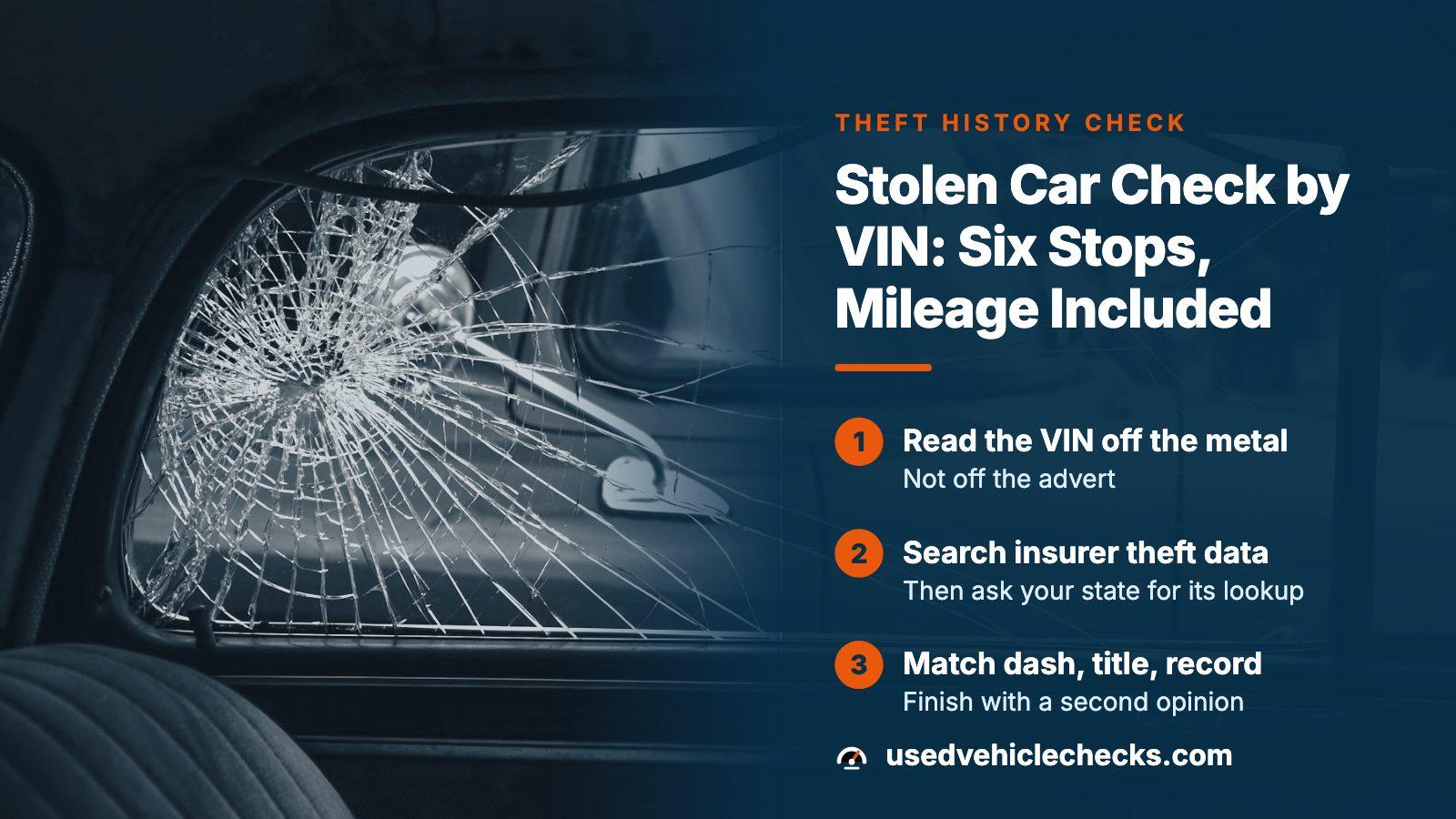
Enter the car's 17-character VIN into NICB's VINCheck to see insurer theft and salvage reports, then find out whether your state runs a stolen-vehicle lookup. Next, get the title and odometer history for the VIN and set it beside the dash and the title in your hand. A flag at any stop means pause the sale. A clean result lowers the risk but never proves the car is legitimate, because cloned VINs and silent insurers slip through.
- Insurer lookup
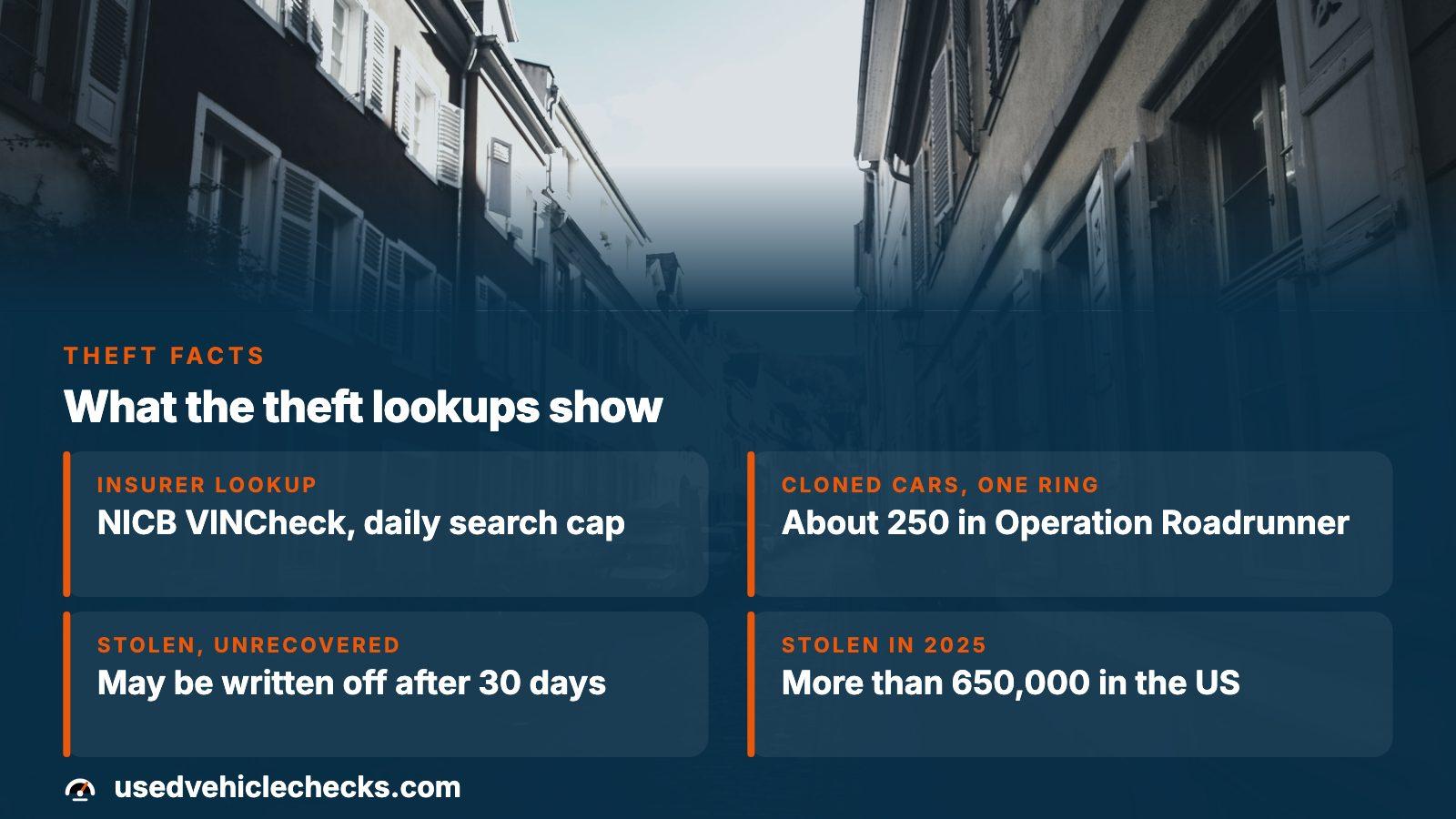
- NICB VINCheck, no charge, with a daily search cap
- Cloned cars found in one ring
- About 250 recovered in Operation Roadrunner
- Stolen but unrecovered
- An insurer may write the car off after 30 days
- Vehicles stolen in 2025
- More than 650,000 in the United States
Stop 1: Read the VIN off the metal, not the ad
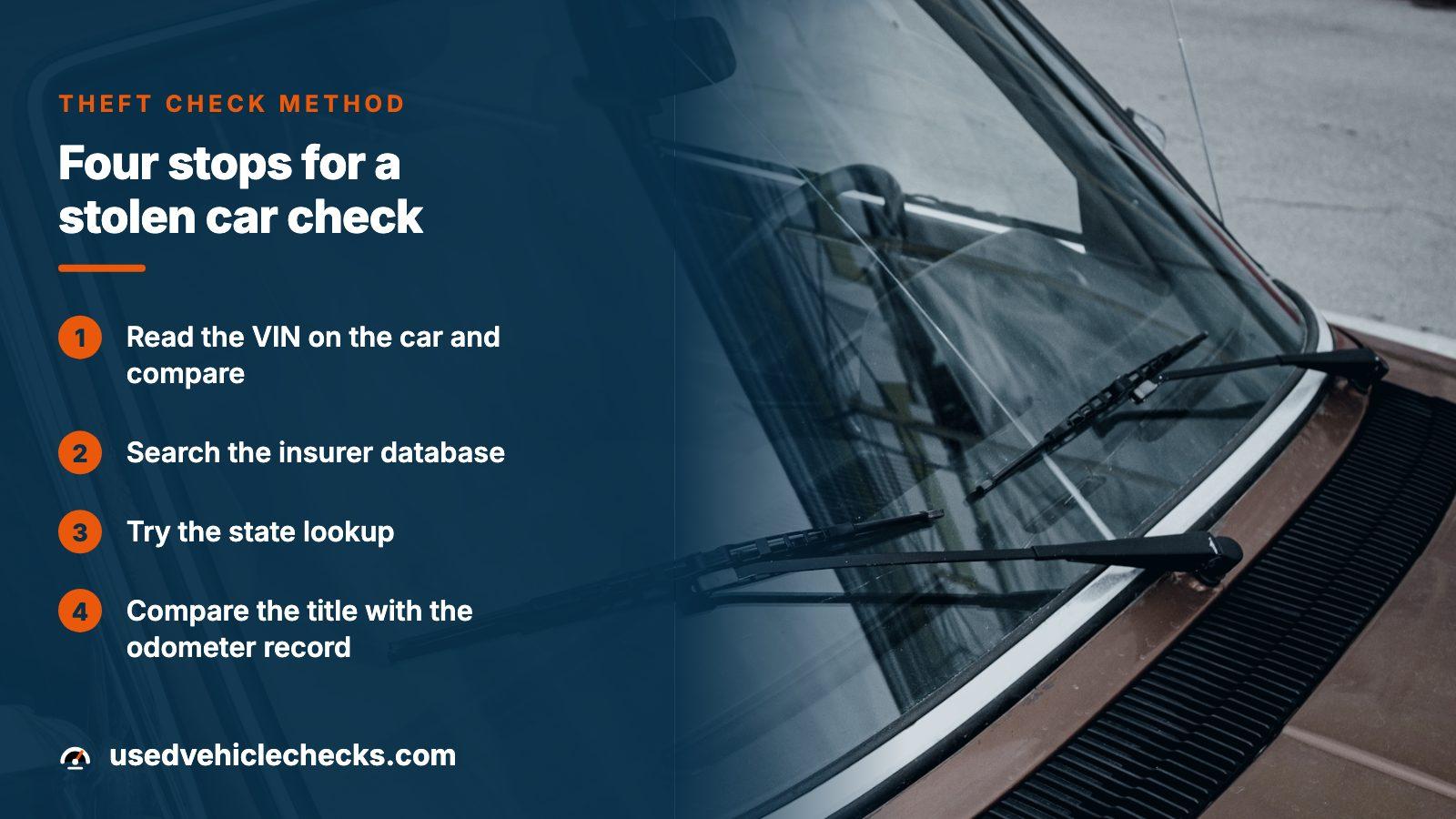
Start with the 17 characters on the car itself. A small plate sits at the bottom-left of the windshield, and the same string belongs on the registration card and the title the seller gives you. Take a picture of the plate and key the VIN in from that picture, because NICB warns that a single wrong character can hide a real match.
- The windshield plate and the registration agree, character for character.
- The title shows the same VIN, with no smudging or overwriting.
A mismatch between any two of these ends the checking until the seller explains it.
Stop 2: Run the insurer theft and salvage database
NICB's VINCheck is the quickest first test. Type in the VIN and it tells you whether insurers on its member list have flagged the car as taken and never found, written it off as salvage, or marked flood damage. It costs nothing, though one IP address is limited to five searches every 24 hours, so save them for cars still on your shortlist.
NICB says its members account for 92.49% of the insurance premium earned across the country. The same page admits the tool skips police files, skips insurers that opted out, and should not replace a full history report. A hit is strong evidence. A blank is only a blank.
Stop 3: Ask your state for its own stolen-vehicle lookup
Insurer and police records overlap without matching. A state may publish a form that checks a VIN against the stolen-vehicle file its police keep. Colorado's Department of Public Safety does: enter a model year and a VIN, and the form looks for a match in the stolen-vehicle file of the Colorado Crime Information Center.
Where your state has no public form, call its motor vehicle agency and ask how a buyer can have a VIN verified. NICB lists that step, alongside a title search, for private-seller purchases.
Stop 4: Get the title and odometer history for that VIN
A theft check answers one question. The title history answers the next: who has held the car on paper, which brands it carries and what mileage was logged on the way. NMVTIS, run through the Department of Justice, collects data from state titling agencies, recyclers, salvage yards and insurers. A consumer search can return the latest mileage reading, brand history, total-loss and salvage entries and, sometimes, older theft data.
Coverage has holes. NMVTIS estimates that it holds about 87 percent of the nation's vehicles, and not every source has begun reporting, so a search can look clean only because a record never arrived. Read the mileage and theft lines as clues, not a verdict.
Stop 5: Match the dash, the title and the record
This is where a mileage check earns a place inside a theft check. A cloned car wears a VIN copied from a legitimate twin, so the dated readings filed under that VIN may belong to the twin. If the dash shows a figure that cannot fit that history, the paperwork and the metal may not describe one vehicle.
| Source | What to read | A gap points to |
|---|---|---|
| Dash display | Photograph the miles with the ignition on | A tampered display, or a different car than the record describes |
| Title | Mileage the last seller disclosed, plus any brand wording | A figure far from the dash, or a brand nobody mentioned |
| VIN history | Dated odometer readings, oldest to newest | A reading above the dash, or a long gap between entries |
| Service papers | Oil-change stickers, invoices, inspection slips | Dates and miles that stop short of, or run past, the dash |
NHTSA backs the same comparison for spotting odometer fraud, adds tire condition and pedal wear as physical tests, and warns that tampered digital displays are hard to catch.
Stop 6: Look the car over and get a second opinion
Cloning works by fitting a counterfeit VIN tag to a stolen vehicle, so the vehicle on the driveway is the last place to catch it. Compare the tag with the registration and title again in daylight, and note anything loose, scratched or refitted. For a late-model car that shows no lender, NICB advises reading the chain of owners closely and, where possible, asking your own insurer to inspect it first.
Add an independent mechanic: the FTC and the NMVTIS site both say an inspection still has to follow any history search.
What each answer means, and your next move
| Result | Meaning | Your next move |
|---|---|---|
| Stolen and unrecovered at NICB | An insurer logged the car as missing | Stop. Do not pay; contact the police and NICB |
| Salvage or flood at NICB | An insurer logged a write-off or flood damage | Ask for repair records and an inspection first |
| Theft entry that mentions recovery | Stolen once, then found | Ask who holds the title now and when it happened |
| VIN differs between plate and papers | Documents and car may not match | Walk away, or have the state agency verify |
| Dash miles disagree with the history | Tampering, or a record for another car | Ask the seller in writing and request the title |
| Nothing flagged anywhere | No source on this VIN reports a problem | Move to inspection and keep your paperwork |
A salvage flag is not a theft flag, but the two can blur. NMVTIS explains that an insurer may call a stolen car a total loss once it has stayed missing past 30 days. If the car is found later in good shape, that label can stay on its record.
Why a clean result still leaves gaps
Operation Roadrunner, a South Florida investigation, recovered roughly 250 cloned cars. Buyers, titling agencies and police were all fooled because each car displayed a plausible VIN. NICB adds the sting: the buyer of a cloned car never legally owns it, and it can be taken back for the rightful owner or the insurer that paid the theft claim.
From an NHTSA owner complaint
A 2018 Honda CR-V owner wrote to NHTSA that a theft record was already attached to the VIN when the car was sold, yet it was never disclosed at the sale and was missing from the report the dealership used. The owner took the history reports to California's motor vehicle agency and heard that the entry counted as "insignificant". After the purchase, the owner added, thieves went after the car several times and it was later repossessed.
A theft entry that shows in one source and not in another is still a question for the seller. Use more than one source, and ask in writing whether the car was ever reported stolen.
Where the preview and the full report fit
Open with the preview; it is free. A paid report is bought outright with nothing to cancel later, and a pack suits people comparing a few cars. Figures in force today are on the pricing page. For this check the report gathers theft, title-brand, salvage and odometer entries for the VIN in one document, so Stops 4 and 5 are done from a single page.
Do the insurer and state lookups first, since the NICB one costs nothing and can end the search early. Spend on a report only for cars that survive them.
Where this information comes from
- NICB: VINCheck lookup — What the insurer database searches, its limits and the daily search cap.
- NICB: Buying a used vehicle — How VIN cloning works and the checks NICB lists for buyers.
- NMVTIS (Department of Justice): For consumers — What title records contain, coverage gaps and the Roadrunner cloning case.
- NHTSA: Odometer fraud — Buyer comparisons for the dash, the title and maintenance records.
- Colorado Department of Public Safety: Motor Vehicle Verification System — An example of a state form that checks a VIN against its stolen-vehicle file.
- FTC: Buying a used car — History reports, the NICB tool and why an inspection still matters.
- NHTSA owner complaint 11722318 — owner experience, paraphrased
Sources and photos: Facts checked against the sources above in November 2026. Photos by sippakorn yamkasikorn, Max Tokarev and Karwin Luo on Unsplash; diagrams by UsedVehicleChecks.
Keep reading
- Odometer Rollback Check by VIN: Run the Mileage Test Before You PayA fuller look at the dash-versus-record comparison from Stop 5.
- Title Check by VIN: A Step-by-Step Check, Odometer Entries FirstBrands and dated entries on the title record behind Stop 4.
- Buying a Car Out of State: Check the Mileage Before You TravelOut-of-state titles are where cloned and washed cars tend to slip through.
- Curbstoning: Spotting an Unlicensed Dealer by the Odometer and TitleSellers whose name is not on the title, and the questions to put to them.
Frequently asked questions
Can I check whether a car is stolen with only the VIN?
Yes, for the insurer side: NICB's VINCheck takes only the VIN. Police files need a state lookup or a call to the motor vehicle agency, and neither source is complete alone, so add a title history before you commit.
Is the NICB search enough on its own?
No. NICB calls it a useful tool, not a full history report, and it covers only participating insurers. A car can be stolen or damaged with nothing showing there. Treat a flag as serious and a blank as one data point.
Would these checks catch a cloned car?
Not reliably. A clone carries a VIN copied from a real vehicle, so lookups can return that vehicle's tidy record. Match every VIN on the car and papers, compare miles with dated readings, and have a mechanic or your insurer inspect it.
What if the seller will not share the VIN?
Treat it as a refusal to let you check. The number is on the windshield plate, so you can copy it yourself with the seller standing there. If you are not allowed near the car, there is nothing to buy yet.
Does a theft entry mean the car is off the table?
Not always. A car can be stolen, recovered and returned to use, and NMVTIS notes that a total-loss label from a long absence can remain afterward. Find out when it happened, whether it was recovered, and who holds a clean title today.
Now check the car itself
The guide explains what to look for. The report shows what this VIN has on record.