THE SHORT ANSWER
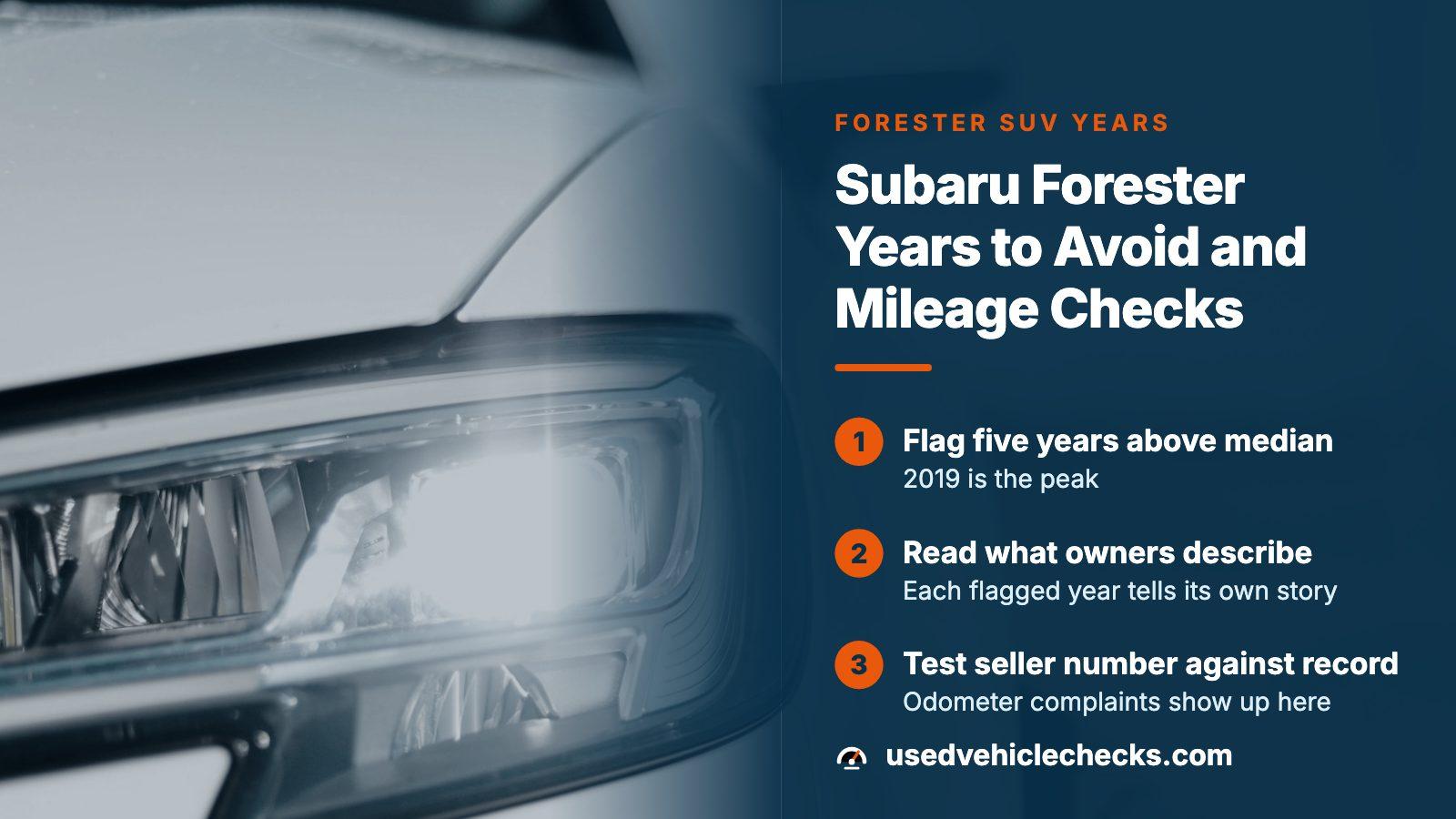
On NHTSA complaint counts, approach the 2019, 2015, 2020, 2017 and 2018 Subaru Forester with extra care: they run from 1.9 to 3.18 times the median of 262 complaints a year. Treat a Forester year on this list as a cue to look harder at that car, not a ruling on it. Older years such as 2008 and 2013 draw the fewest filings, though age brings its own wear. Whatever the year, read that VIN's mileage readings, recalls and title record before paying.
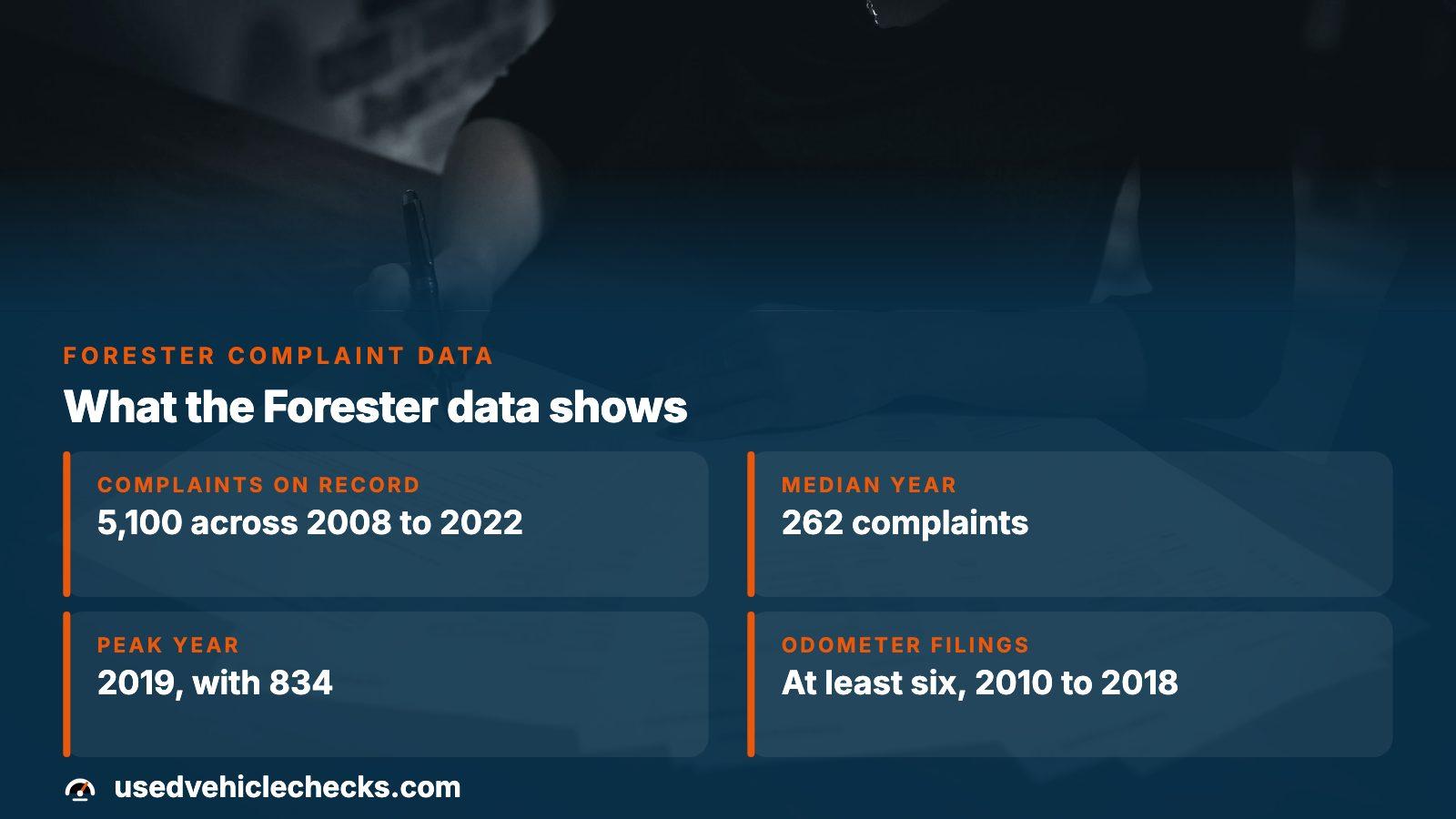
- Complaints on record
- 5,100 across 2008 to 2022
- Median year
- 262 complaints
- Peak year
- 2019, with 834
- Odometer filings
- At least six, on 2010 to 2018 models
Five Forester years that sit well above the median
NHTSA holds 5,100 owner complaints about Forester model years 2008 to 2022. The middle year of those fifteen draws 262, so each year is read against that figure and not against other SUVs.
| Model year | Complaints | Times the median | Most-listed area |
|---|---|---|---|
| 2019 | 834 | 3.18 | Visibility and wiper |
| 2015 | 617 | 2.35 | Engine |
| 2020 | 603 | 2.3 | Visibility and wiper |
| 2017 | 593 | 2.26 | Air bags |
| 2018 | 498 | 1.9 | Visibility and wiper |
The 2016 and 2014 cars follow at 416 and 403. The steepest climb, from 498 for 2018 to 834 for 2019, may coincide with a redesign, so neighbors can behave like different SUVs.
What owners describe in each flagged year
| Model year | What the filings say | Related recall |
|---|---|---|
| 2015 | 131 list the engine, and 25 of those mention a stall | 16V162000, a turbo intake duct that may crack on 2.0XT cars built in 2015 |
| 2017 | 167 list air bags, and 121 mention the passenger air bag, a sensor or a warning light | 19V701000, a loose passenger seat sensor connection on certain 2015 to 2018 cars |
| 2018 to 2020 | Visibility filings run 135, 370 and 252, and nearly all mention the windshield or a crack | None about glass among the recalls listed |
A cracked windshield is a repair bill and a sight-line problem, while a stalling engine is a different order of risk. Read the year as a pointer for inspection: glass on 2018 to 2020, the passenger air bag light on 2015 to 2018, the turbo duct on 2015 XT cars.
The quiet years are not a clean bill
Counts run lowest for 2008 at 50, 2013 at 78 and 2022 at 100, with 2012 at 106 close behind. The 2022 figure is provisional, because the newest SUVs are still young and owners have filed less so far, and a low count can also mean fewer sales.
Age cuts the other way. Of the 50 filings for 2008, 11 name the suspension, and 6 of those mention rust or corrosion. A quiet record on an old SUV still needs a mechanic's eye and service invoices that fit the miles.
Odometer complaints turn up in the busy years too
The Forester file for 2008 to 2022 also holds filings about mileage that did not add up, spread across models from 2010 to 2018. Four of them, set out below as the filers report them, give both figures.
| Model year | Sold by | Mileage at the sale | Higher figure found later |
|---|---|---|---|
| 2014 | Private seller | 77,000 | 166,000 at registration |
| 2015 | Private seller | 74,700 | 184,064 at registration |
| 2016 | Dealer | 108,127 | 188,130 on a history report |
| 2018 | Dealer | 65,800 on the contract | 86,588 on the state title record |
From an NHTSA owner complaint
A buyer filed this about a 2015 Forester in October 2026. The SUV came from a private seller showing 74,700 miles. At registration the record showed 184,064, which is 109,364 miles more.
That buyer met the second figure at registration, after the purchase was done, when a dated record could have been read beforehand. A fifth filing, for a 2010, describes a dealer's history search that found the mileage dropping from roughly 171,000 to roughly 91,000 ahead of the owner's purchase.
When the seller's number and the record disagree
Two dealer sales in the file show the same gap from different angles.
From an NHTSA owner complaint
An owner who bought a 2016 Forester from a dealer says the mileage at purchase was 108,127 and the dash read 110,000 at registration. A history report, the owner adds, listed 188,130. The filing is headed odometer fraud.
The dash and the sale mileage agreed with each other here, so only a dated history exposed the gap.
From an NHTSA owner complaint
A buyer paid about $19,500 for a 2018 Forester and says the sales contract carried 65,800 miles, while the state title record and a history report showed 86,588. The owner says the title later carried a brand reading mileage unknown. The listing, the owner adds, had promised "excellent condition, only minor scratches", and a trade-in left a loss of about $9,283.78, not counting repairs. A demand letter drew no answer.
Both buyers could have set the contract figure beside the record before signing, the cheapest step in the whole purchase.
How to read the mileage history of one Forester
A dash shows one number. The dated entries behind it show whether that number can be trusted. Put them in a column, oldest first, and look for these shapes:
- A steady climb that suits the SUV's age: ordinary use.
- One figure repeated across dates: a stalled gauge or a reporting gap, worth a question.
- A later entry below an earlier one: a rollback or an unreported gauge swap, so ask for paperwork or walk.
- A leap bigger than the age explains: hard use or a missing stretch, so ask for service invoices.
On paper, federal law (49 U.S.C. 32705) makes the seller give you a written statement on the title: either the figure the odometer shows or, when the seller knows that figure is off, a note that the actual mileage is unknown. NMVTIS, the federal title database, shows the most recent reported odometer reading, which is one point and not a sequence. A report that lists readings by date supplies the sequence.
Recalls belong to a VIN, not to a model year
NHTSA lists two recalls for the 2014 Forester, three each for 2015, 2016, 2018 and 2019, one for 2017 and none for 2020. Three that bear on the flagged years:
| Campaign | Cars covered | Problem | Dealer remedy |
|---|---|---|---|
| 16V162000 | 2.0XT built April 10 to October 20, 2015 | Turbo air intake duct may crack and stall the engine | Inspect, replace as needed, no charge |
| 19V701000 | Certain 2015 to 2018 with heated seats | Passenger seat sensor connection may loosen and switch the passenger air bag off | Inspect, replace the harness, no charge |
| 21V587000 | Certain 2018 Foresters | Low-pressure fuel pump may fail and stall the engine | Replace the pump, no charge |
Each campaign names a production range, so two SUVs of one year can land on opposite sides. Search the VIN at NHTSA's recall lookup, which charges nothing, and ask the seller for the paperwork behind each repair.
Check the Forester in front of you before you pay
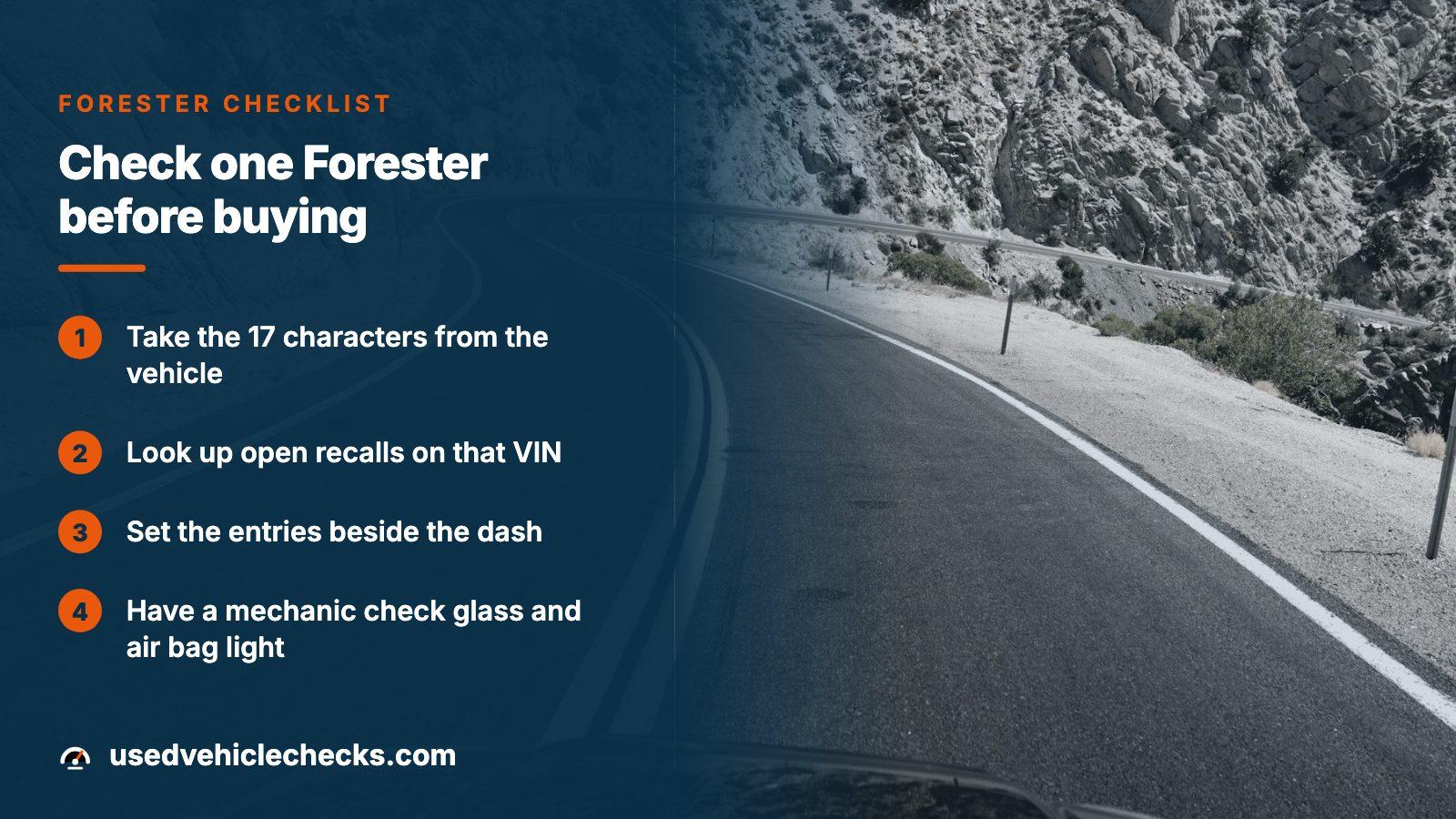
- Take the 17 characters from the vehicle, not from the ad, and check that the model-year character agrees with the seller's claim.
- Look up open recalls on that VIN and note any repair still waiting.
- Open the preview on this site. If the Forester stays on your shortlist, buy the report and read its odometer entries from the oldest down.
- Set those entries beside the dash and the contract, then read what the title says, whether any accident is recorded and how the SUV was used.
- Have a mechanic check the glass, the passenger air bag light, the engine and the underbody, and ask for invoices that fit the miles.
Nothing is charged to open the preview. Forester buyers pay one time for the report, never monthly; options are laid out on the pricing page.
Where this information comes from
- NHTSA: Subaru Forester complaints data — The federal record behind each model year's complaint count and the most-listed areas.
- NHTSA: Subaru Forester recalls data — The recall campaigns listed for each year, with the cars covered and the no-charge remedy.
- NMVTIS: information for consumers — What the federal title database holds, including the most recent odometer reading, and its reporting gaps.
- 49 U.S.C. 32705: odometer disclosure — The written mileage statement a seller must give a buyer on the title.
- NHTSA owner complaint 11773793 — owner experience, paraphrased
- NHTSA owner complaint 11668761 — owner experience, paraphrased
- NHTSA owner complaint 11695152 — owner experience, paraphrased
Sources and photos: Facts checked against the sources above in November 2026. Photos by Sara Kurfeß, Will Truettner and Dimitri Karastelev on Unsplash; diagrams by UsedVehicleChecks.
Keep reading
- Odometer Rollback Check by VIN: Run the Mileage Test Before You PayHow to line up a vehicle's mileage entries and spot a step backward.
- Mileage Check by VIN: What the Recorded Odometer Readings ShowWhat a VIN-based mileage check lists and how to read it.
- Odometer Discrepancy Check: Find a Mileage Mismatch Before You PayWhat to do when the dash and the records tell different stories.
- Toyota RAV4 Years to Avoid: Complaints by Year and the Odometer CheckThe same year-by-year read for a compact SUV that shoppers often weigh against the Forester.
Frequently asked questions
Which Subaru Forester years should I avoid?
Start your caution with 2019, 2015, 2020, 2017 and 2018. The 2019 model year has 834 NHTSA complaints where the median year has 262. Those years justify a closer inspection and a firmer price, though a clean mileage and title record on the VIN counts for more.
What are the best Subaru Forester years?
On complaint counts, 2008 at 50, 2013 at 78 and 2012 at 106 are the lightest among the older years, and 2022 at 100 is lower but provisional. A light record does not mean a sound car, so judge each SUV on its own invoices, recalls and dated mileage.
Is the 2019 Subaru Forester a bad year?
It has the highest count, 834, but 362 of the 370 filings listed under visibility and wiper mention the windshield or a crack. That is an expensive nuisance more than a failure. NHTSA lists three recalls for the year, so look up the VIN before paying.
Which Subaru Forester problem do owners report most?
Across 2008 to 2022, visibility and wiper is the component listed most often at 1,025 filings, followed by the engine at 756, the electrical system at 743 and air bags at 709. Start an inspection with the glass, oil level, wiring and air bag light.
How do I check the mileage on a used Subaru Forester?
Use the VIN. A report lists dated readings for that one SUV, which you can lay beside the dash and the figure on the contract. Each entry should top the one before. A drop, a long stall at one number or an odd jump calls for questions, or a walk.
Now check the car itself
The guide explains what to look for. The report shows what this VIN has on record.