THE SHORT ANSWER
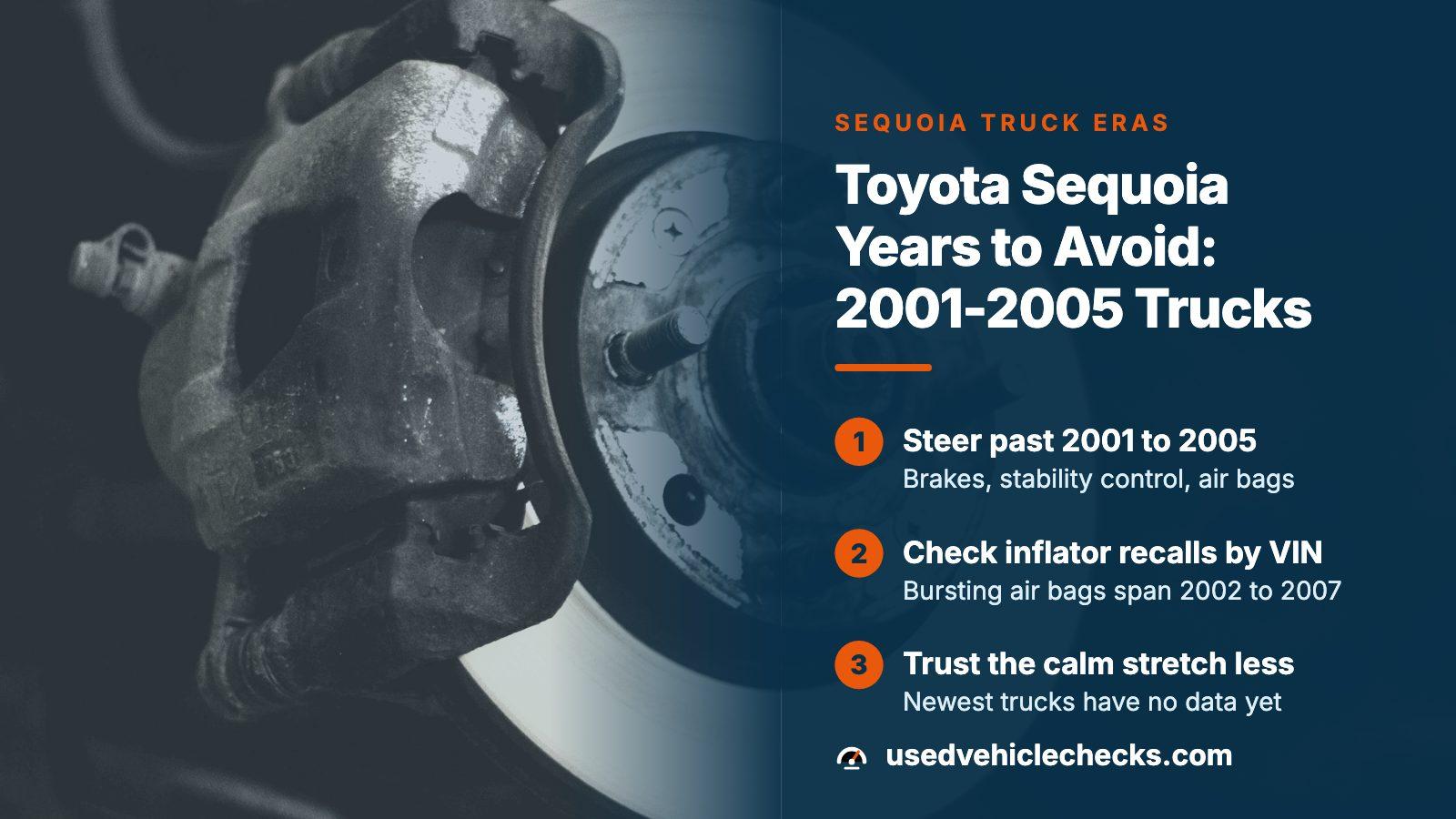
Steer away from the 2002 (692 NHTSA complaints), 2003 (684), 2001 (530), 2004 (380) and 2005 (352) Sequoias, where stability control, brake and air bag problems dominate. The 2006 and 2007 trucks sit in between. From 2012 onward, yearly complaint counts are in the teens or lower. Confirm open recalls by VIN and verify the mileage before paying for any of them.
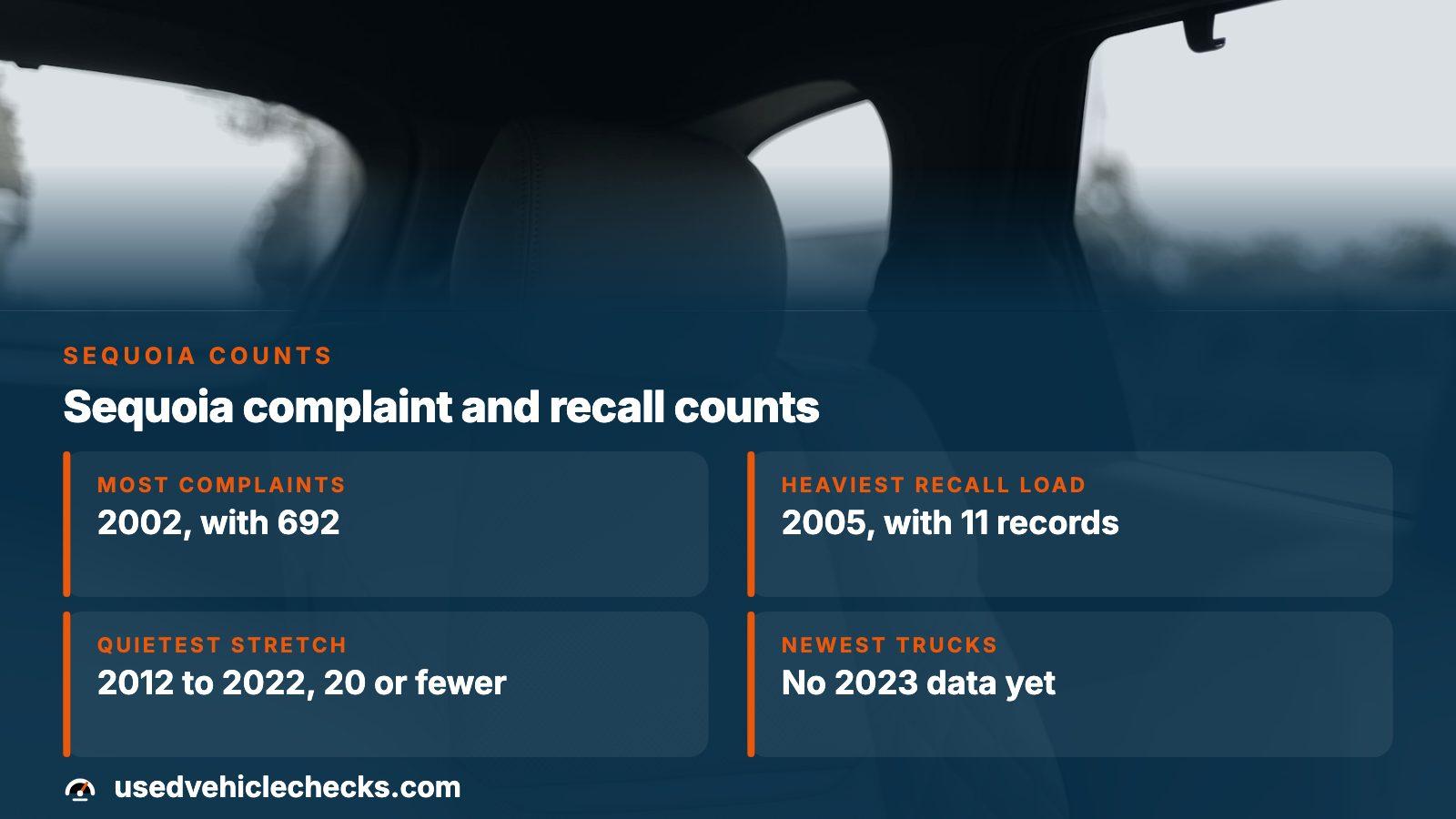
- Most complaints
- 2002, with 692 NHTSA filings
- Heaviest recall load
- 2005, with 11 recall records
- Quietest stretch
- 2012 to 2022, 20 complaints or fewer a year
- Newest trucks
- No complaint data yet for 2023 and later
What the complaint and recall counts show
I pulled every Sequoia model year from NHTSA's complaint and recall records. A complaint is one owner's report and not a proven defect, and older trucks have had far longer to collect them. Even with that caveat, the early years stand apart from the rest.
| Model year | Complaints | Recall records | Biggest complaint area |
|---|---|---|---|
| 2001 | 530 | 3 | Service brakes |
| 2002 | 692 | 8 | Service brakes, stability control |
| 2003 | 684 | 7 | Stability control |
| 2004 | 380 | 9 | Stability control |
| 2005 | 352 | 11 | Stability control |
| 2006 | 202 | 10 | Air bags |
| 2007 | 136 | 9 | Air bags |
| 2008 | 67 | 9 | Structure |
| 2010 | 31 | 10 | Engine cooling |
| 2012 | 20 | 4 | Mixed |
The recall column counts equipment recalls as NHTSA lists them, so a few entries are aftermarket parts rather than Toyota campaigns.
2001 to 2005: warning lights, grinding and brakes
Brakes and electronic stability control lead the complaint list for these years. In 2003, 192 owners named stability control and 181 named brakes. Owners describe the stability and traction lights flashing, a grinding sound, and the anti-lock system pulsing while the truck is going straight, after which the lights stay lit.
Toyota issued a recall for part of the 2003 production, built between April 2002 and April 2003, for a steering angle sensor that was not storing its center position correctly. The remedy was an ECU reflash or a new unit at no charge. Trucks outside that build window got no such campaign, which is the gap some owners complain about.
From an NHTSA owner complaint
The owner of a 2002 Sequoia wrote that the stability light flashed on a 35 mph road, the dash beeped and the anti-lock brakes pulsed on their own. The shop pointed at tired brakes and a drifting yaw sensor. After roughly $1000 of work, the episode repeated 600 miles later with the owner's teenage daughter driving. The owner noted that the 2003 trucks had been recalled but the 2002s had not.
The lesson for a buyer: a Sequoia from these years with a stability warning light on, or a service invoice showing a brake and sensor job, needs a long test drive and a pre-purchase inspection.
2002 to 2007: air bag inflators that can burst
Air bag complaints climb as the early years fade: 40 for the 2005, 46 for the 2006 and 34 for the 2007. They tie into the large inflator recalls. A 2018 campaign, numbered 18V883000, covered passenger inflators on 2002 to 2005 trucks, warning that propellant could degrade and the inflator could throw metal fragments.
A second campaign, 19V741000, covers 2002 to 2007 Sequoias that had already received a replacement inflator of the same design. Those trucks can need the part swapped again. A 2015 recall also targeted 2005 to 2007 trucks sold or registered in Florida, Gulf Coast states and other humid territories.
- Ask the seller for proof the inflator work was done, and check which campaign it fell under.
- Look up the VIN in NHTSA's recall tool again on signing day, since new campaigns appear.
- Ask where the truck spent its life, since humidity features in the 2015 campaign.
Front ball joints on the 2004 and 2005 trucks
Two campaigns, 05V225000 in 2005 and 07V013000 in 2007, dealt with front lower ball joints. In the first, a scratched ball surface could wear loose and add steering effort, with a possible separation causing loss of steering control. The second involved lubrication that could break down. Dealers replaced the joints in both.
A 2022 equipment recall later covered aftermarket ball joints sold for 2004 to 2007 Sequoias. So if a truck has had its front end redone, find out whose part went in. Original-fitment joints replaced under recall are one thing; a bargain aftermarket part is another.
2006 to 2011: fewer complaints, still a long recall list
Complaints drop sharply here, from 202 on the 2006 down to 67 on the 2008 and 31 on the 2010, yet recall records stay at 9 or 10 a year. Several are shared with other Toyota models: an accelerator pedal that could stick or return slowly (2008 to 2010 Sequoias, fixed with a reinforcement bar), power window switches and tire pressure monitoring.
The 2008 filings include two reports of the shifter moving out of park with the key removed, one ending with a truck rolling into a garage. A third 2008 owner said the air bags stayed shut in a serious side impact. These are single reports, but they show why paperwork matters on this generation.
2012 to 2022: the calm stretch, with one steering recall
Yearly complaints sit at 20 or fewer from 2012 through 2022, and recall records fall to 3 a year across 2013 to 2017. The 2018 truck picked up two software recalls: one for stability control that could switch off, which was superseded by an October 2018 campaign for an air bag control unit that might not deploy. Both are fixed with a free software update.
The one to watch is recall 21V920000, covering 2008 to 2022 Sequoias. A power steering gear built incorrectly can leak oil and cause a sudden loss of assist. The fix is a free dealer inspection and, where needed, a new gear. Any Sequoia in that span should have the work completed or ruled out.
NHTSA's lookup returned no complaints and no recalls for 2023 and later trucks when I checked, which says more about their age than their quality.
Mileage is the second half of the verdict
Even the best model years are old now, and a big body-on-frame SUV is used for towing, family trips and long commutes. The odometer figure drives the price, so confirm it before the model year matters. A reading that is lower than a past inspection or service entry is a reason to walk away or reprice.
- Compare the dash reading with past readings on the title and with service invoices.
- Look for wear that disagrees with the number, such as a worn driver seat bolster on a low-mileage truck.
- Ask whether the instrument cluster was ever swapped, and demand paperwork if so.
A short routine before you pay for a used Sequoia
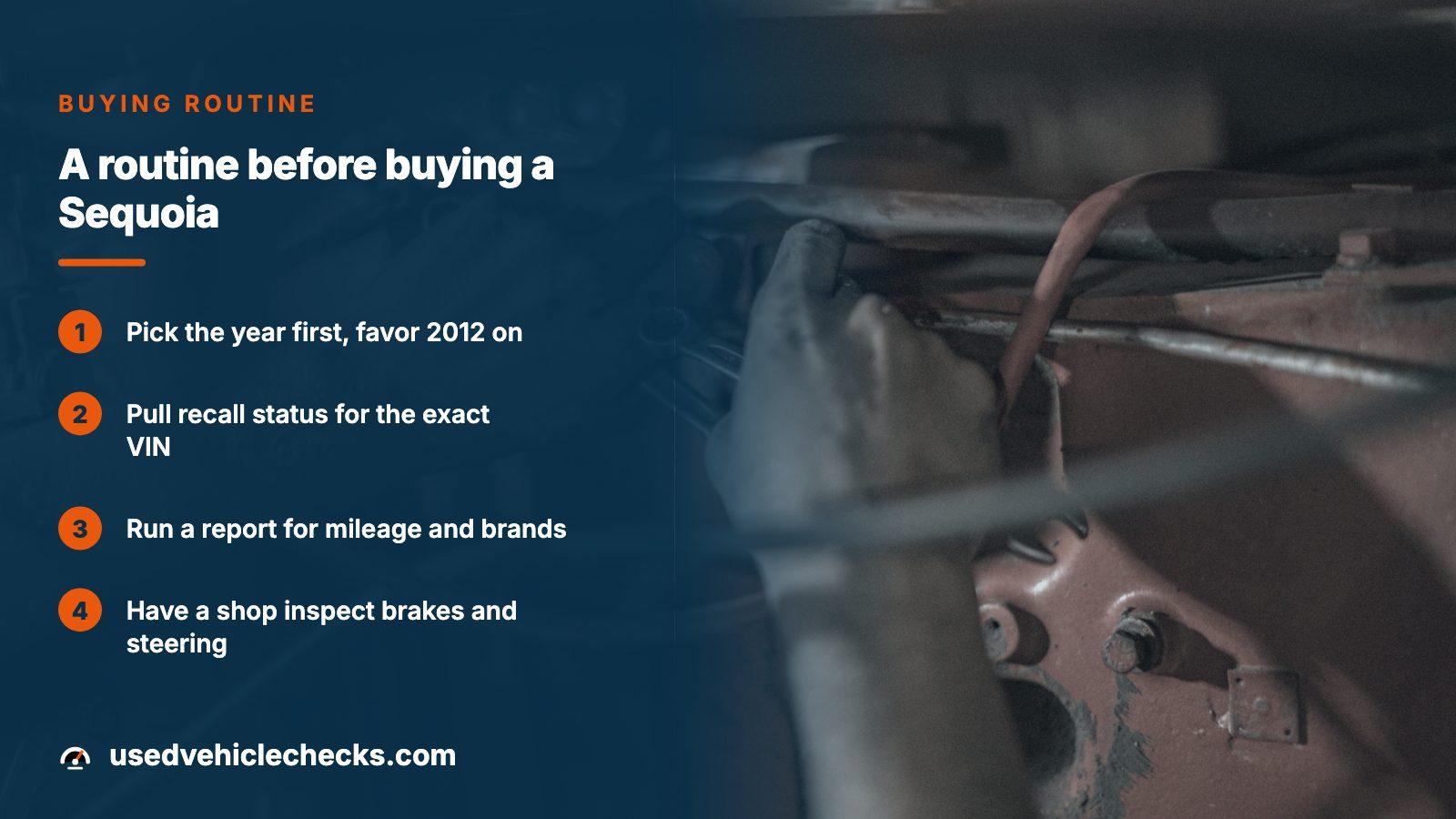
- Pick the year first: favor 2012 and later unless the price on an early truck reflects its history.
- Pull the recall status for the exact VIN and ask for dealer paperwork on air bag and steering work.
- Run a VIN report to see odometer readings across time, title brands, accident and salvage records.
- Test drive for stability or traction lights, grinding on braking and any steering looseness.
- Have an independent shop inspect the brakes, front suspension and steering gear.
UsedVehicleChecks gives a free preview first, then one payment per report. The odometer timeline and title records speak to step three, and to the questions a seller may brush aside.
Where this information comes from
- NHTSA complaints API: 2002 Toyota Sequoia — complaint counts and components by model year
- NHTSA recalls API: 2003 Toyota Sequoia — stability control and air bag campaign details
- NHTSA recalls API: 2018 Toyota Sequoia — steering and software campaigns
- NHTSA owner complaint 11330282 — owner experience, paraphrased
Sources and photos: Facts checked against the sources above in November 2026. Photos by Benjamin Brunner, Nina Mercado and Crosby Hinze on Unsplash; diagrams by UsedVehicleChecks.
Keep reading
- Toyota Tundra Years to Avoid, Ranked by NHTSA Complaint and Recall CountsThe Tundra shares the steering recall and several air bag campaigns.
- Toyota 4Runner Years to Avoid: Read the Year, Then the MileageAnother Toyota SUV, with its own set of bad years.
- Mileage Check by VIN: What the Recorded Odometer Readings ShowHow to confirm a truck's mileage history from its VIN.
- How Many Miles Is Too Many on a Used Car? Age, Pace and ProofWhere mileage becomes a price and reliability problem.
Frequently asked questions
What is the worst year for the Toyota Sequoia?
By NHTSA complaint count the 2002 is worst at 692, with the 2003 close behind at 684. Both lead with stability control and brake complaints. The 2005 carries the longest recall list at 11 records, mostly air bag and suspension campaigns, so no single year is clean among the first five.
Which Toyota Sequoia years are the most reliable?
Judged only by NHTSA filings, 2012 through 2022 are the quietest, each at 20 complaints or fewer. That is not a guarantee of low repair bills, since complaints measure safety reports, not wear. Pair the year with a recall check and a service history review.
Do I need to worry about the 2008 Sequoia?
Its 67 complaints are far fewer than the early trucks, but it falls under the pedal recall and the steering gear recall, and a few owners reported the shifter leaving park without a key. Confirm both campaigns were done and test the shifter yourself.
How do I check whether a used Sequoia has open recalls?
Use NHTSA's recall lookup with the 17-character VIN. It lists campaigns not yet repaired on that exact truck. Repeat it after purchase, because new campaigns are added over time, and keep any dealer repair invoices the seller can provide.
Does a high-mileage Sequoia mean a bad buy?
Not by itself. A truck with documented service and steady readings can be fine. The risk is an odometer figure that does not match past records, so compare title, inspection and service entries before accepting the number on the dash.
Now check the car itself
The guide explains what to look for. The report shows what this VIN has on record.