THE SHORT ANSWER
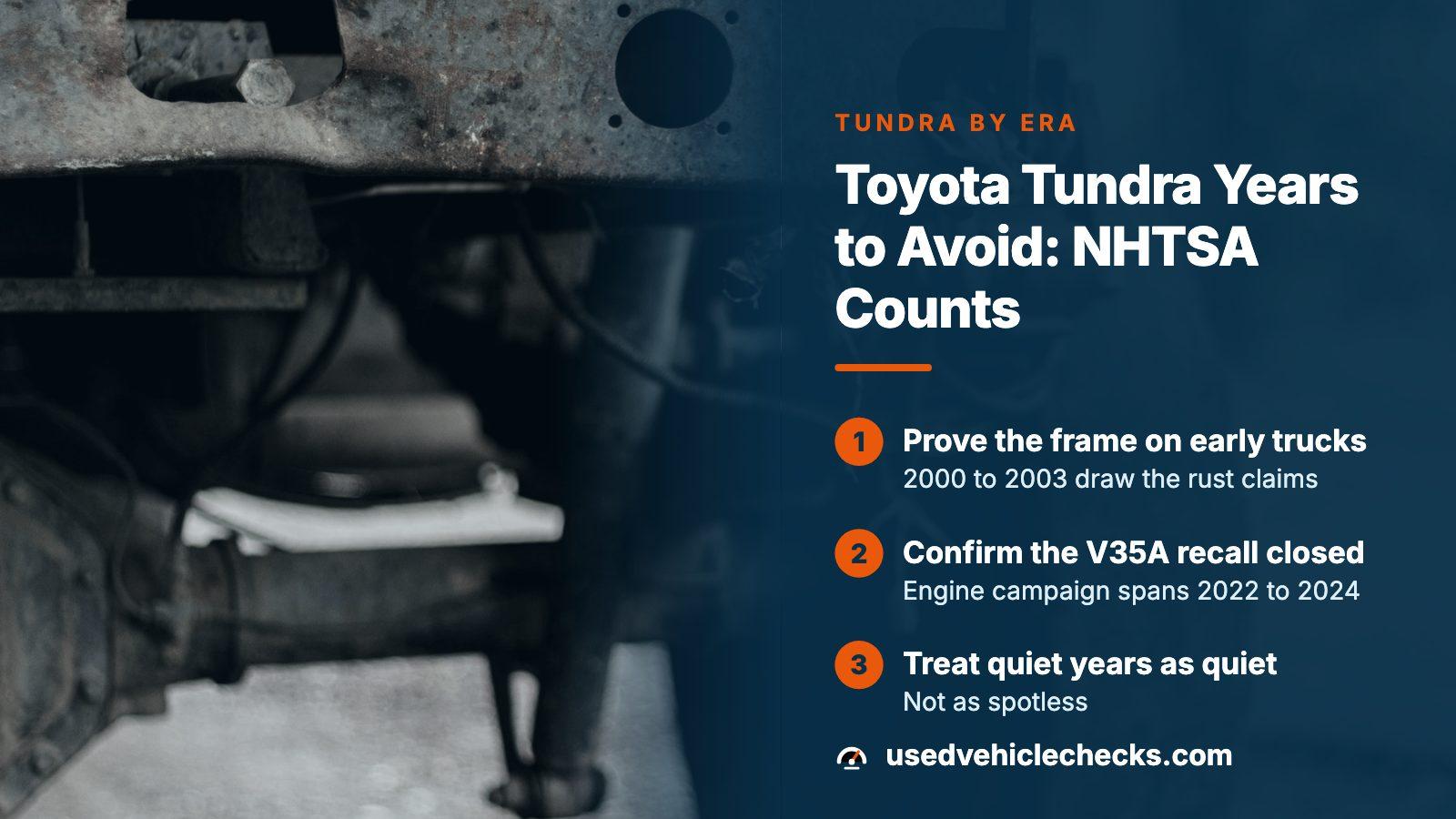
Skip 2000 to 2003 unless the frame is proven sound: 2000 alone drew 1032 complaints, over half naming structure. Treat 2022 to 2024 as a recall-completion question, since the V35A engine campaign now spans those years. The 2004 to 2008 trucks sit in the middle. Years from 2013 to 2021 show far fewer complaints, though no year is clean on paper.
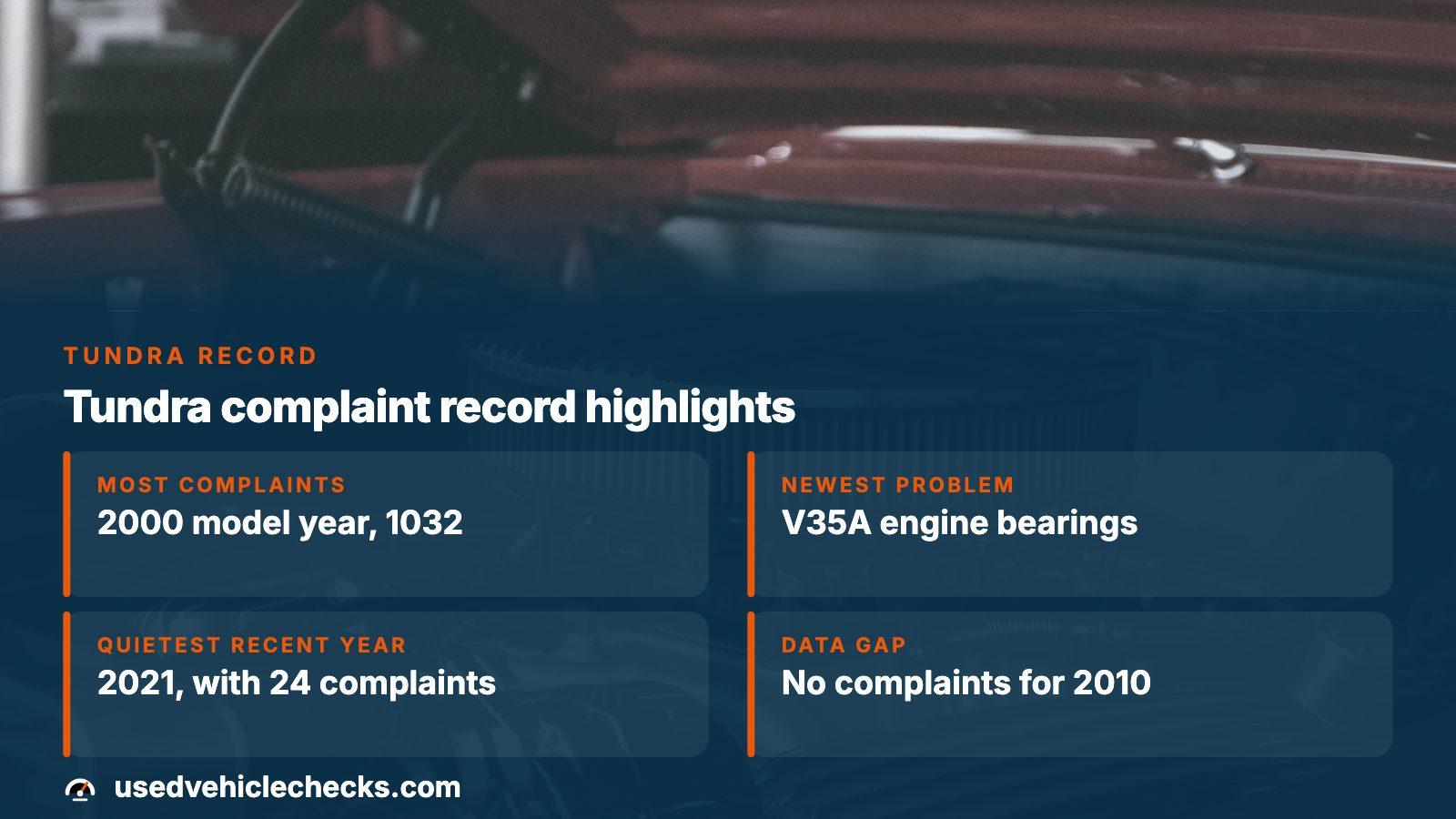
- Most complaints
- 2000 model year, 1032 filed with NHTSA
- Newest problem
- V35A engine main bearings, 2022 to 2024
- Quietest recent year
- 2021, with 24 complaints and 3 recall records
- Data gap
- NHTSA returned no complaints at all for 2010
The verdict, grouped by era
The Tundra has three distinct problem periods, and each one has a different cause. Rust drives the first generation, a mix of braking, air bag and drivetrain issues marks the middle years, and engine failures dominate the newest trucks. Knowing which era a truck belongs to tells you what to inspect, which matters more than a blanket list of bad years.
- 2000 to 2003: avoid unless a mechanic has put the truck on a lift and cleared the frame and rear cross member.
- 2004 to 2008: buy only with full records, a brake and driveline inspection, and every recall closed.
- 2009 to 2012: the data is thin and uneven, so lean on the individual truck's history.
- 2013 to 2021: the safest stretch by these counts, though 2018 and 2019 carry more recall records than their neighbors.
- 2022 to 2024: avoid any truck whose engine recall is open or unresolved.
How these counts were pulled, and what they miss
For each model year from 2000 to 2025 we called NHTSA's public complaints and recalls interfaces for the Toyota Tundra and tallied what came back. A complaint is an owner's own report to the agency. A recall record is any campaign NHTSA lists against that year, which includes a few aftermarket lamp and hitch wiring recalls alongside Toyota's own.
Two limits apply. Raw counts ignore how many trucks were sold, and older trucks have had far more years to collect complaints. The 2010 model year returned zero complaints and only 38 came back for 2009, which looks like a gap in the data rather than a clean record. Read the counts as a pointer to where to look, then verify the specific VIN.
Counts for the years that matter
| Model year | Complaints | Recall records | Biggest complaint area |
|---|---|---|---|
| 2000 | 1032 | 7 | Structure |
| 2001 | 421 | 5 | Structure |
| 2002 | 511 | 6 | Structure |
| 2003 | 411 | 10 | Not broken out here |
| 2004 | 466 | 13 | Structure, then suspension |
| 2006 | 545 | 13 | Structure, then air bags |
| 2007 | 390 | 14 | Power train |
| 2008 | 327 | 13 | Vehicle speed control |
| 2012 | 156 | 4 | Engine |
| 2016 | 120 | 6 | Service brakes |
| 2021 | 24 | 3 | Not broken out here |
| 2022 | 433 | 13 | Engine |
| 2023 | 415 | 13 | Engine |
| 2024 | 352 | 10 | Engine |
Between 2009 and 2021 the complaint counts fall and stay at or below 156, with 2012 as the high point. The spike returns in 2022.
2000 to 2003: the rust trucks
Structure was the most common component in the 2000 complaints, named 530 times among 1032 filings, with service brakes at 278. Campaign 09V444000, filed in November 2009, explains much of it. Toyota found that corrosion of the rear cross member on 2000 to 2003 trucks from cold-weather states could let the spare wheel fall onto the road and weaken the rear brake lines and proportioning valve.
The remedy was an inspection, with replacement of the cross member and related parts if needed. Owners were told to take the spare out from under the truck in the meantime. A recall tied to winter states leaves trucks that lived elsewhere in a gray area, and some owners say they were turned away for that reason.
From an NHTSA owner complaint
An owner of a 2000 Tundra told NHTSA that the VIN was inside the frame corrosion campaign. A dealer said the frame needed replacing, but added that several other parts had to be repaired first, so the recall work never happened. The truck sat unrepaired at about 190,000 miles. Take from this that a recall on paper does not guarantee a finished fix on an old truck.
2004 to 2008: heavy recall histories and mixed complaints
These years carry 13 or 14 recall records each. In 2004, structure led with 200 complaints and suspension followed with 152. In 2006, air bag complaints reached 134. By 2007 and 2008 the pattern shifts to power train and vehicle speed control, with 73 and 77 complaints in their top categories.
Two specific recalls are worth checking on a 2007. Campaign 07V579000 covered a weak slip yoke on certain four-wheel-drive trucks that could let the propeller shaft drop. Campaign 21V920000 covers 2007 to 2021 Tundras for a power steering gear that may leak oil and cause a sudden loss of assist. Ask for proof that both were handled.
2022 to 2024: the V35A engine problem
Complaints jumped from 24 for 2021 to 433 for 2022, and engine was the top component each year from 2022 to 2024. The cause shows up in campaign 24V381000: manufacturing debris can contaminate the V35A engine and wear out the main bearings, which can stall the truck and cut drive power. It first covered 2022 and 2023 trucks with an engine replacement.
Campaign 25V767000, filed in November 2025, widened the scope to 2022 through 2024. For that one, dealers inspect the number 1 main bearing with diagnostic software and drive data, and replace the engine if the inspection calls for it. A separate 2024 campaign, 26V320000, followed in May 2026. Model year 2022 also has an axle flange nut recall, 22V445000, and a fuel tube chafing recall, 23V566000, so the VIN's recall list is long.
From an NHTSA owner complaint
One 2022 Tundra owner told NHTSA the recall engine swap happened near 38,200 miles. That new engine quit while driving about a year later, near 50k miles, and Toyota's answer was still pending. Take from this that a completed recall repair on a V35A truck is still worth a closer look at the service paperwork.
2013 to 2021: where the numbers are quietest
Complaint counts in these years run from 24 up to 120, and 2015, 2017 and 2020 to 2021 are especially light. The 2016 pile leans toward service brakes with 34 complaints, and 2018 shows electrical and brake entries with 26 and 22. Recall records stay in a range of 3 to 10, with 2018 and 2019 at the top of it.
A low number can also mean fewer owners filed, and the steering gear campaign reaches up to 2021. Use these years as the starting pool, not the finish line.
Before you buy any Tundra, check the actual truck
A model year tells you the odds; the VIN tells you the facts. For a used Tundra, the mileage record deserves first attention. Trucks that tow or work a job site rack up hard miles, and a dashboard reading below the logged history is a reason to walk away. UsedVehicleChecks starts a VIN lookup with those dated odometer readings, then adds title brands, damage records and any open recalls.
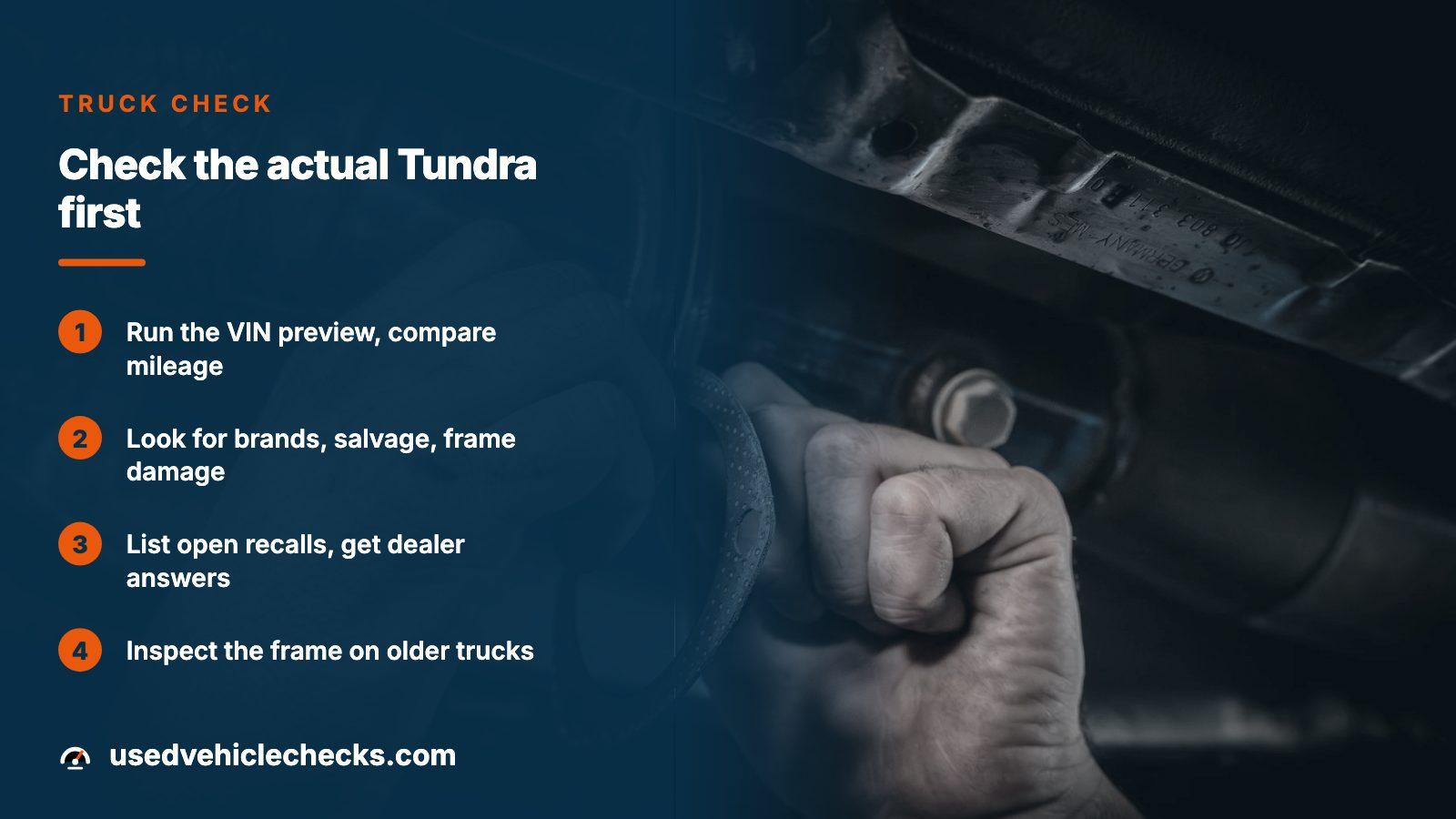
- Run the VIN preview, which costs nothing, and compare the dashboard mileage to the logged readings.
- Look for title brands, salvage or auction entries, and flood or frame damage notes.
- List every open recall and get the dealer's written answer on each one.
- For a 2000 to 2008 truck, have a shop inspect the frame, cross member and brake lines.
- Buy the full report only for a truck that is still on your list.
Where this information comes from
- NHTSA recalls API: Toyota Tundra — campaign numbers, dates and remedies for the recalls named here
- NHTSA complaints API: Toyota Tundra — owner complaint counts and components for each model year
- NHTSA owner complaint 11524666 — owner experience, paraphrased
- NHTSA owner complaint 11770560 — owner experience, paraphrased
- VehicleHistory.gov: NMVTIS for consumers — the federal title system that history reports draw on
Sources and photos: Facts checked against the sources above in November 2026. Photos by Zoshua Colah, Martin Fennema and Victor Hughes on Unsplash; diagrams by UsedVehicleChecks.
Keep reading
- Toyota Tacoma Years to Avoid: Judge the Odometer Before the Model Yearthe same count-based verdict for Toyota's smaller pickup
- Chevrolet Silverado Years to Avoid, and What the Odometer Addshow the Tundra's full-size rival stacks up year by year
- Mileage Check by VIN: What the Recorded Odometer Readings Showhow to read dated odometer readings for a truck that has worked hard
- How Many Miles Is Too Many on a Used Car? Age, Pace and Proofwhen high mileage on a pickup becomes a dealbreaker
Frequently asked questions
What is the worst year for the Toyota Tundra?
By NHTSA complaint volume, 2000 is the worst, with 1032 filings and 530 of them naming structure. The newest trouble is the V35A engine recall on 2022 to 2024 trucks. Which one is worse for you depends on whether you are buying an old truck for cheap or a new one at a high price.
Which Toyota Tundra years are the most reliable?
No agency ranks reliability, but NHTSA counts are lowest from 2013 to 2021, and 2021 shows only 24 complaints. Low filing numbers support picking from that range. They do not clear an individual truck, so still read its recall list, title brands and mileage history before paying.
Is the 2007 Tundra a bad year?
It is a middling year with a heavy paper trail: 390 complaints and 14 recall records. Check that the driveshaft yoke campaign and the power steering gear campaign were both completed. A shop inspection of the driveline and steering before purchase is sensible for a truck this old.
Does an engine recall make a 2022 to 2024 Tundra unsafe to buy?
Not automatically, but the truck's recall status matters. Ask the dealer whether the bearing inspection or engine replacement was done, and get it in writing. If the work is still pending because parts are not available, factor that uncertainty into your offer or choose another truck.
Can a VIN check show if a Tundra had the frame recall?
A VIN-based check lists open recalls attached to the truck, which tells you whether the frame campaign is still unresolved. It cannot show the frame's current condition. For any 2000 to 2003 truck, you still need a mechanic to look at the cross member and underbody on a lift.
Now check the car itself
The guide explains what to look for. The report shows what this VIN has on record.