THE SHORT ANSWER
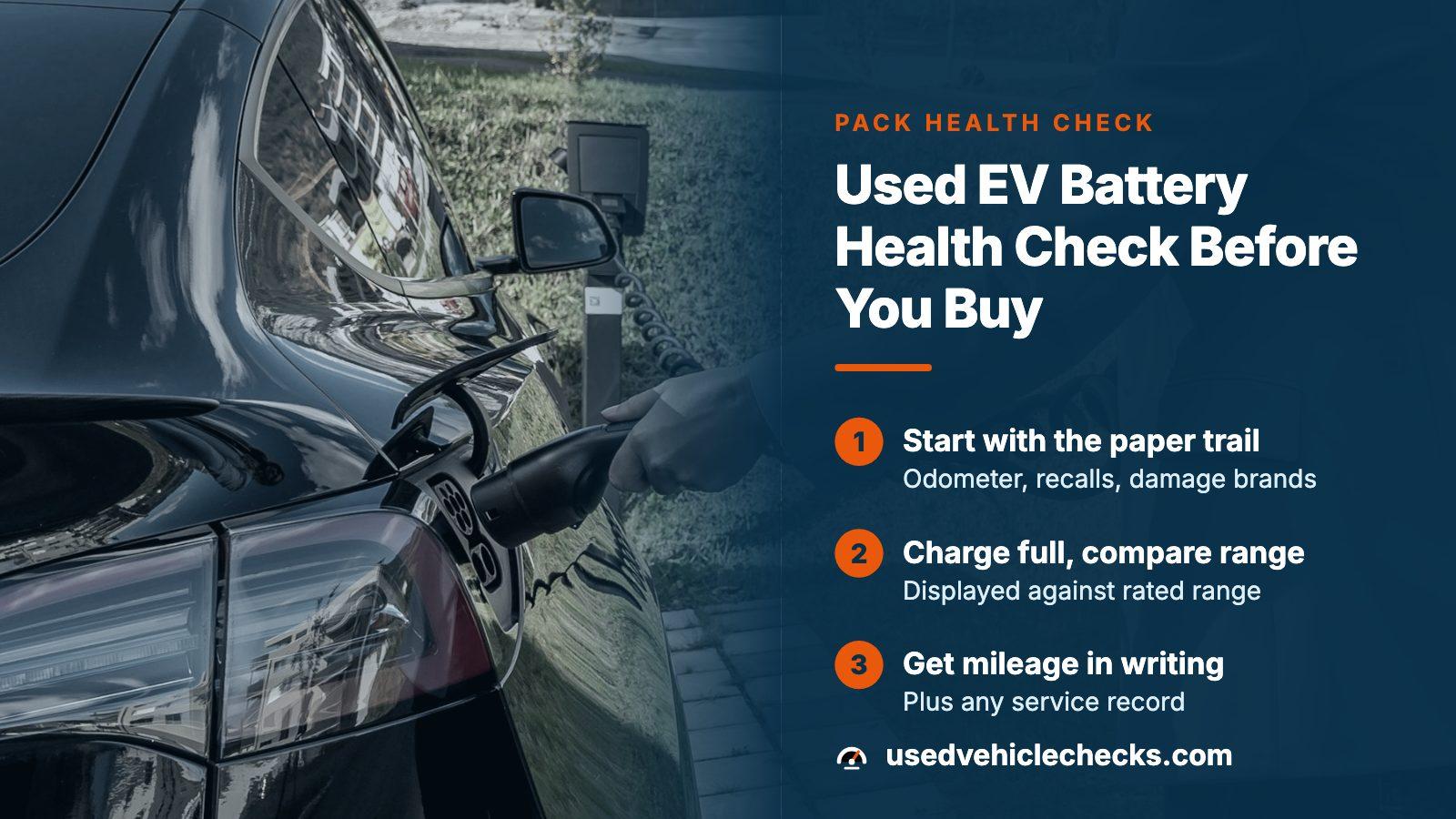
Check the battery in two layers. Paper first: run the VIN for odometer readings, open recalls and damage or salvage brands, because mileage and crash history drive pack wear and risk. Then test the car: charge it to full, compare the displayed range with the rated range, and ask the seller for a written mileage statement and any service record.
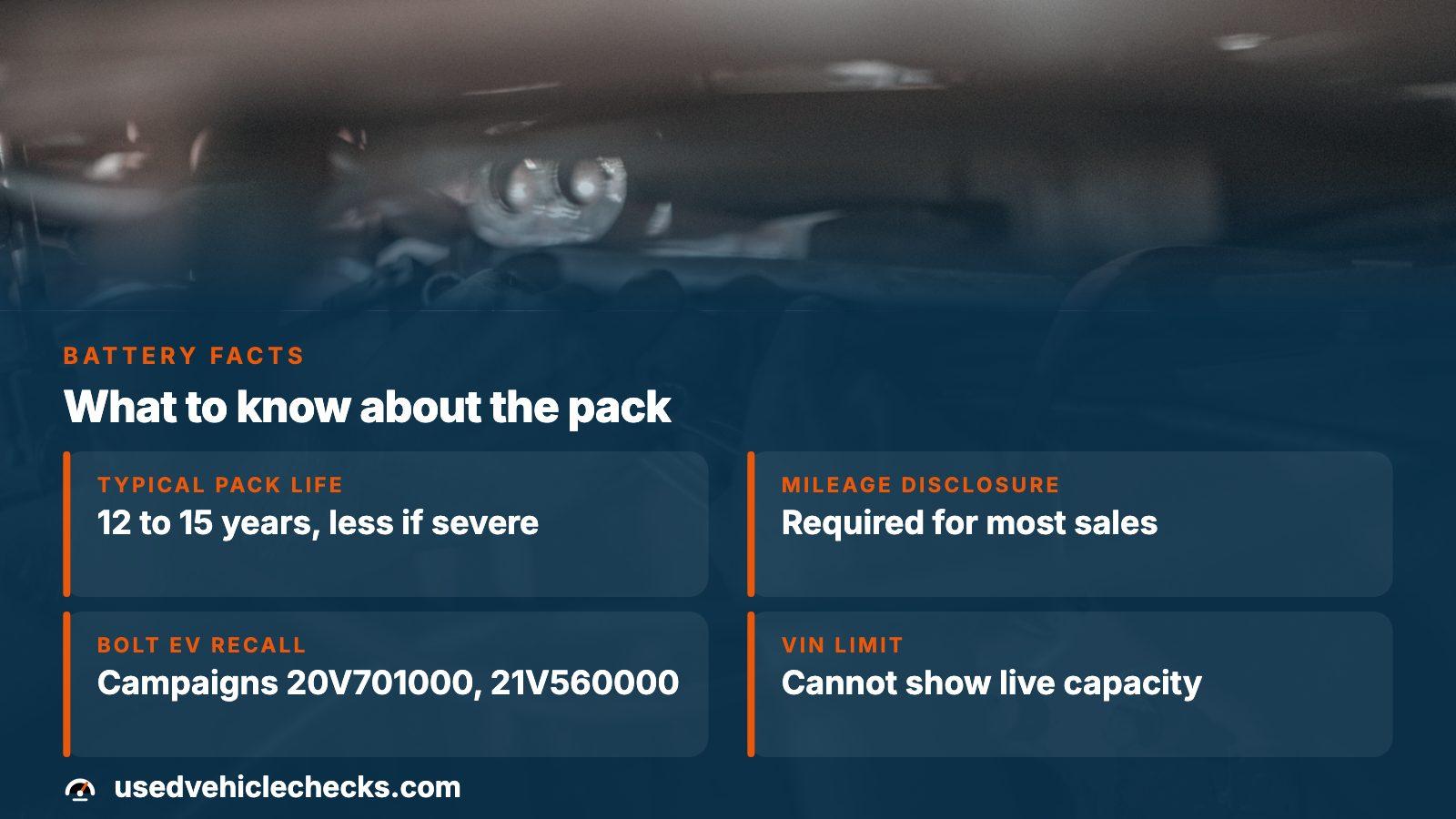
- Typical pack life
- 12 to 15 years, or 8 to 12 in severe climates (DOE)
- Mileage disclosure
- Required on the title or transfer paper for most sales
- Bolt EV battery recall
- Campaigns 20V701000 and 21V560000
- What a VIN cannot show
- Live battery capacity
What a record check can and cannot tell you about the pack
A battery's real capacity lives inside the car, in the pack's own management software. No database reads it from a VIN, and any listing that promises a battery score from the number alone is guessing. What the records do give you is the evidence around the pack: how far the car has traveled, whether the odometer ever moved backward, whether a crash or flood put water or impact near the cells, and whether the maker has an open campaign on the battery.
That evidence matters because mileage is the closest stand-in for charge cycles that a buyer can verify before the test drive. An EV showing low miles and a degraded range is a puzzle. An EV showing high miles and full range may have a replaced pack, which the seller should be able to document.
Start with the odometer history
Mileage is the one number a buyer can check against several dated readings. Pull the reading trail from the VIN and look for a steady climb: inspection, service and title entries should rise at a believable pace. A reading that falls, or a long flat stretch followed by a jump, deserves a direct question to the seller.
Electric cars have digital dashboards, and the mileage on those screens can be altered with the right software, so the on-screen figure alone settles nothing. If the history shows a reading that conflicts with the dash, treat the pack's age as unknown and price the car as if the battery may need work.
- A reading lower than an earlier one
- Mileage that barely moves for years, then jumps
- A dash figure far below the last recorded reading
- No readings at all after the first sale
Look for open battery recalls on that exact VIN
Battery recalls are not rare in this segment, and they attach to specific cars. Take the Chevrolet Bolt EV. NHTSA's record shows campaign 20V701000, received in November 2020, covering all 2017 and 2018 cars and certain 2019 cars because the traction pack risked igniting if topped up to or close to its limit. Campaign 21V560000 followed in July 2021, and its notice says cars fixed under the first one still needed the newer repair.
While waiting for the fix, owners were told to use a charge limit feature, Hill Top Reserve on 2017 and 2018 models and Target Charge Level on 2019 models. Ask a seller whether that limit is still switched on, because a pack held back from full charge will show a lower range than the rating suggests.
A repair on file is not the end
Two further Bolt campaigns, 22V930000 and 23V845000, show that a car repaired once can land in a second round when the first repair was done incorrectly. Read the status on the VIN, not the seller's memory.
Crash, flood and salvage brands near the battery
The pack sits low and flat under the floor, which is the part of the car most exposed to a hard underbody strike or standing water. A car with a total-loss or salvage brand, an airbag deployment or a flood record deserves a much harder look at the pack, even if it has since passed a repair inspection and been retitled.
Ask for the repair invoice and whether the high voltage system was scanned afterward. A seller who cannot say who looked at the pack after the loss is asking you to carry that risk. If the history shows damage and the seller says there was none, walk away from the deal or reprice it.
Run a range test on the day you inspect the car
Once the paper checks out, test the pack. Ask the seller to charge the car to full before you arrive, then compare the range on the screen with the rating for that model year. FuelEconomy.gov notes that most EVs travel more than 100 miles on a charge and some go well beyond 200, so the rating for your exact car is the benchmark, not a general figure.
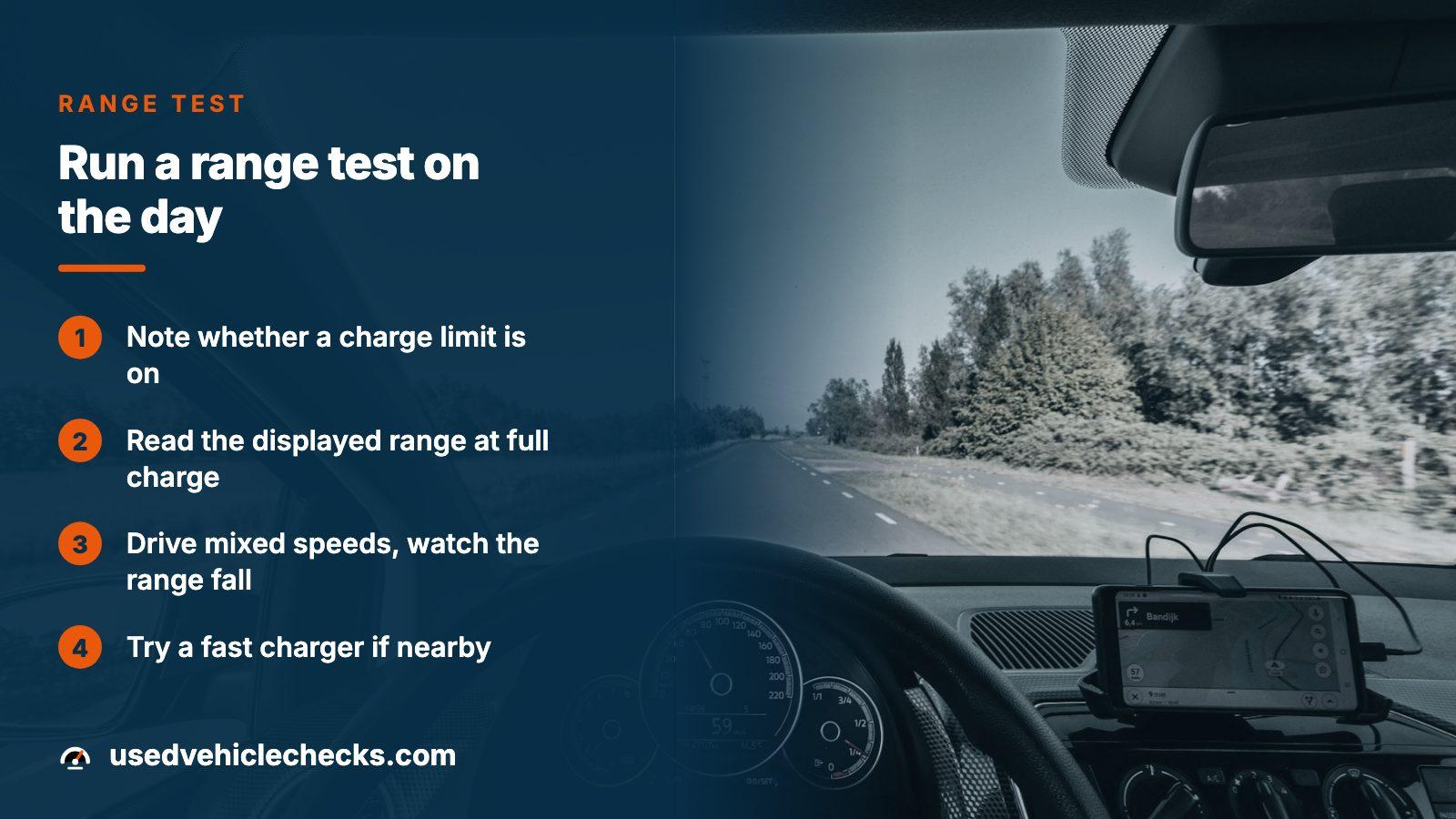
- Confirm any charge limit is off, or note it
- Read the displayed range at full charge
- Drive at mixed speeds for a few miles and watch how fast the number falls
- Check how the car behaves at a fast charger if one is nearby
- Note the dash battery bars or health readout, and photograph it
Range shown on the dash is itself an estimate that shifts with temperature and speed, so use it to spot a large gap, not a small one.
What a used buyer reported to NHTSA
From an NHTSA owner complaint
An owner of a 2013 Nissan Leaf bought it used in 2019 and saw about 70 miles of range at purchase. Three months later it would charge only to 62. At the dealer, the technician said enough bars remained, so the pack was not under a battery recall, and offered a replacement plan the owner put at over $10K.
Take two things from that account. First, the bars on a dash gauge can show healthy while range slips, so record the range figure on the day you buy and compare it later. Second, ask what a replacement would cost before you sign, because that cost can rival what the car is worth.
Get the mileage in writing from the seller
Federal rules under 49 CFR 580.5 make the seller put the mileage on the title or transfer document, with a signature and printed name. The form records the whole-mile reading, the day of transfer, who sold and who bought with their addresses, and the car's identity down to the VIN. A printed warning on it says that lying or leaving the line blank can be punished with fines or jail time.
Check that the number you sign for matches what the history shows. Rules in 49 CFR 580.17 exempt some sales: a model year 2011 or later vehicle is excused only after 20 years, so a used EV you are looking at today almost certainly falls under the disclosure rule, and a seller who refuses to sign it is a red flag by itself.
Running the VIN check on an EV
Type the VIN into the search box on this site; it is printed on the dash by the windshield and on the driver's door frame. Only the preview costs nothing. If you want the odometer trail and the rest, you pay once for that report, and no plan renews. Current rates sit on the pricing page.
Read the odometer readings first, then open recalls, then title and damage entries. If all three are clean and the range test matches the rating, the pack is a lower risk. If any one is off, bring the printout to a mechanic who can read the pack's own diagnostics before you pay.
Where this information comes from
- FuelEconomy.gov: All-electric vehicles — pack life estimate and typical range figures
- eCFR: 49 CFR 580.5, odometer disclosure — what the seller's mileage statement must contain
- eCFR: 49 CFR 580.17, exemptions — which vehicles skip mileage disclosure
- NHTSA: Recalls API, Chevrolet Bolt EV 2019 — battery campaign numbers, dates and interim steps
- NHTSA owner complaint 11254870 — owner experience, paraphrased
Sources and photos: Facts checked against the sources above in November 2026. Photos by smart-me AG, Sander Jeurissen and Nina Mercado on Unsplash; diagrams by UsedVehicleChecks.
Keep reading
- Mileage Check by VIN: What the Recorded Odometer Readings ShowHow to pull the reading trail for any car from its VIN.
- Odometer Discrepancy Check: Find a Mileage Mismatch Before You PayWhat to do when two readings disagree.
- Can Digital Odometers Be Rolled Back? Yes, and How to Catch ItHow screen mileage can be altered on newer cars.
- Odometer Disclosure Statement: What the Seller Signs and What to CheckThe signed mileage form at the sale, line by line.
Frequently asked questions
Can a VIN check show battery health?
No. Battery capacity is held in the car's own software and is not stored in title or history databases. A VIN check shows the surrounding facts, such as odometer readings, open recalls and crash or flood brands, which help you judge how hard the pack has worked and whether it carries known risk.
How long should a used EV battery last?
A Department of Energy study cited by FuelEconomy.gov puts pack life at 12 to 15 years where the weather is mild, and 8 to 12 where it is harsh. Those figures describe the average pack, so a particular car's mileage, charging habits and climate history matter more than its age alone.
Does a battery recall mean I should skip the car?
Not by itself. A recall with a completed remedy on that VIN can be fine, and the maker pays for the work. An open recall should be fixed before or as part of the sale, and a repeat campaign on the same car calls for a closer look at what was done.
What range loss is a red flag?
There is no federal threshold in the sources I read. Compare the displayed range at a full charge with the rating for that model year and ask how the figure compares with one the seller recorded earlier. A large gap, or a gauge that disagrees with the range, justifies a pack diagnostic.
Does the seller have to tell me the mileage?
For most vehicles, yes. Federal rules require a signed mileage statement on the title or transfer paper at sale. Model year 2011 and newer vehicles are exempt only after 20 years, so a used EV on the lot now is covered. Refusing to sign is a warning sign.
Now check the car itself
The guide explains what to look for. The report shows what this VIN has on record.